
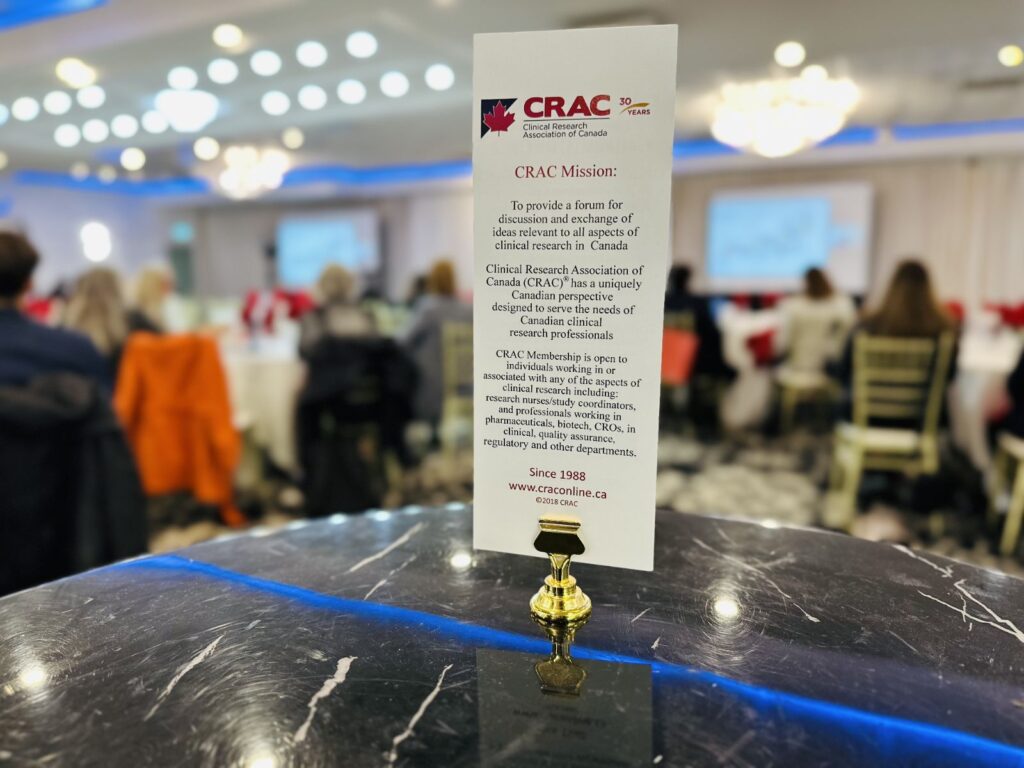
On October 15, 2025, the Clinical Research Association of Canada (CRAC) brought together stakeholders from across the clinical research ecosystem at the Pan-Canadian Framework for Promoting Clinical Research in Canada Summit to discuss how Canada can strengthen its position in a highly competitive global trials landscape.
Xtalks was proud to be the conference’s media partner and spoke to industry leaders and subject matter experts about the clinical research landscape in Canada and how the country is positioning itself on the global stage.
Sponsors, CROs, research sites, patient advocates and technology leaders all emphasized a shared goal: to make Canada a faster, more unified and more participant-centered place to conduct high-quality studies.
The conversations centered around several interlocking themes, including the need for pan-Canadian alignment, the centrality of the human experience in research, the importance of governance and data-driven trust, Canada’s role in building international bridges and the accelerating influence of AI and digital tools.
Canada’s Global Positioning and the Case for Competitiveness
Sponsors are increasingly setting up trials globally and Canada has the tools to become a significant global partner. Stakeholders are aligning to present a clear value proposition: faster start-up, predictable reviews and reliable enrollment, which could move Canada up the site-selection list.
Stakeholders across Canada are now thinking collectively about how to work together to create more opportunities for patients to learn about and participate in clinical trials. Canada must present a clear, reliable value proposition that convinces global program teams to choose Canadian sites earlier and more often. And Canada’s role in a global clinical research ecosystem starts at home, with a unified pan-Canadian framework.
Susan Marlin, MSc, President and CEO of Clinical Trials Ontario (CTO), told Xtalks about the competitive reality facing Canada, noting that because sponsors are placing trials all over the world, the country must continually position itself as a top destination for clinical research.
“What excites me is we’re thinking about this across Canada to weigh in on how we can all work together and get things done to provide the opportunities for patients that need clinical trials,” said Marlin.
“When it comes to the investigators, facilities, the people here are top-notch, global leaders. When it comes to how fast and efficiently we do trials, that’s where we’re lagging and I see the opportunity being there,” said Marlin.
Over the years, province by province, capacity is being built within organizations to help improve provincial landscapes for clinical trials.
Canada isn’t a big enough country for provinces to compete individually or with each other, explained Marlin. And that’s why she said she’s “excited about how we’re working more and more together on initiatives to position Canada as a top destination for clinical trials.”
One Voice at Home and Collaboration Abroad
Elyse Summers, JD, President and CEO of the Association for the Accreditation of Human Research Protection Programs, Inc. (AHRPP) in the US, emphasized that global collaboration cannot be overstated in an increasingly interconnected world.
“The importance of global collaboration cannot be overstated. We live in an increasingly small world. We’ve always appreciated our collaboration with folks in Canada and how important it is that everyone speak with one voice and bring the same energy and commitment to solving problems and supporting the public’s health and welfare,” said Summers.
In Canada, unifying voices and coming together at the same table means reducing friction across provinces and institutions so that Canada appears to sponsors as a cohesive ecosystem rather than a patchwork of processes and expectations.
It also means aligning on practical enablers of speed and quality, such as shared ethics templates, mutually recognized reviews, standardized data and consent language, and clear service-level expectations for start-up and oversight, so that multi-site and cross-border studies can launch with fewer handoffs.
Collaboration with international partners, including US and European accreditation and regulatory bodies, can help Canadian sites map their practices to widely used frameworks, streamline reliance arrangements and give global study teams confidence that Canadian processes will integrate smoothly with broader programs.
Centering the Participant Experience
Patient centricity continues to be a central theme in clinical research today. Focusing on the human side of research is key in fostering effective trial participation.
This means designing protocols with input from patient groups, using plain-language materials, flexible visit schedules and tools that reduce burden. It also means sharing data transparently and measuring what matters, including enrollment, retention and patient-reported outcomes, to show that patient-focused changes improve trial performance.
Tasnuva Hoque, Clinical Research Manager at University Health Network (UHN), described how involvement in research can restore hope and foster community among participants who may otherwise feel isolated. She said she has observed that research engagement often gives people permission to talk about their symptoms and experiences more openly.
The human interaction is also important for clinical research professionals like Hoque. From the beginning of her career in clinical trials, she said, there has always needed to be a human dimension to the work for her.
In terms of gaps in the field, Hoque said, “I don’t think we have enough diversity in our clinical trial participants. They don’t represent the waiting rooms we have, even in a multicultural city like Toronto.”
Solutions to increasing trial diversity could include better engagement with patients and helping to remove some of the stigma or perceived biases that a marginalized community may have about participating in research.
“I think this is our biggest setback. But Canada is sitting at a really great spot to provide that diverse population as we start to get more clinical trials coming into the country. So it’s both, it’s our challenge but it could also be our strength. And it can be an opportunity if we are able to engage more patients.”
Governance, Transparency and Data-Driven Trust
Governance and trust will be critical enablers of Canada’s competitiveness in the global playing field. Alexandra Obadia, LLB, LLM, Chief Legal and Data Officer at Catalis Quebec, stressed that it is not enough to assert excellence; it must be demonstrated through evidence.
“What’s missing or could be improved in Quebec is optimizing access to health data. We have great legislation that was enforced in 2024; now we need to be able to implement it to recruit patients faster and have access to real-world evidence,” said Obadia.
Access to data is both empowering and sensitive, reinforcing the need for approaches that respect privacy while enabling participants to understand and manage their health.
“There’s a momentum here in Canada, which is exciting. We see the number of clinical trials increasing and we’re doing better and better in Canada and we should be proud of it. It touches all kinds of innovations. We get to reach patients, and sometimes it’s their last recourse. In that sense, I’m very proud of what we’re doing here.”
She also said the key is to build on each province’s strength. All of the provinces are more or less facing the same challenges, for example, with remote populations. By having collective discussions around common pain points and challenges, “we can all help each other by learning from each other while building together.”
Martin Letendre, LLB, LLM, President of ethica CRO, pointed to the importance of putting governance systems in place that enable collaboration, including harmonized ethics reviews and a framework of transparent performance metrics. When sponsors can see consistent timelines for ethics approvals, site start-up, query resolution and enrollment, confidence grows and the decision to work in Canada becomes easier.
Letendre explained that the sharing of data is a current challenge, as Canada has 10 provinces, each with their own privacy legislation. At the same time, the country has a public healthcare system and access to a lot of data that could be useful for research.
To connect and encourage a collaborative country-wide clinical research ecosystem, the key is to “put in place good partnerships and a framework in which everyone trusts each other so data can flow from one province to the other,” said Letendre.
Digital Transformation and AI
The role of digital tools and AI in reshaping operations continues to expand. Kim McDonald-Taylor, MSc, Board Director & Toronto Chairperson, Clinical Research Association of Canada (CRAC), noted that AI will bolster remote monitoring and that the surge in device trials is accelerating the shift toward digital-first models of data collection and oversight. Change management and digital literacy will be as important as the technologies themselves.
McDonald-Taylor said she was excited about the conversations about collaborations she heard at the event. “We’ve made some great strides in today’s meeting. We were happy to have people from all across the country, with most of the provinces represented. We’re proud of our team for bringing this together.”
She was also excited about the possibilities that technologies like AI have to offer. Improvements in including rural communities, such as Indigenous communities and others, through remote monitoring and remote device trials, for example, are being made across the country. These communities have been neglected, often not on purpose, but due to gaps in technology and frameworks, she explained. However, with new technologies, “the future is bright,” she said.
“AI is going to help [with] remote monitoring. I love the one speaker who said that young people are going to be bringing us to it and making us accept it because they are generally okay with sharing data … so let’s just do it as it’s going to help my health, my family’s health.”
Learning from International Playbooks
Learning from international peers can provide additional direction for Canada’s global clinical research trajectory.
Alex Karabanow, Senior Manager of Operations for Clinical Research Services at UHN, who helped organize the Pan-Canadian Research Summit, said that insights from other major countries and understanding their playbooks can accelerate Canada’s progress toward a pan-Canadian framework that both conducts and attracts clinical trials.
The selective adoption of proven strategies that fit Canada’s context, such as nationally aligned ethics pathways, common data standards and transparent reporting on operational performance, is key.
“We heard the perspective of some of the other major countries like the UK, US and Australia, and I think learning from what they’re doing will help us on our trajectory in terms of building a Pan-Canadian framework to conduct and attract clinical trials.”
One of the keys to building a robust clinical research landscape across the country is to build a trained, certified, professional workforce. This would allow people to retain their jobs and attract talent to Canada, explained Karabanow.
Being involved in human resource protection, Karabanow said the presentations that impacted him the most at the conference were one about the CanReview process, which is a new streamlined research ethics review process at the national level, and the importance of accreditation.
“What we learned is that we can have a national process for ethics review, and making it based on accreditation would strengthen it and allow institutions to be able to accept each other’s approvals. And that’s the key to attracting clinical trials to Canada,” said Karabanow.
One of the main takeaways from the event was that Canada does not need to reinvent clinical research; it needs to coordinate it. By speaking with one, unified voice, measuring what matters and embracing tools that genuinely reduce burden, the Canadian research ecosystem can match its scientific ambition with operational excellence. That is how more trials will come to Canada, how more patients will gain timely access to innovation and how the country will contribute even more meaningfully to the world’s collective progress in clinical research.
The country’s next chapter will be defined by how effectively it harmonizes processes across provinces, proves its performance with transparent, accessible data and maintains a focus on the participant experience. If these elements come together, Canada can present itself to global sponsors as a unified, trustworthy and forward-leaning environment where studies start quickly, run predictably and keep people at the center.














Join or login to leave a comment
JOIN LOGIN