
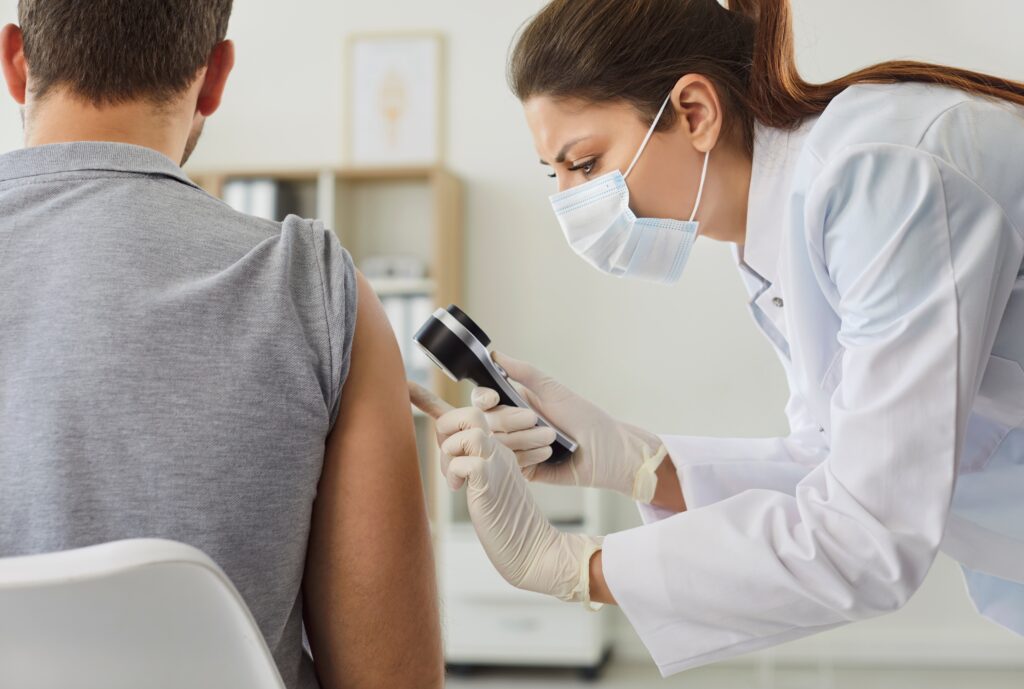
Dermatology is rapidly transforming, with innovative prescription treatments increasingly gaining market traction alongside traditional OTC products.
Collectively, they reflect a maturing dermatology landscape driven by advanced formulations, broader indications and a shift toward both biologics and innovative oral/topical options.
As the dermatological drug market in the US expands from around $8.3 billion in 2024 to $14.5 billion by 2030 (CAGR ~9.7%) and the global dermatology drug market grows from $21.4 billion in 2024 to over $62.6 billion by 2034 (CAGR ~11.3%), learn about some of the standout therapeutics that are poised to lead 2025’s growth trajectory.
1. Cosentyx (secukinumab)
Indication(s): Psoriasis and other inflammatory skin conditions
2024 Sales (USD): $6.14 billion, an increase of 23% YoY
Growth driver: Novartis’ Cosentyx remains a blockbuster in the anti-IL-17 segment, anchored by its substantial contribution to the company’s dermatology portfolio. Cosentyx’s strong performance last year was driven by solid demand across the US, Europe and emerging markets, boosted by recent launches such as approval for hidradenitis suppurativa (HS) and an intravenous formulation in the US. Continued volume growth in core indications, including psoriasis, psoriatic arthritis (PsA), ankylosing spondylitis (AS) and non-radiographic axial spondyloarthritis (nr-axSpA), also fueled sales. With both subcutaneous and intravenous formulations now available, including an IV version approved in the US in 2023, Cosentyx offers flexibility in administration, which supports broader adoption in clinical settings and among diverse patient groups. Cosentyx continues to be a top biologic for moderate-to-severe plaque psoriasis, with proven long-term efficacy and safety.
2. Otezla (apremilast)
Indication(s): Plaque psoriasis, psoriatic arthritis and Behçet’s disease
2024 Sales (USD): ~$2.13 billion
Growth driver: As a convenient oral PDE4 inhibitor for multiple moderate-to-severe skin disorder indications, Amgen’s Otezla offers a user-friendly, non-injectable option attractive to patients and prescribers. This is significant as oral therapies are growing within a market increasingly favoring alternatives to injectables. In April 2024, Otezla became the first oral therapy approved for pediatric plaque psoriasis in children aged six to 17 years. Otezla maintains a high list price (~$5,000/month) and continues to evade generic competition, as Amgen recently defended its patents, winning an appeal preventing generics from entering the US market until 2028. Otezla also continues to demonstrate favorable clinical trial results. Last year, the Phase III PPP study, presented at AAD 2024, met its primary and secondary endpoints, with 67.8% achieving PPPASI‑50 (a scoring system that evaluates the severity, i.e., redness, thickness, pustule presence and extent of lesions on the palms and soles) by Week 16 and sustained efficacy at 52 weeks. Palmoplantar pustulosis has few systemic options, highlighting a major opportunity for Otezla. Beyond the US, the treatment received pediatric approval in October 2024 in the European Union (EU), and continues to be included in formularies in Canada, Japan and emerging markets.
3. Zoryve (roflumilast cream)
Indication(s): FDA‑approved for plaque psoriasis (scalp/body) and under study for atopic dermatitis
2024 Sales and Trajectory (USD): Q1 2025 sales of $63.8 million, up 196% YoY, and ~$166.5 million for full‑year 2024, up 471% YoY
Growth Driver: Zoryve was Arcutis’ first product to receive FDA approval and with a foam formulation. According to Acrutis, Zoryve is currently the most prescribed branded non-steroidal topical treatment in the US for plaque psoriasis, seborrheic dermatitis and atopic dermatitis. The drug has received several recent FDA approvals expanding its use, including a foam formulation for seborrheic dermatitis in patients aged nine and older in December 2023, and a cream formulation for pediatric plaque psoriasis in children aged six to eleven in July 2024. Zoryve is covered by all three major national PBMs and increasingly in Medicaid formularies. In addition, Arcutis’ pricing and patient-access programs have boosted reimbursement uptake. With two more drug approvals expected in 2025, the company is emerging as a major player in therapeutic dermatology and saw a ~250% stock increase in 2024.








Join or login to leave a comment
JOIN LOGIN