
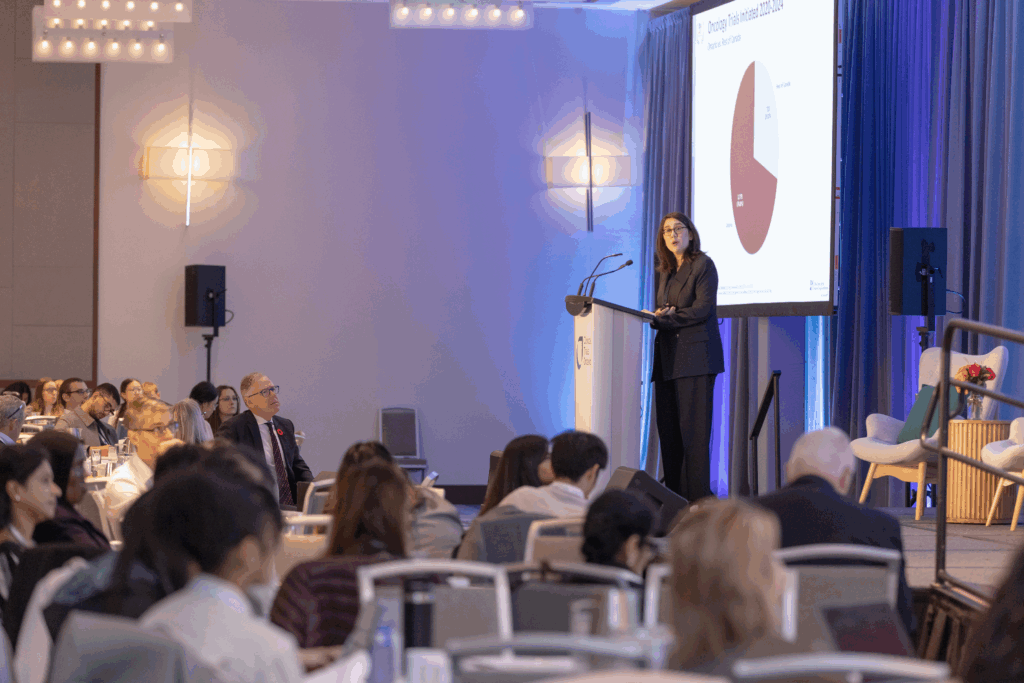
2025’s Clinical Trials Ontario (CTO) conference brought together researchers, regulators, industry leaders and patient advocates for two days of frank discussion on what it will take to strengthen Canada’s clinical trials ecosystem.
The sessions moved between high-level system perspectives and practical realities, offering a layered view of where progress is happening and where more alignment is still needed.
Across presentations, a central thread emerged: efficiency remains a core priority. Speakers reflected on variation in trial numbers and start-up times across provinces, pointing to persistent inconsistencies that slow momentum. Several talks highlighted that while Canada produces strong scientific output, coveting 4% in global clinical trials, there was still room to improve the pathways that turn evidence into action — from study design to ethics review to site activation.
Speakers Kenneth Getz and Maria Florez from the Tufts University Center for the Study of Drug Development pointed to variations across provinces in trial volume, startup timelines and operational readiness. They noted that while Canada is moving up the global clinical trial chain, there is still room to accelerate trial startup and improve consistency across regions.
Ethics modernization was another major focus. Canada’s new single research ethics review system, CanReview, was spotlighted for its potential to streamline multi-site reviews through predictable timelines and clearer processes. Presenters underscored the importance of reducing duplication, coordinating review efforts and building infrastructure that enables community hospitals and research centres to participate equitably.
Data infrastructure also featured prominently. Discussions explored how data flows across systems, how technology supports interpretation and how the right tools can reduce administrative burden at the site level.
Attendees brought real-world issues into focus, from AI safety and funding to workforce training and the downstream impact of regulatory and industry changes on both researchers and participants.
The responsible use of AI across the clinical trial landscape was found to be a frequent mention. In panels and presentations, speakers discussed how AI is already being applied to document summarization, operational planning and communication. Keynote speaker Ramy Nassar highlighted the importance of maintaining the “human in the loop”, especially when AI touches anything that informs study execution or influences regulated decisions.
Both the speakers and the attendees echoed a shared sentiment towards AI: that responsible use requires literacy, guardrails and clear governance.
Alongside the business and regulatory discussions, speakers with lived experience grounded the conversation in patient realities. Panels emphasized designing studies that account for time, mobility, clinic congestion and the real-life commitments participants juggle. The conversation around accessibility extended beyond digital tools to broader questions about equity and the distribution of trials across regions.
All in all, the conference resonated a sense of forward momentum. Speakers were pragmatic about real challenges, and shared a willingness to rethink how trials are designed, reviewed and delivered across Canada.
Voices from CTO 2025: A Snapshot
Xtalks had the opportunity to speak to several notable voices at the CTO 2025 conference. They reflected on what it truly takes to modernize the research ecosystem, from system structures to everyday realities.
Dr. PJ Devereaux, Director, Division of Perioperative Care at McMaster University and Nominated Principal Applicant, Accelerating Clinical Trials (ACT) Consortium, spoke with urgency about the need for a national, unified approach. “We want a single national research ethics approval process with really strict timelines to make us the fastest in the world,” he said, emphasizing that delays affect both researchers and patients.
PJ also pointed to the importance of domestic investment. “We need as a country to make a much bigger investment in supporting Canadian biotech and keep it Canadian.”
His remarks reinforced both structural redesign and the need to translate efficiency into faster patient access once interventions prove safe and effective.
From an ethics and governance standpoint, Susan Marlin, President & CEO, Clinical Trials Ontario, offered a long-range view of progress. She noted that Canada has steadily moved toward more coordinated, multi-site review processes over the past two decades, explaining, “Everything’s been moving towards single research ethics review… if anything, we’ve kept going in the direction of being more streamlined and efficient.”
With CanReview advancing, she expressed optimism for the year ahead and underscored the value of predictable timelines in enabling multi-site collaboration and expanding trial access nationally.
Matt Westmore, Chief Executive, UK Health Research Authority, brought insights from the UK. He described how collaboration between agencies dramatically reduced startup timelines and delivered a smoother experience for researchers and participants. “It’s really powerful to work together to provide a single experience… a single cross-Canada solution would be really powerful,” he remarked.
Matt also returned to a core principle that echoed throughout the conference: “The most precious commodity in research is trust… it’s very difficult to earn and very easy to lose.” His reflections reinforced how transparency and aligned communication can strengthen public engagement and research uptake.
AI was another central thread, and speakers shared pragmatic views on its potential and limitations. Ramy Nassar, AI & Emerging Technology Expert, described recruitment as a meaningful entry point: “Recruitment’s an interesting entry point… self-screening tools can improve the quality of patients coming in.”
Ramy also cautioned that organizations must develop clear boundaries around use: “Organizations need to develop their own rules around the use… setting your own boundaries and ensuring everyone knows what those boundaries are.” He noted that many teams default to a single tool without considering whether it’s actually the best fit for the job.
Ramy pointed out that AI use becomes more effective when teams understand the strengths and limits of different models and intentionally choose the right one.
In cell and gene therapy, patient realities came into sharp focus through the perspective of Dr. Sowmya Viswanathan, Scientist, Osteoarthritis Program, Division of Orthopedic Surgery, Schroeder Arthritis Institute & Krembil Research Institute (University Health Network). She discussed the logistical and physical demands placed on patients, noting that “Clinical trials involve a lot of follow-up visits. So there is a commitment that the patients have to make. These are considerations we need to think about.”
Dr. Viswanathan emphasized the importance of listening closely to patient feedback: “We’re listening to what works for them, what’s cumbersome, what’s difficult for them, so we can think about ways to alleviate that.” Her comments grounded the discussion in real-world considerations, underlining the need to design trials that respect time, mobility and everyday barriers.
From the industry side, Donna Janzen, Director, Regulatory Affairs Strategy and Policy, Roche Canada, provided an inside look at the evolving regulatory landscape for AI. “Where we are globally with respect to how AI is regulated, we’re still in really early stages,” she said, reflecting how varied international approaches remain.
Donna emphasized that “transparency and validation are key considerations,” especially when AI touches regulated decision-making or endpoints. Her perspective reiterated that responsibility, risk assessment and thoughtful implementation are essential for AI adoption across the drug development cycle.
“Research Is Care”
As CTO 2025 came to a close, speakers reminded attendees that the strength of clinical research lies in its people: those who follow up, listen and take time to see the person behind the trial.
A recurring message across CTO 2025 was clear: research is care. Whether discussed through patient burden, ethics modernization, data readiness or national coordination, many sessions circled back to the idea that the clinical research ecosystem should ultimately be guided by the patients and made accessible without barriers.
If you want your company to be featured on Xtalks.com, please email [email protected].









Join or login to leave a comment
JOIN LOGIN