
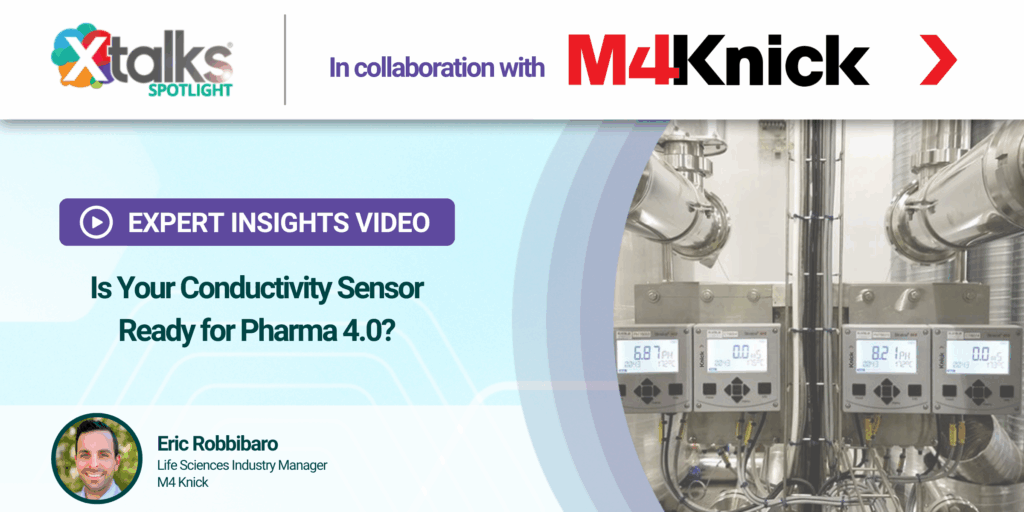
In pharmaceutical manufacturing, water may seem like a simple raw material, but it is one of the most critical components of the entire production chain.

Life Sciences Industry Manager
M4 Knick
Whether it is purified water or water for injection (WFI), its quality underpins everything from product safety to regulatory compliance.
“If the water’s bad, then the medicine doesn’t matter,” says Eric Robbibaro, Life Sciences Industry Manager at M4 Knick, in this Xtalks Spotlight edition.
According to Robbibaro, conductivity monitoring is one of the most reliable ways to ensure that water systems meet the highest standards.
Unlike lab-based assays, conductivity sensors provide continuous, real-time data. This means operators can catch deviations before water is ever used in production, helping protect not just processes and products, but ultimately patients as well.
Why Conductivity Matters for Water and WFI Systems
Conductivity is the simplest and most reliable way to confirm that purified water or water for injection (WFI) meets strict pharmacopeia standards, says Robbibaro. Any dissolved salts, acids or bases are immediately detected through conductivity, making it a real-time indicator of ionic contamination.
Conductivity sensors provide continuous monitoring every second of the day, which is especially powerful, Robbibaro explains. If a deviation occurs, it can be caught before the water is ever used in production.
Because water is such a universal ingredient and cleaning medium in pharmaceutical production, a small issue in water quality can have a cascading effect across every other stage of manufacturing.
This is why both the USP and EP pharmacopeias mandate routine conductivity testing.
Robbibaro emphasizes that conductivity is both simple and powerful. “Conductivity serves as the first line of defense for both compliance and quality. In short, “it’s a simple tool with a huge impact,” he says.
To address industry needs, M4 Knick developed the SE605H conductivity sensor, a MemoSense coaxial sensor designed for hygienic applications. It has a wide measuring range from 0.0012 to 2000 µS/cm, robust stainless-steel electrodes that allow mounting in virtually any orientation and integrated temperature compensation to ensure accurate results across different process conditions.
Supporting Biopharma Processes: From CIP to Chromatography
Robbibaro explains that conductivity measurement plays a practical role in several core biopharma processes, including clean-in-place (CIP), buffer preparation and chromatography.
In CIP, conductivity reveals when rinse water has completely displaced detergents, preventing both over-rinsing, which wastes resources, and under-rinsing, which risks leaving residues behind.
In buffer preparation, conductivity ensures that the correct ionic strength has been achieved, providing a quick and reliable way to confirm solution concentration.
In chromatography, it helps monitor column conditions, indicating when buffer exchanges are complete and assisting in tracking product elution.
While it may seem like a straightforward measurement, conductivity brings reliability and control to processes that are otherwise highly complex.
Meeting USP 645 Requirements
The USP <645> chapter specifies conductivity limits at different temperatures, and regulators expect companies to show evidence that water systems remain within those limits.
“It’s not just a best practice, it’s a formal compliance requirement. What regulators want to see is evidence that you’re in control of your water system.”
“From a regulatory standpoint, conductivity is non-negotiable.” — Eric Robbibaro
Continuous conductivity monitoring provides exactly this type of evidence: an objective and real-time record of water quality.
Robbibaro notes that auditors pay particularly close attention to conductivity data because it is simple, transparent and directly tied to patient safety.
For this reason, conductivity is not merely a box to check on a compliance list but one of the clearest ways for manufacturers to demonstrate that their systems are under control and their products are safe.
Driving Efficiency and Sustainability
While conductivity is essential for compliance, Robbibaro also highlights how it supports efficiency and sustainability in pharmaceutical operations.
Without real-time sensors, operators often rely on fixed rinse times to ensure cleanliness. For example, a system might be flushed for 20 minutes just to be safe, even if the rinse is complete in half that time.
Conductivity data eliminates this guesswork by showing exactly when water has returned to baseline, allowing rinsing to stop immediately. This approach saves time, reduces water and utility consumption and helps conserve valuable resources.
The same principle applies to buffer exchange. Instead of flushing excessively to ensure that one buffer has been replaced by another, conductivity measurements confirm the exchange in real time. This avoids wasting costly buffers and keeps production moving efficiently.
In this way, conductivity monitoring does more than help companies meet regulatory standards; it also contributes to smarter, more sustainable operations.
Risks of Neglecting Conductivity Monitoring
When conductivity is not properly monitored or maintained, the risks can be significant.
Ionic contamination could go undetected, leading to substandard water being used in drug products or for cleaning equipment. If detergents are not fully rinsed away, chemical residues may remain and compromise product safety. In processes like chromatography or buffer preparation, incorrect conductivity levels could result in improper buffer strength or poor separations, both of which undermine quality.
On top of these operational risks, companies would lack the data to demonstrate that their systems were under control. This could lead to regulatory findings, product holds or even recalls.
As Robbibaro stresses, conductivity may seem like a small parameter, but its absence would create major vulnerabilities in pharmaceutical manufacturing.
M4 Knick’s SE605H conductivity sensor is designed to address these risks with a multi-stage verification function compliant with USP <645>, explains Robbibaro. This ensures accuracy and traceability, which are essential under GMP best practices for ultrapure water systems. By providing certifiable proof that sensors are functioning correctly, the technology helps manufacturers safeguard both quality and compliance.
Conductivity measurement may appear to be a simple detail, but in pharmaceutical manufacturing, it is a cornerstone of quality assurance.
From ensuring water purity to improving efficiency and demonstrating compliance, it functions as both a protective safeguard and a catalyst for smarter operations, with the ultimate goal of delivering safe medicines to patients.
This article was created in collaboration with the sponsoring company and the Xtalks editorial team.


Join or login to leave a comment
JOIN LOGIN