
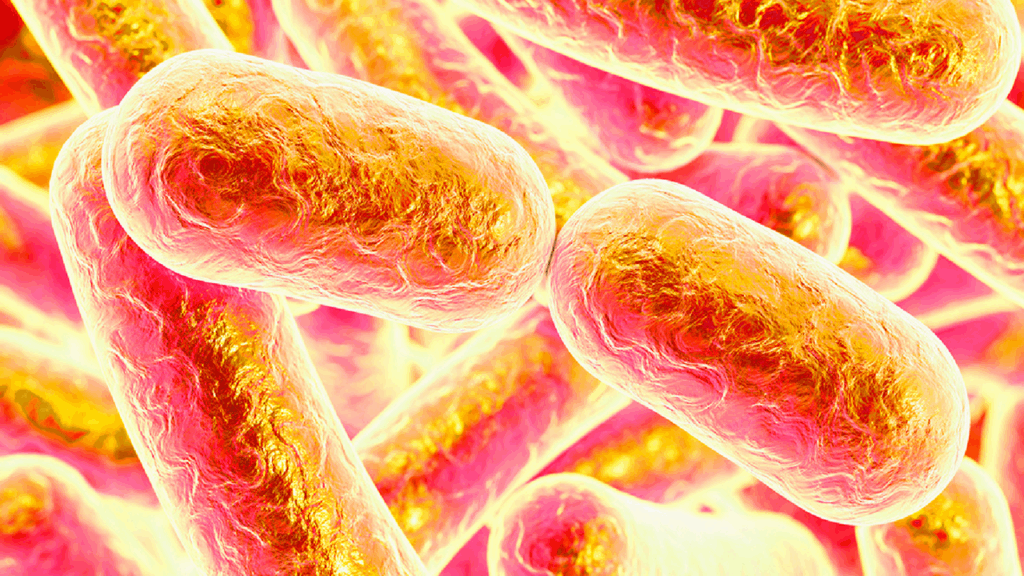
Microbial-based fermentation can yield major benefits for patients and manufacturers in terms of accessibility and cost-effectiveness. It allows for both faster processes and notable cost-savings; that said, it comes with inherent challenges and requires expert understanding and handling.¹ Oftentimes, microbial-based products are unique, complex molecules that require specific processes that may not be platform-based. They require specific purification techniques and specialists that can think critically to adapt approaches.
In many cases, complex microbial-based biologics are born out of university offshoots and small biotech companies funded by private equity or venture capital firms who stage-gate funding. In such cases, reaching toxicology trial and IND are major steps towards unlocking additional resources. The key is working with a contract development and manufacturing organization (CDMO) partner that has the knowledge and experience to navigate the inherent challenges of microbial fermentation and complex process development effectively and efficiently. For developers looking to quickly reach first-in-human clinical trials with their microbial-based therapeutic, working with an experienced CDMO means that the program can be exclusively focused and intentionally tailored to develop a process for IND and beyond.
The Challenges of Microbial Process Development
Despite its advantages, microbial process development (PD) often must be customized for each molecule, which can make implementation of a standard platform process unrealistic; as a result, development must be performed predominantly from scratch. Ideally, a manufacturer will be able to produce a high titer lead strain during strain development. Once it’s time to develop downstream processes, it is well-advised to build a new workflow from the ground up. Even with previous screening experience, manufacturers often encounter new obstacles. A large part of microbial PD is spent screening new chromatography resins and tangential flow membranes coupled with optimizing their operating conditions.
Purification processes vary widely from molecule to molecule. If a molecule is expressed as inclusion bodies, it typically needs to be refolded, with refolding conditions specific to the protein of interest. You may need to navigate misfolded forms and charge variance. For soluble molecules, you’ll face similar challenges around the separation of different forms as well as potentially more complex separation procedures, where host cell proteins must be flocculated to enrich the clarified material going into the downstream process. To navigate these difficulties, it is critical to work with a manufacturer that takes an iterative approach to development by gathering data and making real time adjustments to the process while communicating developments and presenting options that have longer-term viability.
The Gene to GMP Solution
At FUJIFILM Biotechnologies, our PD teams have a deep and extensive knowledge of the development of microbial-based biologic processes. This range of manufacturing experiences has enabled our teams to design a streamlined development strategy to help sponsors quickly reach preclinical IND enabling studies. Specifically, the Gene to GMP program is a set portfolio of services structured to efficiently progress microbial biologics to first in human clinical trials and includes the following:
- Strain development in coli or yeast (P. pastoris) with top producing strains identified in as little as 6 weeks
- An 11-week expanded workflow (including strain development) to assess titer of top strains and early product quality (PQ) analysis, buffer screening and capture column definition
- Full PD with a minimum of two chromatography stages and one tangential flow filtration (TFF) step to bring product to sufficient purity as well as a suite of analytical testing methods to assess the product prior to release for tox trial
- Lab-scale run to generate material for further assay development or client use
- Pilot 100 L scale run to generate material for tox trial
- Liquid formulation, no higher than 10 mg/mL
- Phase appropriate validation of analytical methods
- 100 L scale GMP run
- Drug Product fill (within FUJIFILM Biotechnologies network or third party vendor with integrated project timelines)
- QC release drug substance and drug product
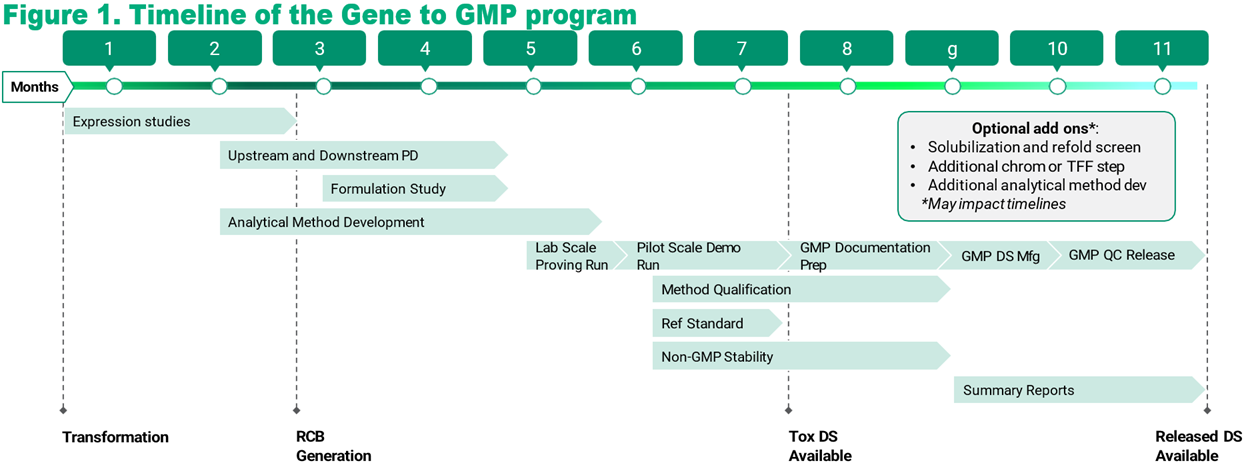
Overall, it’s a shorter, leaner, and more affordable program for developers looking to reach tox trials efficiently. While traditional PD aims to take clients all the way through to cGMP manufacture, our Gene to GMP workflow allows for a natural break in process development. At this stage, clients can conduct toxicology trials and progress to Phase I clinical manufacturing when ready. Leveraging this set package of work allows for an efficient process and a manageable scope of work for sponsors who may not have taken a molecule through to cGMP manufacture previously. We also offer the benefit of additional modular packages which can be added to address specific client needs. Thanks to our streamlined development approach, buffers, resins, and membranes are procured from trustworthy vendors to ensure they are well-stocked and easily accessible.
Gene to GMP is tailored towards providing material for early phase clinical trials. We act as an extension of our partners development labs supporting rapid and robust scale up. Once positive results and funding are secured for later phases, the program can be effortlessly resumed. FUJIFILM Biotechnologies have extensive experience optimizing and scaling up microbial processes and supporting partners through to commercial production.
References
- Mirasol, F. (2022, October 1). Weighing the benefits of fermentation for new Biotherapies. BioPharm International. https://www.biopharminternational. com/view/weighing-the-benefits-of-fermentation-for-new-biotherapies
About the Author
Steve Loftus serves as Director, Commercial Technical Lead for Biologics at FUJIFILM Biotechnologies. With over 19 years in the biotechnology industry, he excels in strategic growth and project management, focusing on mammalian cell culture and microbial service offerings. Steve plays a pivotal role in solution-based selling, aligning technical offerings with client needs, and guiding FUJIFILM Biotechnologies to industry leadership. Steve holds a PhD in Biochemistry/ Biophysics from the University of York and a degree in Medical Microbiology from the University of Newcastle.
Contact FUJIFILM Biotechnologies to discuss your science — get the latest updates on their network and capabilities.




Join or login to leave a comment
JOIN LOGIN