
The global medtech sector reached an estimated $584 billion in 2025, with companies projected to deliver 6% to 7% revenue growth despite ongoing macroeconomic and trade pressures, according to Ernst & Young. Investment activity has also remained strong, with venture capital funding rising 16% and average deal sizes increasing.
At the same time, the sector is operating in a changing healthcare environment, with more than $1 trillion in annual healthcare spending expected to shift toward digital, data-enabled and patient-centered care models. Care delivery is also extending to the home with growing use of remote monitoring, home-based care and AI-supported clinical decision-making. Companies are expanding into areas such as robotics, structural heart and diabetes care.
These developments are influencing how medtech companies scale their operations, from manufacturing and supply chains to global commercial activities. In this context, workforce size offers one lens into how companies support these functions at scale.
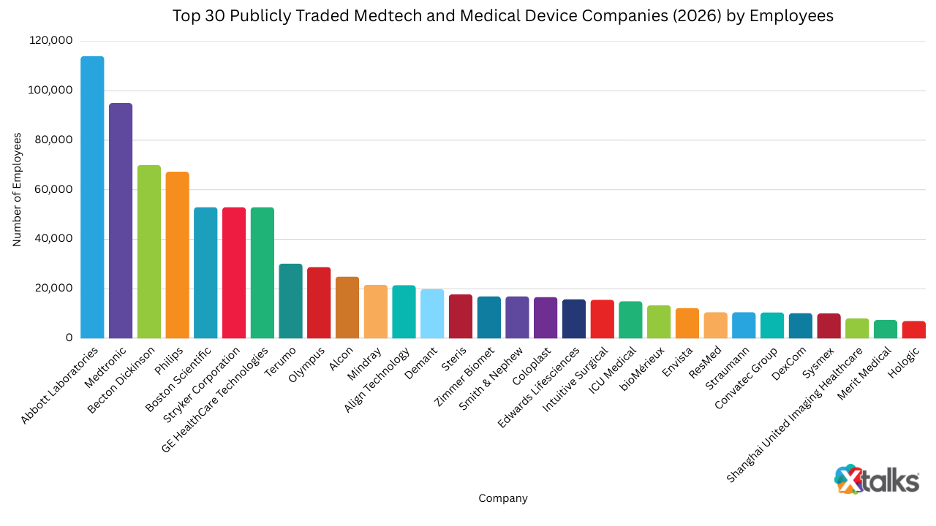
In our blog, we highlight 30 publicly traded medtech and medical device companies ranked by employee count as featured on companiesmarketcap.com.

1. Abbott (114,000 employees)
Abbott is a US-based healthcare company with a portfolio spanning cardiovascular devices, diagnostics, diabetes care and neuromodulation technologies. Its cardiovascular business includes implantable sensors and remote monitoring systems used to manage chronic conditions such as heart failure. Recently, the FDA approved Abbott’s next-gen CardioMEMS HERO reader, a pulmonary artery pressure monitoring device. The remote reader is designed to support earlier detection of heart failure progression through daily remote readings.
2. Medtronic (95,000 employees)
Medtronic is an Ireland-headquartered medtech focused on cardiovascular, neuroscience, medical surgical and diabetes devices. Its portfolio includes implantable cardiac devices, surgical technologies and diagnostic tools used across hospital and procedural settings. Medtronic recently announced plans to acquire CathWorks in a deal valued at up to $585 million. The deal expands its capabilities in AI-enabled coronary physiology assessment using angiography-based analysis.
3. BD (Becton, Dickinson and Company, 70,000 employees)
BD (Becton, Dickinson and Company), a medtech company based in the US, specializes in medical supplies, diagnostic systems and life sciences tools used across clinical and laboratory settings. Its products support medication delivery, infection prevention and surgical workflows in hospitals and outpatient environments. BD received FDA 510(k) clearance for its Surgiphor 1000 mL antimicrobial irrigation system, designed to standardize wound cleaning and integrate with powered surgical irrigation procedures.

4. Philips (67,263 employees)
Philips is a Netherlands-based health technology company focused on diagnostic imaging, patient monitoring and connected care solutions. Its portfolio includes imaging systems, clinical informatics and monitoring technologies used across hospitals and outpatient settings. Recently, Philips applied its AI-based RATE algorithm in a pilot with Dutch professional football club PSV Eindhoven, originally founded by Philips employees. The goal was to test its AI-based infection detection algorithm using wearable data to identify early signs of respiratory illness.
5. Boston Scientific (53,000 employees)
Boston Scientific is a US-based medical device company focused on interventional therapies in cardiovascular, urology, endoscopy and neuromodulation. Its products are used in minimally invasive procedures to treat conditions such as arrhythmias, chronic pain and vascular disease. The company reported Q4 2025 net sales of $5.29 billion, reflecting double-digit growth across its MedSurg and cardiovascular segments, alongside product development and clinical trial activity.
6. Stryker (53,000 employees)
US-based Stryker is a medtech giant specializing in orthopedics, surgical equipment and robotic-assisted systems. Its products are used in joint replacement, neurotechnology and minimally invasive procedures. The company recently received the first enterprise-level Gold Resiliency Badge from the Healthcare Industry Resiliency Collaborative, recognizing performance across its supply chain operations. It also introduced the Mako RPS handheld robotic system for knee procedures in a limited market release, expanding robotic technology offerings to surgeons.

7. GE HealthCare (53,000 employees)
GE HealthCare is a US-based medtech company specializing in imaging, ultrasound and clinical software solutions. Its products support radiology, oncology and diagnostic workflows across hospital and imaging center environments. GE’s View was recently cleared by the FDA as a diagnostic imaging viewer designed to enable remote access and improve radiology workflow efficiency. The company partnered with Springbok Analytics to gain AI-assisted 3D visualizations of MRI, helping assess muscle health in injury recovery and performance.
8. Terumo (30,207 employees)
Terumo is a Japan-based medical device company focused on cardiovascular systems, blood management and cell therapy technologies. Its products span catheters, blood collection systems and automated processing platforms used in hospitals and research settings. Terumo Blood and Cell Technologies have partnered with Taiwan Bio to advance automated regulatory T-cell manufacturing using its Quantum Flex platform, which supports more scalable cell therapy production. The company’s Terumo Aortic division received FDA Breakthrough Device designation for the Fenestrated Treo stent-graft system, used to treat complex abdominal aortic aneurysms.
9. Olympus (28,838 employees)
Like Terumo, Olympus is also Japan-based and a medical technology company focused on endoscopy, surgical imaging and minimally invasive therapeutic solutions. Its products are used across gastrointestinal, respiratory and surgical specialties in hospital settings. Recently, the company launched the Visera Elite III surgical imaging platform in the US. The platform integrates 4K and 3D visualization technologies to support minimally invasive procedures.
10. Alcon (25,000 employees)
Swiss company Alcon is a medical device company focused on eye care, including surgical equipment and vision care products. It manufactures intraocular lenses, surgical systems and ophthalmic consumables used in cataract and refractive procedures. In a company report, Alcon shared that more than 175 million of its intraocular lenses have been implanted globally, including over 6 million presbyopia-correcting lenses, with its PanOptix and Vivity platforms each reaching multi-million implant milestones.
11. Mindray (21,677 employees)
Mindray is a China-based medical device company specializing in patient monitoring, anesthesia systems and diagnostic imaging. Its products are used across acute care, primary care and remote healthcare settings. In 2025, Mindray introduced a wireless handheld ultrasound system, called the TE Air e5M, designed to support whole-body scanning across 22 types of clinical exams.
12. Align Technology (21,485 employees)
Align Technology is a US-based dental technology company focused on clear aligners and digital orthodontics. It develops Invisalign systems and iTero intraoral scanners, which are handheld devices used to create digital 3D images of teeth for treatment planning. In 2026, the company will support Switzerland’s first national oral health study using its iTero Lumina scanner. In addition, Align introduced its mandibular advancement system in markets such as Thailand and the Philippines, designed to reposition the lower jaw while straightening teeth in patients with certain bite misalignments.
13. Demant (19,917 employees)
Demant is a Denmark-based hearing healthcare company specializing in hearing aids, implants and care delivery. The company recently divested its Oticon Medical hearing implants business to Impilo for approximately $92.5 million (DKK 600 million), letting it focus more on its core hearing aid and care operations. Demant will support the transition, including product development and supply services. The company has also agreed to acquire KIND Group for around $806.2 million (DKK 5.2 billion), adding around 650 clinics and expanding its presence in the German market.
14. STERIS (17,787 employees)
Irish medtech company STERIS is focused on infection prevention, sterilization and surgical products. Its offerings support hospitals, laboratories and pharma manufacturing. In its latest quarterly results, the company reported revenue of $1.5 billion. Growth was seen across healthcare, sterilization and life sciences segments, driven by higher service activity, consumables demand and equipment sales, despite ongoing cost pressures from inflation and tariffs.
15. Zimmer Biomet (17,000 employees)
Zimmer Biomet is a US-based orthopedic device company specializing in joint replacement, surgical robotics and musculoskeletal solutions. Its technologies are used in hip, knee and other orthopedic procedures. The company reported Q4 2025 sales of $2.24 billion. It also received FDA clearance for an updated ROSA robotic knee system, alongside new device launches and expanded digital tools to track patient recovery. Zimmer was also named to Forbes’ America’s Best Companies of 2026 list.
16. Smith+Nephew (17,000 employees)
Smith+Nephew is a UK-based medtech company focused on orthopedics, sports medicine and wound care. Its technologies support joint repair, reconstruction and surgical workflows. At the American Academy of Orthopaedic Surgeons (AAOS) 2026 annual meeting, the company presented its CORI handheld robotic system, one of its latest orthopedic products, which is used to assist surgeons in joint replacement procedures. The system is commercially available and part of the company’s existing surgical platform.
17. Coloplast (16,741 employees)
Danish medical device company Coloplast specializes in chronic care products such as ostomy, continence and wound care solutions. Its products are used in long-term patient management across home and clinical settings. In 2025, the company introduced a new five-year strategy called Impact4, which outlines plans to grow its product offerings, improve operational efficiency and expand the use of digital and AI technologies. The strategy targets 7% to 8% organic revenue growth through FY 2029/30.
18. Edwards Lifesciences (15,800 employees)
Edwards Lifesciences is a US-based medtech company focused on structural heart disease and critical care monitoring. Its products include transcatheter heart valves and surgical therapies for cardiovascular conditions. Late last year, the FDA approved the company’s SAPIEN M3 system. The device is a transcatheter mitral valve replacement for patients with moderate-to-severe or severe mitral regurgitation who are not eligible for surgery or other catheter-based repair options.
19. Intuitive Surgical (15,638 employees)
Intuitive Surgical, another large medtech in the US, is focused on robotic-assisted surgery and minimally invasive care. It developed the da Vinci surgical systems that are being used across multiple specialties. Early this year, Intuitive received FDA 510(k) clearance for its da Vinci 5 system for certain cardiac procedures, including mitral valve repair. The update expands use into cardiac surgery, enabling minimally invasive procedures through small incisions rather than open chest surgery.
20. ICU Medical (15,000 employees)
Also US-based, ICU Medical medical device company is focused on infusion therapy, IV solutions and critical care products. Its portfolio includes delivery systems used in hospitals and acute care settings. In 2025, the company formed a joint venture with Otsuka Pharmaceutical Factory to expand IV solutions manufacturing. The partnership combines global production capacity of about 1.4 billion units annually and hopes to strengthen supply reliability in North America.
21. bioMérieux (13,409 employees)
French company bioMérieux is an in vitro diagnostics company that develops infectious disease testing and microbiology solutions. Its systems are used in clinical and laboratory settings to identify pathogens and guide treatment decisions. In March 2026, the company received IVDR CE marking in Europe for two BIOFIRE SPOTFIRE panels used to detect respiratory and sore throat infections. The tests can identify multiple pathogens in about 15 minutes and are designed for use near the patient, including outside traditional lab settings.
22. Envista (12,300 employees)
Envista is a US-based dental technology company that develops imaging systems, implants and orthodontic solutions. Its portfolio includes brands such as DEXIS (dental imaging), Nobel Biocare (dental implants) and Ormco (orthodontics), supporting diagnostics, tooth replacement and alignment procedures. The company reported Q4 2025 revenue of $751 million with double-digit core growth. Performance was supported by increased training activity, higher R&D investment and cost reductions across operations.
23. Resmed (10,600 employees)
From the US, medtech company Resmed drives sleep apnea, respiratory care and home-based healthcare solutions. Its products include connected devices and digital health platforms used in home and clinical settings. The company announced this year that it is opening a new distribution center in Indiana, expected to begin operations in 2027. The facility will expand logistics capacity, improve delivery times across North America and increase two-day shipping coverage from 75% to 90%.
24. Straumann Group (10,554 employees)
Swiss company Straumann Group is a medical device company specializing in dental implants, orthodontics and digital dentistry solutions. Its products support tooth replacement and orthodontic treatment workflows. In 2025, the company partnered with Smartee to expand its clear aligner capabilities and manufacturing capacity. It also collaborated with DentalMonitoring to integrate AI-based remote treatment monitoring into its ClearCorrect platform, with rollout planned for 2026.
25. Convatec (10,489 employees)
Convatec is a UK-based medical products company focused on advanced wound care, ostomy care and continence solutions. Its products are used in both hospital and home care settings. The company expects organic revenue growth of 5% to 7% in FY2026 and continued earnings growth. It also received regulatory approvals in Europe and the UK for a nitric oxide-based wound dressing and is progressing additional product launches across its care segments.
26. Dexcom (10,200 employees)
Continuous glucose monitoring (CGM) system maker Dexcom is a US-based medical device company. CGMs are used to track blood sugar levels in people with diabetes. Its wearable sensors provide real-time glucose readings and alerts to support disease management. At the Advanced Technologies and Treatments for Diabetes (ATTD) 2026 conference, the company presented data showing that use of its G7 system improved A1C levels and supported weight management in people with type 2 diabetes not using insulin. It also reported reductions in diabetes-related hospitalizations and shared updates on upcoming product features and clinician training frameworks.
27. Sysmex (10,042 employees)
Sysmex is a Japan-based diagnostics company specializing in hematology, immunoassay and clinical testing systems. Its technologies are used to analyze blood samples and support disease detection. In collaboration with Shiga University of Medical Science, the company contributed to a study examining blood-based biomarkers for Alzheimer’s disease in a general population, supporting earlier risk assessment through simple blood tests. Sysmex was ranked in the top 1% of companies in S&P Global’s Sustainability Yearbook 2026.
28. Shanghai United Imaging Healthcare (8,173 employees)
China-based Shanghai United Imaging Healthcare is a medtech company focused on imaging, radiotherapy and digital health solutions. Its systems include MRI, CT and molecular imaging platforms used across clinical specialties. The global company signed a collaboration agreement with Bayer to explore the integration of imaging systems, digital platforms and connected technologies. The partnership focuses on improving interoperability and expanding access to imaging solutions across global markets.
29. Merit Medical (7,400 employees)
Merit Medical is a US-based medical device company that manufactures interventional and diagnostic products used in cardiovascular and endovascular procedures. Its technologies support minimally invasive treatments, including vascular access for dialysis. The company reported 24-month clinical data in 2025 from its WAVE trial, showing improved ability to keep blood vessels open with its Wrapsody endoprosthesis, a stent-like implant used to keep blood vessels open in patients on hemodialysis, compared to standard angioplasty. The device has FDA approval and is being further evaluated in real-world registries.
30. Hologic (7,063 employees)
Based out of the US, Hologic, a medtech company, develops solutions for women’s health, including diagnostics, imaging and surgical innovations. Its products support screening and early detection of diseases such as cervical cancer. In February 2026, the company received FDA approval for its Aptima HPV assay for primary screening, expanding its use beyond co-testing and Pap-based approaches. The test detects high-risk HPV infections using mRNA technology and is supported by data from a large real-world study involving more than 650,000 women.
If you want your company to be featured on Xtalks.com, please email [email protected].












Join or login to leave a comment
JOIN LOGIN