
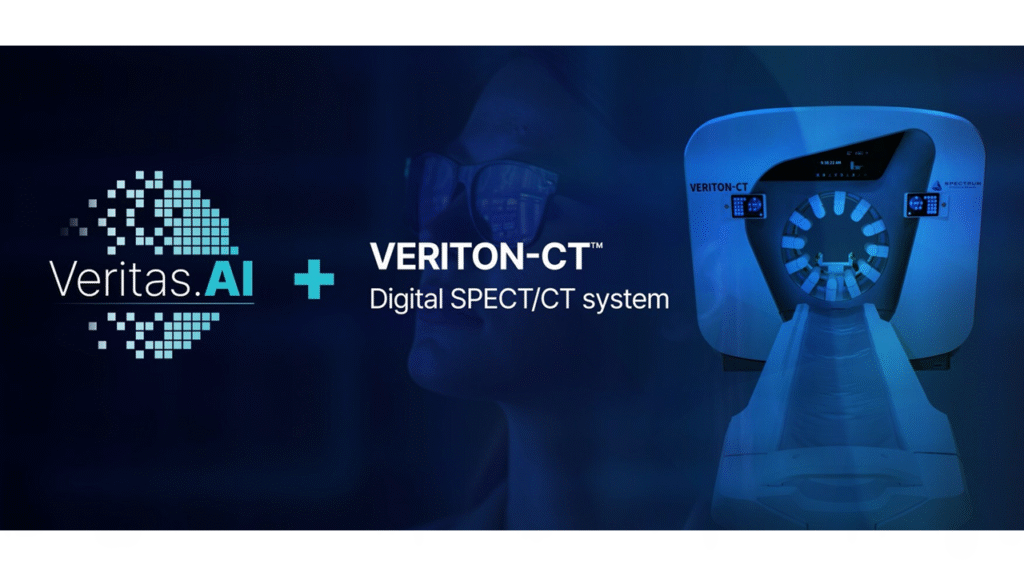
Spectrum Dynamics Medical has received FDA 510(k) clearance for Veritas.AI Noise Reduction, a software platform that uses AI to reduce image noise on the company’s VERITON-CT digital SPECT/CT system. The software is intended to reduce noise in nuclear medicine imaging, where low signal counts and statistical noise can affect image quality.
The VERITON-CT combines 3D single-photon emission computed tomography (SPECT) functional imaging with CT. It uses a ring-shaped array of solid-state detectors arranged around the patient to capture where signals are located in the body and how strong they are in a single scan.

In practice, digital SPECT/CT systems are used in hospital nuclear medicine departments. A SPECT scan shows how a radiotracer distributes in the body, providing functional information about organs or disease processes. It is often combined with CT to combine functional imaging with CT images of the body.
SPECT imaging relies on detecting gamma photons emitted by radiotracers within the body. In certain clinical situations, such as low-dose protocols, delayed post-therapy imaging or pediatric exams, fewer photons may be detected, which can cause images to appear visually “grainy.”
Traditional denoising approaches can reduce this noise, but may also compromise spatial resolution or quantitative accuracy. Both are important for interpretation and assessment across multiple scans over time.
Veritas.AI is designed to address these issues using a deep learning convolutional neural network trained to reduce image noise.
Thursday, March 12, 2026, at 11am EDT (4pm CET/EU-Central)
Register for this webinar to learn how product safety compliance applies to connected medical devices and the testing pathways that support market access.
Veritas.AI is designed to operate alongside the VERITON-CT system’s hardware and workflows, including its 360-degree cadmium zinc telluride detector architecture, wide-bore design and quantitation-ready imaging protocols. These features are intended to support routine diagnostic imaging, quantitative SPECT applications, theranostics and clinical research.
The software has been clinically validated across multiple applications and tracers, including bone imaging, lutetium-177-based theranostics and iodine-123 metaiodobenzylguanidine imaging. These cases are technically demanding because they involve low-count statistics or require consistent quantitative measurements over time.
The cleared platform includes a range of application-specific modules. Bone-IQ.AI is intended for whole-body bone imaging and is designed to support shorter acquisition times while maintaining image quality. Thera-IQ.AI is designed for lutetium-177 theranostics, where uniform noise levels across post-treatment scans may aid quantitative assessment and dosimetry. MIBG-IQ.AI is designed for iodine-123 MIBG imaging and is intended to support faster acquisitions, which may be especially relevant in pediatric imaging.
Across applications, the software is reported by the company to support scan time reductions of up to 50% while maintaining diagnostic accuracy in low-count or high-noise conditions. Shorter acquisition times may also enhance patient comfort.
Related: FDA Transitions to QMSR, Updating How Medical Device Inspections Are Conducted
Nuclear Medicine Imaging and AI Adoption
Across the nuclear medicine equipment market, SPECT systems account for a substantial share of installed equipment, particularly in hospital settings.
Veritas.AI’s clearance comes not so long after GE’s AI software was cleared. In January 2026, GE HealthCare received FDA 510(k) clearance for MIM LesionID Pro. This is an AI-based software that automates whole-body tumor burden analysis in PET/CT and SPECT/CT studies, reducing the manual effort required to quantify disease extent and track changes over time in theranostic workflows.
More companies across the imaging and theranostics ecosystem are integrating AI into nuclear medicine workflows. Recent examples include Nucs AI, which recently established a medical advisory board to guide the responsible development and clinical integration of AI-driven theranostics. Late last year, Philips announced the launch of Verida, an AI-powered spectral CT system designed to reduce image noise and streamline imaging workflows by applying AI across acquisition and reconstruction. The system is CE-marked, with FDA clearance pending.
If you want your company to be featured on Xtalks.com, please email [email protected].














Join or login to leave a comment
JOIN LOGIN