
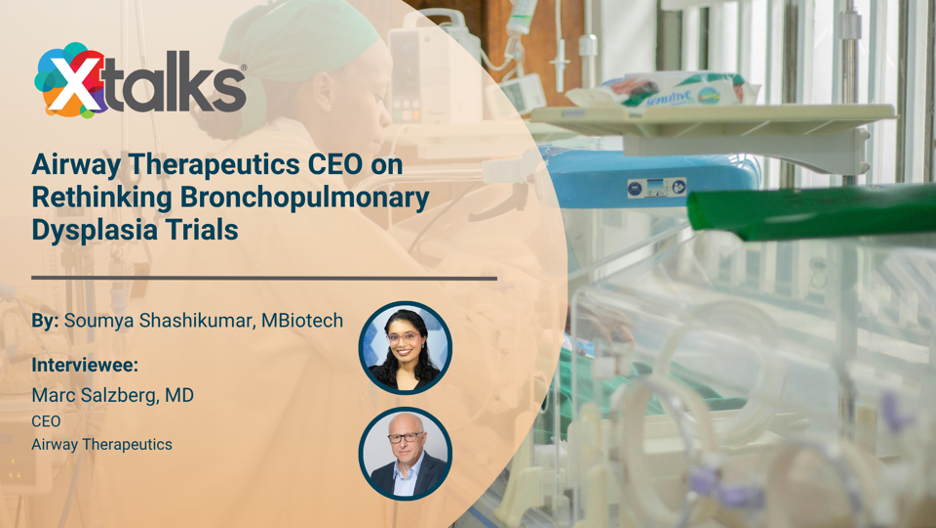
From blinded teams to early dose readouts, Airway Therapeutics’ CEO explains the clinical and operational hurdles behind bronchopulmonary dysplasia (BPD) prevention research in preterm infants.
When babies are premature, breathing support is essential in the first days of life. But premature lungs are still developing, and the oxygen and ventilation used to help newborns breathe can also contribute to lung injury, inflammation and longer-term respiratory complications.
Bronchopulmonary dysplasia (BPD) is a serious lung condition that affects newborns, most often those born more than 10 weeks before their due date, weighing less than 2 pounds and already experiencing breathing problems. BPD can also lead to feeding difficulties, pulmonary hypertension, delayed speech, vision and hearing problems, learning difficulties and infections.
Every year, around 10,000 to 15,000 babies in the US develop BPD.

Chairman and CEO
Airway Therapeutics
Airway Therapeutics is developing zelpultide alfa, an investigational biologic, for the prevention of BPD in very preterm infants. The therapy is being studied in infants born between 22 and 27 weeks of gestational age, with a Phase IIb dose-selection stage followed by Phase III expansion.
Xtalks spoke with Marc Salzberg, MD, Chairman and CEO of Airway Therapeutics, about why BPD has been so difficult to address with new therapies and what it takes to run clinical trials in one of the most fragile patient populations in medicine.
Dr. Salzberg has more than 30 years of experience across academic medicine and the pharmaceutical industry, including drug development and clinical research.
Get industry leading pharma and biotech news, events and expert insights delivered to your inbox.

Understanding BPD as a Cycle of Injury, Inflammation and Infection
BPD was previously known more broadly as chronic lung disease. Dr. Salzberg said the field’s understanding has evolved over the past two to three decades. Researchers are now focusing more closely on how respiratory support, lung injury and inflammation interact in premature infants.
“Bronchopulmonary dysplasia is a very severe condition, the most frequent severe respiratory condition in preterm babies,” he said.
That severity can be difficult to interrupt once it begins.
“These babies enter into a vicious cycle of lung injury, inflammation, infection and the need for even more ventilation and oxygenation because of that, because the lungs are damaged,” he explained.
BPD is also a heterogeneous disease, meaning infants may differ in clinical status, risk profile and care needs even within the same trial population.
For Airway Therapeutics’, the aim is to intervene earlier in the lung injury and inflammation process that can contribute to longer-term respiratory damage.
Orphan Disease Trials Require Leaner, Faster Designs
Clinical drug development in BPD must account for the fact that the eligible patient population is limited.
“In orphan indications, you need to make sure that you do not have too big of a sample size in clinical trials and clinical development because it’s difficult to recruit into these studies,” highlighted Dr. Salzberg.
This can push sponsors toward more streamlined development plans. Early studies must answer enough questions about dose, regimen and safety to support the next stage of development.
“The goal really is to, on one hand, efficiently understand safety, have good parameters for safety as well as early efficacy readout to not need too many patients to be treated in a clinical study,” he said.
Running Trials Inside the Urgency of the NICU
“In a NICU setting, you have urgencies and emergencies. Everything goes quickly. You need to act fast,” began Dr. Salzberg.
The NICU is not a predictable research setting. Eligible infants may be born at any time. “That could be at three in the morning because who knows when these babies are born,” elaborated Dr. Salzberg.
Before an infant can be randomized into a study, the clinical team must inform the parents or guardians and obtain consent, often within a narrow window. Blinded trials add another layer of complexity, where one team may need to give the study drug, placebo or control, while another team remains blinded to assess the infant’s progress.
Blinding is more challenging when drugs are administered endotracheally, meaning through a tube placed into the airway. Dr. Salzberg shared that in many European centers, physicians administer these therapies, which can immediately unblind the person giving the treatment and require another team to remain blinded for trial assessments.
Bridging Regulatory Expectations and Real-World Feasibility
According to Dr. Salzberg, regulators expect neonatal trials to generate strong evidence, particularly when investigational therapies are being studied in medically fragile infants. That can mean blinded study design, clear endpoints, adequate sample size and a well-defined patient group.
“You want ideally a blinded trial, you want a sufficient sample size, you want a very homogeneous patient population, meaning you need to define them as strictly as possible,” he said.
The challenge, however, is that very preterm infants often have multiple medical issues related to early birth. That can make it difficult to design a clean, uniform study population while still enrolling enough infants for the trial to be practical.
“You need to bridge all these elements to get to something feasible,” he pointed out.
Dr. Salzberg said the lack of newly registered drugs in this setting over the past 30 years may reflect how difficult it has been to align expectations across regulators, sponsors, investigators and clinical sites.
Evidence Generation Before the First Infant Is Enrolled
Strong evidence generation starts with site selection. For neonatal lung disease trials, it is crucial to understand whether a site sees the right patients, where those patients come from and whether the study can be conducted without adding avoidable risk.
“You want to prevent these babies from being transported into the NICU unit because the transport per se is already a risk,” Dr. Salzberg said.
Sites need the right patient flow, trained staff, protocol understanding and practical ability to run a complex neonatal trial in real time.
“A very in-depth due diligence on the level of site qualification is needed, so the expectations are clear,” he noted.
Dr. Salzberg also emphasized that patient selection is key. Zelpultide alfa is being developed as a preventive therapy, not a rescue medication for infants at immediate risk of death within 24 hours of study inclusion. Investigators must identify fragile infants who fit the preventive intent of the study.
For BPD research, the clinical challenge and the trial challenge are closely linked. Trials must be designed tightly enough to generate credible evidence, but realistically enough to operate in one of the most time-sensitive settings in pediatric care.
If you want your company to be featured on Xtalks.com, please email [email protected].












Join or login to leave a comment
JOIN LOGIN