
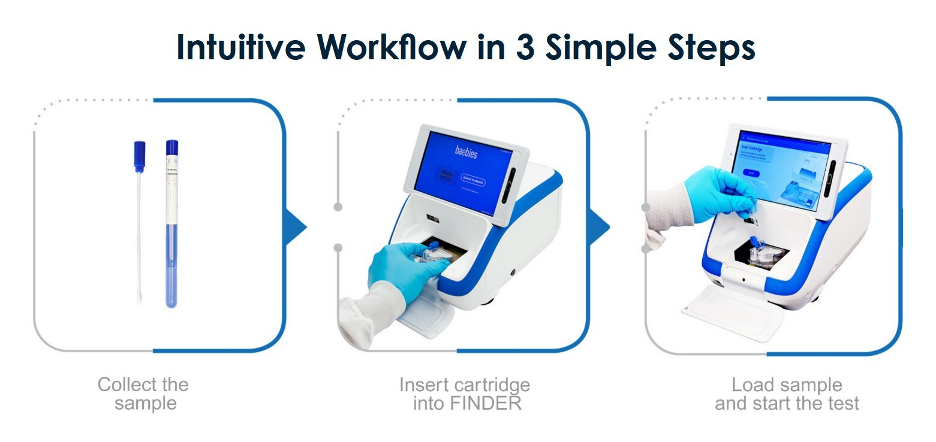
Diagnostics company Baebies has announced the FDA 510(k) clearance for its Finder Flu A&B/SARS-CoV-2 test.
Research Triangle Park, North Carolina-based Baebies said the FDA clearance establishes the system as the first molecular point-of-care system with multifunctional capabilities.
The device also received a CLIA waiver, which allows certain diagnostic tests to be performed outside of traditional laboratories. Tests with the waiver are considered simple to use, have a low risk of error and can be conducted in settings like clinics, pharmacies or at the point of care by non-laboratory personnel.

Historically, molecular diagnostics, particularly PCR-based testing, have been largely confined to centralized laboratories due to complexity and infrastructure requirements. The Finder platform aims to break that paradigm.
The Finder system delivers PCR-quality results during a patient visit, with positive results available in as little as 15 minutes and negative results in around 20 minutes, according to Baebies. This rapid turnaround will enable clinicians in urgent care centers, emergency departments and clinics to make real-time treatment decisions without relying on external lab workflows.
The Finder platform is based on digital microfluidics technology, integrating sample preparation and analysis within a fully enclosed cartridge. This design minimizes hands-on time and eliminates the need for complex lab infrastructure.
Related: Cepheid Receives FDA Clearance for Xpert GI Panel to Support Broad Detection of GI Pathogens
What distinguishes Finder from other point-of-care systems is its multifunctional design, Baebies said. Unlike traditional platforms that focus solely on molecular assays, Finder combines multiple testing modalities, including molecular diagnostics, clinical chemistry, coagulation and immunoassays, on a single system, according to Baebies.
This “multi-omic” approach positions the platform as more than just a rapid PCR device, and instead, acts as a comprehensive diagnostic hub capable of supporting a wide range of assays from a single instrument.
“For too long, testing in decentralized settings has been fragmented across multiple instruments,” said Richard West, Founder and CEO of Baebies. “This clearance expands our opportunity in urgent care and other near-patient settings, and builds an installed base that can support our expanding menu of multifunctional assays. This milestone reflects the extraordinary work of our team and creates a scalable path to new revenue opportunities as additional tests are introduced.”
Baebies is developing expanded test menus, including host-response transcriptomic assays, quantitative PCR programs and high-plex panels for pathogens detected from blood, urine, nasal and vaginal swabs, for infectious diseases such as HIV and hepatitis C.
This roadmap positions Finder “not simply as a fast PCR system, but as a more capable molecular platform built for real-world near-patient testing,” the company explained.
“Call it multimodal, multi-omic or multifunctional, we have a robust pipeline across assay types,” said Vamsee Pamula, PhD, Founder and President of Baebies. “FINDER is designed to deliver the speed and test menu breadth for single-visit diagnostic decisions, helping clinicians get patients the right care without sending them to multiple instruments.”
The system has already secured prior regulatory milestones, including FDA clearance for a G6PD test on a previous version of the platform, and Breakthrough Device Designation for an anti-factor Xa assay for heparin monitoring. “Together, these milestones establish Finder as a multifunctional platform,” Baebies explains.
The dual 510(k) clearance and CLIA waiver are particularly significant because they enable the Finder platform to be used in near-patient settings by non-laboratory personnel, dramatically expanding access to high-quality molecular diagnostics.
Competitors such as Visby Medical and bioMérieux have also secured similar regulatory pathways for rapid PCR-based platforms, underscoring growing momentum in the space.












Join or login to leave a comment
JOIN LOGIN