

Medpace experts explore how meaningful endpoints, flexible visits and practical site strategies can support both participation and data quality in neurodegenerative trials.
Clinical trials for neurodegenerative conditions like Alzheimer’s disease, Parkinson’s disease and Amyotrophic Lateral Sclerosis (ALS) are notoriously long and demanding. As these diseases progress, everyday tasks — such as traveling to a clinic, enduring long hours of testing or keeping frequent appointments — start becoming major hurdles for participants and their families.
This leaves Sponsors with a question: How can clinical trials collect reliable scientific data without overwhelming the people taking part?
A scientifically thorough protocol might call for frequent brain imaging, cognitive tests, blood draws and long clinic stays. Over a multi-year trial, however, these combined demands can contribute to missed visits, participant dropouts and gaps in study data.
In a recent Xtalks webinar, four experts from Medpace, a global contract research organization (CRO), shared practical strategies to build patient- and caregiver-centered trials.
The panel brought together James Thomas, Senior Director of Regulatory Submissions, with over 20 years of experience in global regulatory submissions; Dr. Teresa León Colombo, Vice President of the Medical Department, a neurologist with over 25 years of experience in neurodegenerative and rare neurological disorders; Valentina Valsecchi, Senior Director of Clinical Trial Management, with over 25 years of CRO experience; and Melanie Falcon, Patient Recruitment Manager, whose experience spans clinical trial coordination, monitoring and patient recruitment.
They detailed how endpoint selection, regulatory planning, site management and recruitment strategies can adapt to the daily realities of living with a neurodegenerative disease.
Meeting Global Regulatory Standards in Patient-Centered Trials
Patient-centered clinical trials must also meet regulatory requirements that protect participants while supporting the development of new treatments.
James explained how patients and advocacy groups have helped shape these rules over time. For example, HIV/AIDS activism in the 1980s contributed to the FDA creating its Patient Representative Program in 1991. Today, patient experiences also play a role in how regulators weigh the potential benefits and risks of treatments.
In neurodegenerative research, several regulatory factors shape protocol design, as summarized in Fig. 1.
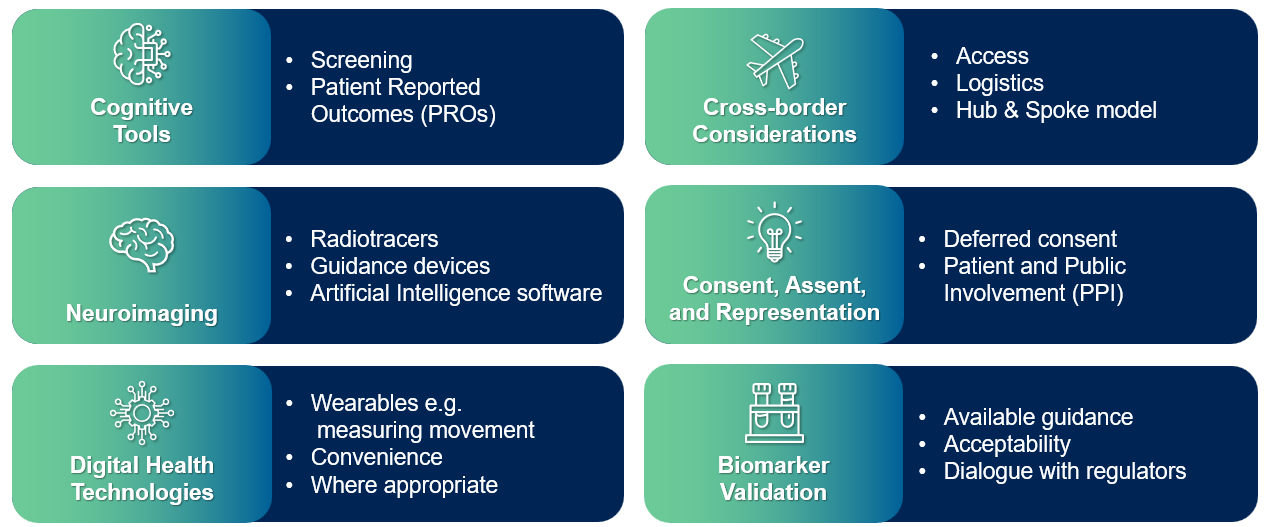
First, as trials target preclinical or early-stage disease populations, Sponsors must establish appropriate screening and clinical assessment methods for people with few or no overt symptoms.
Second, biological markers such as amyloid beta, tau and neurofilament light chain (NfL) are increasingly used for patient selection, trial enrichment and assessing biological responses to treatment. James noted that novel biomarkers require evidence of biological plausibility or clinical benefit. He also pointed to the FDA’s April 2026 guidance on bioanalytical method validation for biomarkers.
Third, studies involving radiotracers, specialized medical devices or AI software may face additional regulatory requirements.
Finally, international trials must navigate regional differences in consent rules, including provisions for legally authorized representatives. James noted that, in the UK, patient and public involvement (PPI) review is required to provide input into informed consent forms ahead of submission.
To expand geographic access, James also discussed hub-and-spoke models, where specialized treatment or procedures occur at a central site while continued care is provided closer to the participant’s home.
Connecting Clinical Outcomes to Patient Priorities
Traditional trial designs rely heavily on clinician-rated scales to track changes in cognition, movement, behavior and daily function. These standardized tools, while essential, do not always reflect what patients and families value most.
A participant’s primary goal might be continuing to drive safely, remaining independent for longer, communicating with family members or sleeping better. Caregivers, on the other hand, may prioritize whether their loved one can dress independently, manage daily routines or remain safely at home.
Dr. León Colombo emphasized that clinical data must be considered alongside these real-world priorities. Referring to FDA discussions around donanemab for early Alzheimer’s disease, she noted how patient associations helped place treatment effects in terms meaningful to patients and families.
“Does it represent additional time living independently?” Dr. León Colombo asked. “Does it mean more time recognizing my family members?”
Standardized scales should be complemented with patient-reported outcomes (PROs) and structured qualitative interviews. However, selecting these tools requires careful thought.
A questionnaire suitable for patients with early-stage disease may become difficult to complete as cognitive or communication impairments progress. In global studies, language differences and how patients interpret the wording and images used in assessments also need to be considered.
Involving Patients Early in Protocol Development
A patient-centered design works best when patients are able to share their feedback before protocols are finalized. Patient advisory boards, focus groups and advocacy partnerships reveal practical friction points while there is still time to make adjustments.
Evaluated on paper, individual procedures might seem manageable. But bundled together, a single study visit can mean more than two hours of travel, fasting, cognitive testing, magnetic resonance imaging (MRI), blood draws and repetitive paperwork.
For someone coping with cognitive decline or severe fatigue, that single day can be exhausting. And for caregivers, it means taking time off work, arranging childcare and managing a long, stressful site visit.
Involving patients and families early allows study teams to simplify schedules, combine procedures or move suitable assessments to home visits. All of this can be achieved while preserving scientific validity and safety.
Caregivers as Partners in Neurodegenerative Research
Caregivers observe subtle daily changes — such as trouble managing medications, navigating familiar streets or following conversations — that brief clinic visits may miss.
As shown in Fig. 2, caregivers fulfill three key roles: observing functional changes in daily life, providing caregiver-reported outcomes and offering insights into evolving care requirements.
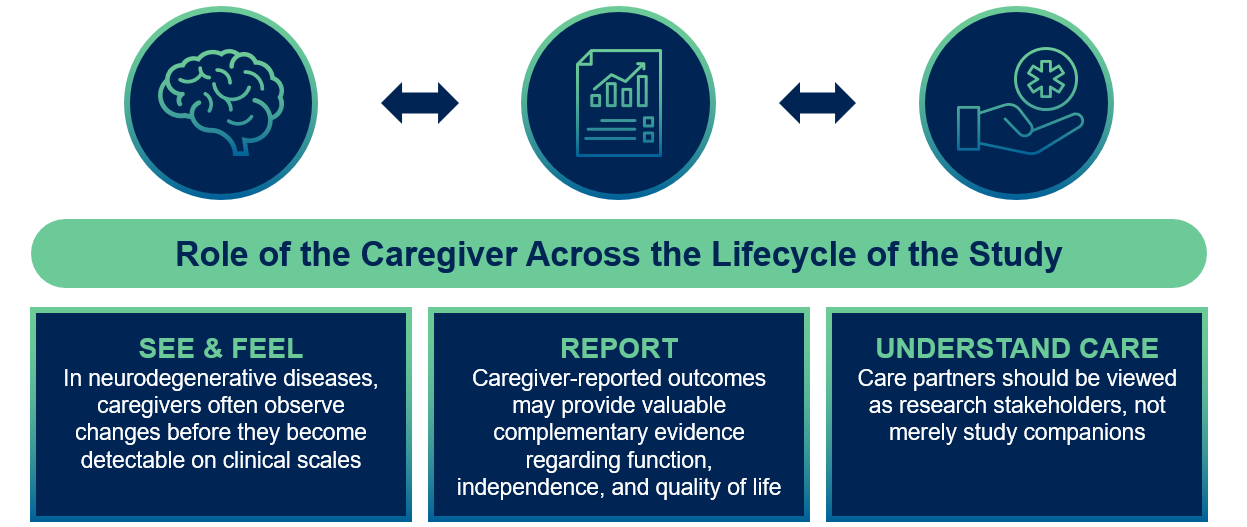
Protocols should treat caregivers as active research partners and not passive companions. Keeping the same study partner throughout a trial, where possible, can support consistent and reliable reporting over time.
Deploying Digital Tech and Hybrid Models Wisely
Digital health tools can bring certain trial activities directly into the participant’s home. Wearables can track activity, gait, mobility and sleep patterns in everyday environments, providing information between clinic visits that may otherwise be missed.
Remote assessments, telemedicine and home health visits can also reduce the need for participants to travel repeatedly to specialized clinical sites.
However, differences in digital literacy, internet access or comfort with devices can shift additional responsibilities onto caregivers. A hybrid trial model, which combines remote activities with targeted site visits, may be more practical for some participants than a fully decentralized approach.
Selecting Protocol-Matched Sites and Safeguarding Data Quality
“A trial rarely fails for one dramatic reason,” Valentina explained. “It fails quietly — a site that enrolls four patients instead of 12, a rater who drifts over 18 months, a caregiver who stops driving in because the visit falls on a workday.”
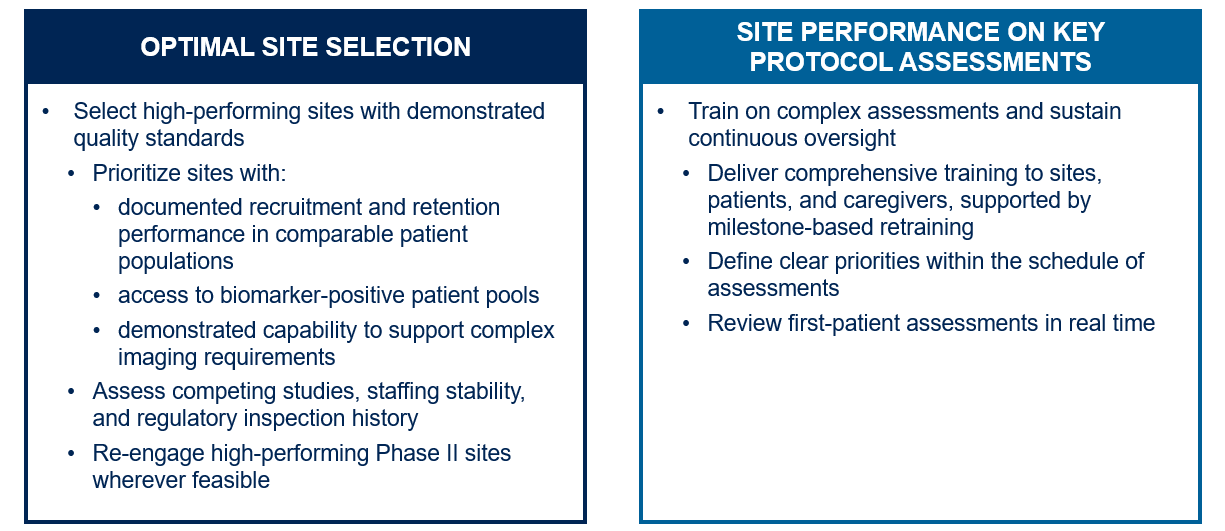
Site selection should match the specific requirements of the study rather than general institutional reputation. A site that performed well in a 12-week symptomatic study may struggle with a two-year disease-modifying trial.
For studies requiring biomarker confirmation, sites with previously characterized patient pools — such as memory clinics with existing positron emission tomography (PET) or cerebrospinal fluid (CSF) data, registries or natural history cohorts — may help identify eligible participants more efficiently. Reliable imaging capacity and staff stability are equally important.
“Losing a coordinator is not an administrative event,” Valentina stressed. “It’s an endpoint risk.”
Maintaining Consistent Clinical Assessments
Scoring inconsistencies in clinician-, patient- and caregiver-reported assessments can affect data quality in neurodegenerative trials.
To maintain consistency, site staff, participants and caregivers should all receive appropriate training. Valentina recommended linking extra training to specific risks, such as a new rater joining the study, scoring drift appearing or a protocol amendment being introduced.
On demanding visit days, participants can become fatigued before all testing is finished. Prioritizing primary cognitive assessments while participants are freshest, keeping the assessment order consistent across visits and placing lower-priority tests later in the day can help protect endpoint quality.
Reviewing the first participant’s assessments promptly also helps catch systematic scoring errors before they affect data across an entire site.
These site-selection and assessment priorities are summarized in Fig. 3.
Electronic diaries (eDiaries) can also address some limitations of paper logs. Valentina noted that paper diaries may be completed retrospectively, sometimes in the clinic car park just ten minutes before an appointment.
Electronic diaries provide time-stamped entries and completion monitoring, making it easier to identify missed assessments and intervene when completion rates decline.
Unifying Recruitment and Retention
Recruitment and retention form a single connected process that begins long before consent and adapts as the disease progresses.
Supporting Informed Decisions
Advocacy organizations can help research teams understand patient journeys, identify practical barriers and design clear study materials. Printed guides, study websites and short videos help explain study goals, expected procedures and available support in plain language.
“The goal is not to persuade someone to participate, of course,” Melanie said. “It’s to help people make an informed decision and understand what participation would involve.”
Transparent communication can help build trust, especially when Sponsors explain how patient and caregiver feedback influenced study planning.
Removing Daily Friction Points
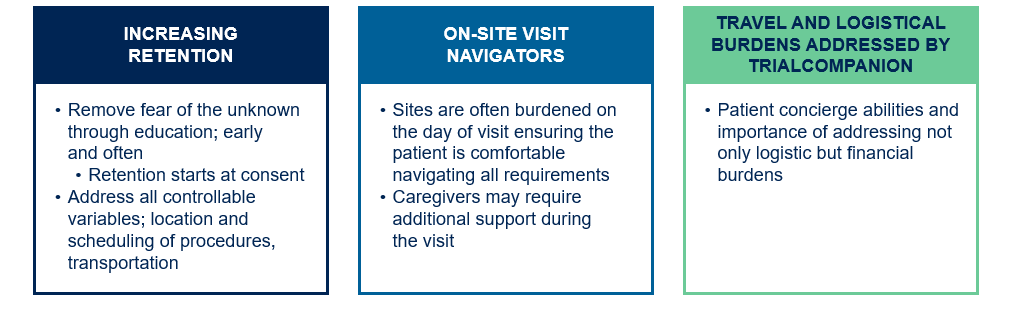
Flexible scheduling helps accommodate changing participant and caregiver needs while keeping required assessments on track. On-site visit navigators can assist families who need to move between different departments during a single visit.
Centralized logistics services, such as Medpace TrialCompanion (formerly Patient Concierge Services), can finance and arrange personalized travel itineraries. Reimbursement for out-of-pocket expenses such as meals and parking, where available, can further reduce financial barriers.
In Fig. 4, we see how early education, on-site support and travel assistance can help make continued trial participation more manageable.
Retention as a Statistical Requirement
In long-term placebo-controlled trials, dropout rates can jeopardize scientific validity. As symptoms advance, participants may struggle to attend visits or complete assessments, or become discouraged if they suspect they are receiving a placebo.
If dropouts occur at different rates across treatment groups, the resulting missing data can reduce statistical power and bias estimates of treatment effect.
As Valentina summarized, “Where you place your sites determines your enrollment curve. How you train your raters determines your measurement precision. How you treat your caregivers determines your retention.”
This article was created in collaboration with the sponsoring organization and the Xtalks editorial team.









Join or login to leave a comment
JOIN LOGIN