
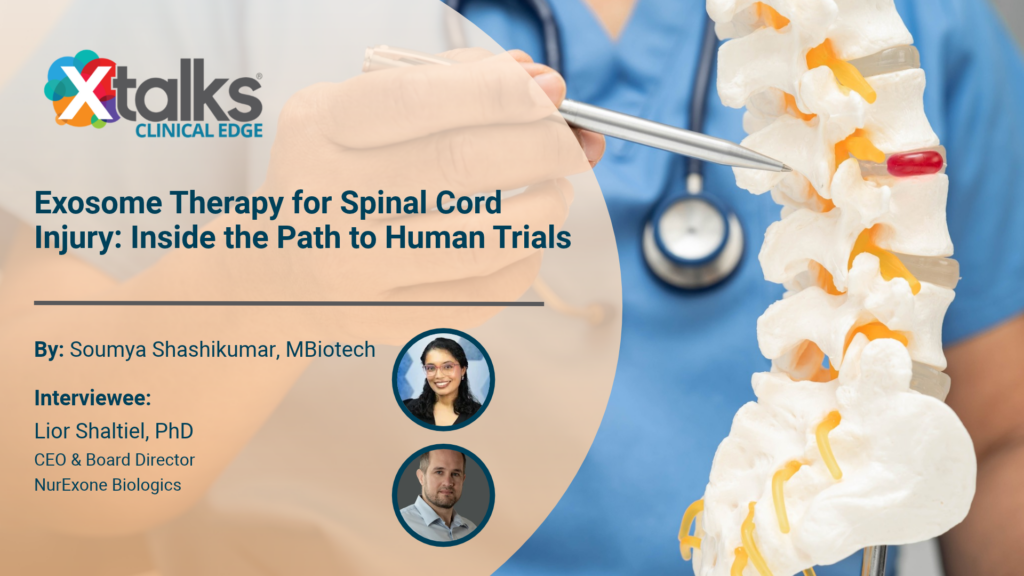
NurExone Biologics CEO Dr. Lior Shaltiel shared what animal studies have revealed about exosome therapy, the challenges of treating spinal cord injuries and what researchers hope to learn from human trials.
A traumatic spinal cord injury can affect a person’s mobility, sensation and basic bodily functions. Damaged nerves in the central nervous system have limited ability to regenerate, and few treatments can restore lost function.
Researchers are now investigating whether exosomes, tiny natural particles that cells use to communicate, could help deliver therapies that encourage injured nerves to regrow. Early animal studies have shown promising results, raising questions about how these findings could translate into human recovery.
“It’s like a post, or it’s like an Amazon package that one cell sent to another that needs some help, needs some aid.”
– Lior Shaltiel
In an exclusive interview with Xtalks Clinical Edge, Lior Shaltiel, PhD, CEO and Board Director of NurExone Biologics, discussed the science behind the company’s experimental exosome therapy, ExoPTEN. He shared insights into the preclinical research, the challenges of treating patients within days of injury and what meaningful recovery could look like in early human trials.

CEO & Board Director
NurExone Biologics
How Exosomes Could Help Damaged Nerves Regrow
Exosomes are tiny, naturally occurring particles released by cells to carry proteins, genetic material and other biological molecules between tissues.
Dr. Shaltiel compared them to “an Amazon package that one cell sent to another that needs some help.” Researchers are exploring how these natural delivery vehicles could transport therapeutic molecules to injured tissue.
ExoPTEN uses exosomes loaded with small interfering RNA (siRNA), a molecule that reduces the production of a protein called PTEN (phosphatase and tensin homolog). PTEN acts as a natural brake on nerve regeneration, and reducing its activity could help damaged nerve fibers regrow and form new connections.
The approach originated from research at the Technion–Israel Institute of Technology and Tel Aviv University, where scientists investigated whether combining exosomes with siRNA could help restore nerve function after spinal cord injury.
What Animal Studies Have Revealed
ExoPTEN has been evaluated in two rat models of spinal cord injury: complete spinal cord transection, where the cord is severed, and spinal cord compression, where pressure damages the nerves.
Treated animals showed improvements in movement in both models, with some severely injured rats regaining the ability to walk. Researchers also observed encouraging results in optic nerve injury models, suggesting possible applications in other parts of the central nervous system.
The team has also refined how the therapy is administered. Early experiments used intranasal delivery through the nose. NurExone subsequently shifted toward intrathecal administration, which involves injecting the therapy into the fluid surrounding the spinal cord.
This approach avoids open spinal surgery, although it still requires an invasive injection procedure. Dr. Shaltiel said the next step is to determine whether the improvements observed in animals can also be demonstrated in patients.

Get industry leading pharma and biotech news, events and expert insights delivered to your inbox.
What Would Meaningful Recovery Look Like?
Bladder and bowel control, sensation and mobility are important measures of recovery after spinal cord injury.
For early clinical testing, Dr. Shaltiel discussed a proposed goal of moving patients from Grade A to Grade B on the American Spinal Injury Association (ASIA) Impairment Scale (AIS). Grade A indicates no preserved sensory or motor function in the lowest sacral segments of the spinal cord, while Grade B indicates some preserved sensation without qualifying motor function.
He also emphasized the value of recovering bladder and bowel function, which must be assessed separately from AIS grading. The former can reduce catheter dependence, therefore making everyday life easier for patients.
Animal studies revealed a curious behavioral observation. Some rats with spinal cord injuries bite or injure their own hind limbs, a behavior known as autotomy. Treated rats on the other hand showed less of this behavior.
“It’s clear that I want to treat it as soon as possible, but practically trying to get a consent to get the patient in the right environment to get the treatment is very challenging.”
– Lior Shaltiel
Whether this reflected reduced pain or changes in sensation is unclear. “We don’t know because we cannot ask them,” he explained. In human trials, researchers could investigate whether ExoPTEN also helps alleviate pain associated with spinal cord injury.
Why the First 72 Hours Could Be Important
According to Dr. Shaltiel, the treatment window following an acute spinal cord injury is about two weeks. Enrolling patients during this period can be difficult, especially when treatment is required within the first 24 hours.
“It’s clear that I want to treat it as soon as possible, but practically trying to get a consent to get the patient in the right environment to get the treatment is very challenging,” explained Dr. Shaltiel.
His goal is to demonstrate whether ExoPTEN could still be effective when administered approximately 72 hours after injury. This could give clinical teams more time to enroll patients and arrange treatment, although the effectiveness of this timing has yet to be established in humans.
Major clinical centers that combine neurosurgical expertise with rehabilitation services key to this process as they allow researchers to coordinate treatment and track patients’ recovery.
The Manufacturing Challenge: Keeping Exosome Batches Consistent
Manufacturing exosome therapies requires strict control over batch consistency. Exosomes come from living cells, and therefore, their biological characteristics can vary depending on the source.
“Each time that you change the donors, some things change in the exosome because it’s biology,” Dr. Shaltiel explained.
Developers must carefully characterize the cell source, measure how much siRNA is loaded into the exosomes and establish consistent product quality. They must also determine how the therapy should be stored, transported and maintained at suitable temperatures.
ExoPTEN is being developed as a donor-derived therapy that could be manufactured in batches for multiple patients. This could help simplify manufacturing and reduce costs.
“We are trying to get a solution which is minimally invasive and much more universal.”
– Lior Shaltiel
The Next Steps Toward Human Trials
ExoPTEN has received Orphan Drug designation for acute spinal cord injury in the US and Europe. NurExone has also completed a pre-investigational new drug (pre-IND) meeting with the FDA.
NurExone hopes to submit an investigational new drug (IND) application in the first half of 2027, although some preclinical and manufacturing work is still underway. The first human trials would assess safety and look for signs that ExoPTEN can help patients regain function after an acute spinal cord injury.
Dr. Shaltiel hopes that positive clinical findings could eventually support research into treatments for people living with chronic injuries.
“We are trying to get a solution which is minimally invasive and much more universal,” concluded Dr. Shaltiel.











Join or login to leave a comment
JOIN LOGIN