
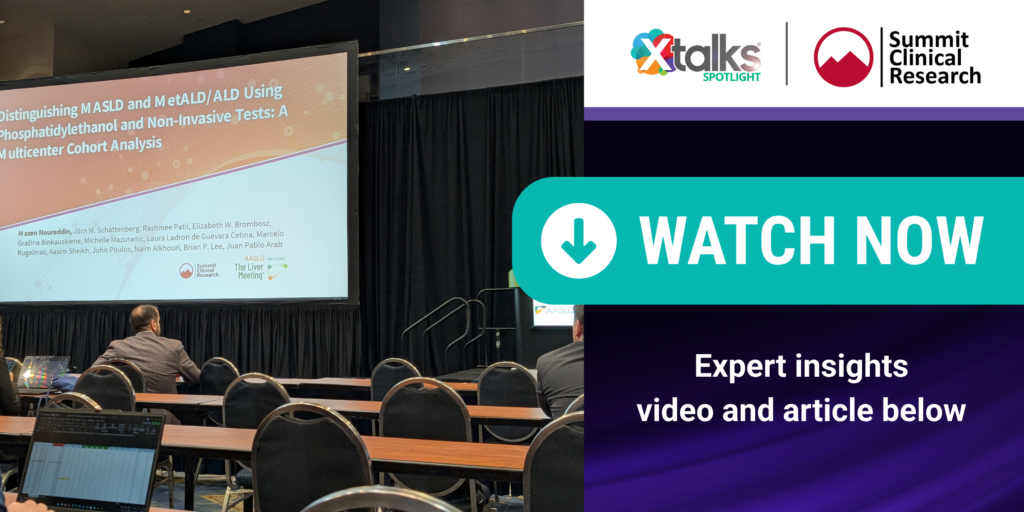
Advances in the understanding of metabolic dysfunction-associated steatohepatitis (MASH) are rapidly transforming both clinical care and scientific research.
Once heavily dependent on liver biopsy, the field is now moving toward noninvasive diagnostics, imaging-based tools and biomarkers that can help clinicians identify, stratify and monitor patients more efficiently. These advances are also changing how clinical trials are designed and conducted, particularly as the therapeutic landscape for MASH continues to evolve.
Co-Chairman of the Board Summit and
Pinnacle Clinical Research
Summit Clinical Research
In this Xtalks Spotlight, Dr. Mazen Noureddin, Co-Chairman of the Board Summit and Pinnacle Clinical Research at Summit Clinical Research, discusses how developments in diagnostics, biomarkers and disease monitoring are reshaping MASH research.
Dr. Noureddin is an internationally recognized hepatologist and clinical researcher with extensive expertise in steatotic liver disease, biomarkers and clinical trial development aimed at advancing treatment for MASH.
He shares insights into how noninvasive tools are improving patient care, how clinical trials are beginning to move beyond biopsy-based models and what questions remain as researchers work to bring more effective therapies to patients with steatotic liver disease.
Noninvasive Diagnostics Are Changing MASH Care
For many years, liver biopsy was one of the few available options for assessing patients with suspected MASH. While biopsy can provide important histological information, it is invasive and often difficult for patients to accept.
Dr. Noureddin said that as recently as 2012, liver biopsy was still one of the only options available to many patients. However, the procedure often created a barrier to follow-up.
“Patients did not like it,” he explained. “And indeed, when they would come to the doctor, they would be recommended to have a liver biopsy, and they would not come back.”
The emergence of noninvasive testing has changed that dynamic. Imaging-based approaches, including MRI techniques and ultrasound techniques, now allow clinicians to better understand the severity of a patient’s fatty liver disease without requiring a biopsy.
According to Dr. Noureddin, these tools have been “game-changing” for patients and clinicians.
With recent drug approvals in MASH, noninvasive diagnostics are playing an even more important role. Clinicians can now diagnose and monitor patients using these tests, rather than relying exclusively on biopsy.
“So with noninvasive testing, such as MRI techniques or ultrasound techniques, patients can come in and we know how severe their fatty liver disease is using these noninvasive tests,” said Dr. Noureddin. “And with the recent drug approvals in the last couple of years, we diagnose them based on those tests without a biopsy, and we monitor them using those tests.”
For patients, this represents a major shift toward less invasive, more accessible care. For clinicians and researchers, it also provides new opportunities to monitor disease progression and treatment response in ways that are more practical for routine care and clinical research.
How Diagnostics Are Reshaping MASH Clinical Trials
Noninvasive diagnostics are not only changing clinical practice but also influencing the design and execution of clinical trials in steatotic liver disease.
Dr. Noureddin explained that these tools were first used primarily in proof-of-concept studies, in which researchers used MRI-based approaches to assess changes in liver fat over the course of a study.
Over time, clinical development programs continued to rely heavily on liver biopsy, particularly for regulatory approval. Biopsy remained central to demonstrating histological improvement and supporting therapeutic approvals.
More recently, however, the field has begun to see another shift: Phase III trials that do not require biopsy. This represents a significant operational change for MASH clinical research and could help reduce barriers to participation.
Reducing reliance on biopsy may make trials more appealing to patients and easier for sites to conduct. However, Dr. Noureddin emphasized that there is still room to improve enrollment and execution, especially as the MASH trial environment becomes more competitive and complex.
Key Scientific Questions in the Evolving MASH Treatment Space
The MASH treatment space has changed significantly in recent years. According to Dr. Noureddin, there are now two approved drugs, with many more therapies in the pipeline.
This progress is raising several important scientific and clinical questions.
“The number one question in this patient population, usually for patients with pre-cirrhotic disease, is, can we improve on that?” Dr. Noureddin said. Researchers are continuing to explore how to generate stronger liver-related benefits and better metabolic outcomes in this population.
Another major question is whether approved and emerging medications can be combined to increase efficacy. Combination approaches may be especially important in a disease like MASH, where liver injury, fibrosis, metabolic dysfunction and cardiometabolic risk often intersect.
“Can we add these medications to each other and thus increase efficacy and benefit on the liver and metabolically?” he said.
A third major area of focus is the cirrhotic population. Dr. Noureddin pointed to a recent trial showing improvement in fibrosis scarring among patients with cirrhosis, raising the question of whether therapies could eventually be approved for patients with cirrhosis and fatty liver disease.
These questions reflect how quickly the field is advancing. As therapies become available and new candidates move through development, researchers are increasingly focused not only on whether MASH can be treated, but how treatment can be optimized for different patient populations.
Challenges in Translating Scientific Progress into Therapies
Despite recent progress, several challenges remain in translating promising discoveries into effective therapies for patients with steatotic liver disease.
One important distinction is the difference between alcohol-associated and non-alcoholic forms of steatotic liver disease. Dr. Noureddin noted that while there has been progress in the non-alcoholic patient population, there remains a need for therapies for patients with alcohol-associated steatotic liver disease.
“The non-alcoholic patient population, we have had a drug approved. The patients with alcohol-associated steatotic liver disease, we’re still looking for therapies,” he said.
Another major challenge is improving the speed and efficiency of clinical trials, particularly without relying on liver biopsy. Although noninvasive tools are gaining traction, the field is still working through how best to validate and apply them across different stages of development.
“How can we do the trials faster and more efficiently without relying on a liver biopsy?” Dr. Noureddin mentioned.
The growing use of glucagon-like peptide-1 (GLP-1) therapies is also affecting the clinical trial space. Dr. Noureddin explained that many patients are now taking GLP-1 therapies, including compounded versions, making recruitment and retention more difficult in MASH studies.
For clinical research networks, these pressures require ongoing adaptation. Dr. Noureddin said networks like Summit Clinical Research are studying these challenges every day and continuing to improve their approaches to support clinical trial advancement in the field.
The Role of Experienced Sites and Patient Participation
Looking ahead, Dr. Noureddin said that experienced clinical trial sites will be essential for ensuring that progress in MASH clinical research translates into meaningful improvements in patient outcomes.
“I think more good sites are needed that are experienced,” he said.
These sites need access to the right patient populations, strong operational capabilities and the expertise required to support increasingly complex MASH studies. As trials evolve, site experience may be especially important for patient identification, retention, noninvasive testing workflows and protocol execution.
Patient participation is also critical. Dr. Noureddin emphasized the importance of patient support and involvement in clinical trials, while also ensuring that patients’ health and benefit remain central.
For Summit Clinical Research, this means continuing to expand its network, support well-designed trials and help bring promising treatments to patients. Dr. Noureddin said the ultimate goal is to advance therapies that offer greater efficacy with fewer side effects.
What Comes Next for MASH Clinical Research
For Dr. Noureddin, the most important takeaway is that the future of MASH clinical research is promising.
“I think the future is bright,” he said. “I’ve been doing this for a while. We did not have treatments for our patients before. Within the last two years, we got two.”
With approved therapies now available, more candidates advancing through the pipeline and new research focused on difficult-to-treat patient populations, the field is entering a new phase.
The challenge now is to ensure that scientific progress is translated into practical, patient-centered advances across the full spectrum of steatotic liver disease.
As noninvasive diagnostics become more established, clinical trials become more efficient and new therapeutic strategies emerge, MASH clinical research is moving toward a future where patients may have more accessible diagnostics, more treatment options and better long-term outcomes.
This article was created in collaboration with the sponsoring company and the Xtalks Editorial team.



Join or login to leave a comment
JOIN LOGIN