
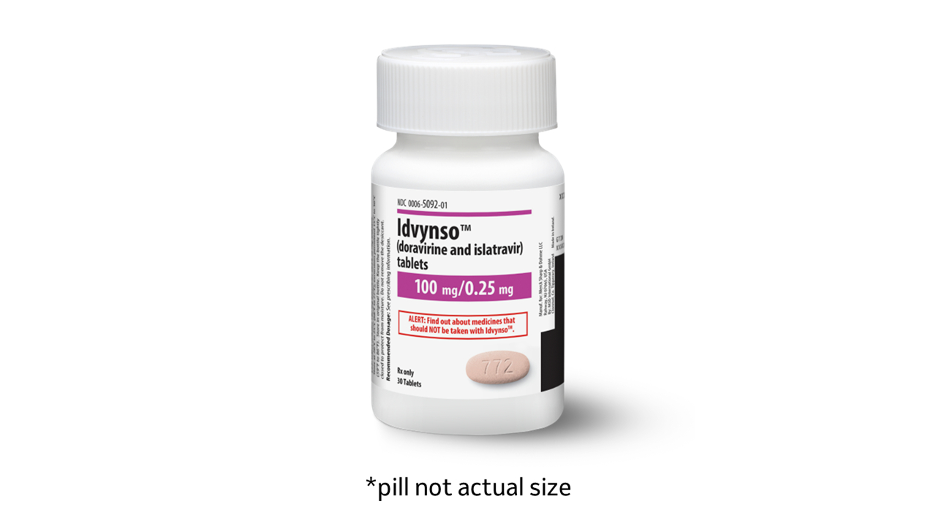
The FDA has approved Merck’s Idvynso (doravirine/islatravir), a once-daily single-tablet regimen for adults with HIV-1 who are already virologically suppressed and switching from a stable antiretroviral regimen.
Here, switching means moving from one stable HIV treatment to another while keeping the virus suppressed. Under guidance, people may switch treatment for several reasons, including side effects, pill burden, drug interactions or other changing care needs.
The approval applies to adults with HIV-1 RNA below 50 copies/mL, no history of virologic treatment failure and no known substitutions associated with resistance to doravirine.
Merck said the drug will be available in US pharmacies after May 11.
The approval adds a new oral switch option for adults whose HIV is already under control. Merck said Idvynso is the first and only non-integrase strand transfer inhibitor (INSTI), tenofovir-free, once-daily complete two-drug regimen to show non-inferior efficacy in a head-to-head Phase III trial against Biktarvy, a standard three-drug regimen.

Get industry leading pharma and biotech news, events and expert insights delivered to your inbox.
HIV is often managed long term, so additional switch options may matter for patients balancing treatment with other medications and broader health needs. HIV-1 is the most common form of the virus that causes HIV infection.
Idvynso is a fixed-dose combination of doravirine and islatravir. Doravirine is a non-nucleoside reverse transcriptase inhibitor, while islatravir is a next-generation nucleoside analog reverse transcriptase inhibitor. Both work by blocking HIV from making copies of itself.
The approval was supported by Week 48 results from two randomized, active-controlled, non-inferiority Phase III trials in virologically suppressed adults living with HIV. Across the two studies, 708 participants received once-daily Idvynso. Participants had to be stably suppressed on their baseline regimen for at least three months and have no history of treatment failure.
In Trial 052, a double-blind study, 513 participants were randomized 2:1 to switch from Gilead’s Biktarvy (bictegravir/emtricitabine/tenofovir alafenamide) to Idvynso or remain on Biktarvy. The primary endpoint measured the proportion of participants whose HIV-1 RNA reached at least 50 copies/mL at Week 48, a standard marker of whether viral suppression was maintained.
Results showed that 1% of participants in the Idvynso group and 1% in the comparator group met that threshold. A secondary endpoint showed that 92% of participants who switched to Idvynso maintained viral suppression below 50 copies/mL, compared with 94% of those who stayed on Biktarvy.
In Trial 051, an open-label study, 551 participants were randomized 2:1 to switch from an oral antiretroviral regimen to Idvynso or remain on baseline treatment. At Week 48, 1% of participants who switched to Idvynso had HIV-1 RNA of at least 50 copies/mL, compared with 5% of those who stayed on baseline therapy.
For the secondary endpoint, 96% of those who switched to Idvynso maintained viral suppression, versus 92% of those who remained on baseline treatment.
Merck said outcomes were similar across subgroups by age, sex and race, and in Trial 051 also across baseline regimen categories. Older adults were included in the studies, and Merck said no overall differences in safety or effectiveness were observed between older and younger participants.

Idvynso is a new switch option for adults with virologically suppressed HIV who may need an alternative to existing oral regimens. Earlier this year, the company also reported Phase III data at CROI 2026 showing that doravirine/islatravir was non-inferior, with a similar safety profile at Week 48, to bictegravir/emtricitabine/tenofovir alafenamide in treatment-naive adults with HIV-1.
Elsewhere in the HIV-1 treatment space, ViiV Healthcare presented early pipeline data on two investigational long-acting therapies with potential for twice-yearly dosing. These included VH184, a third-generation integrase strand transfer inhibitor designed to block HIV integrase, and VH499, a capsid inhibitor that targets the virus’s capsid protein. Both are in Phase I development.
Gilead, meanwhile, has reported Phase III data for an investigational once-daily single-tablet regimen combining bictegravir, an integrase strand transfer inhibitor, with lenacapavir, a capsid inhibitor, in virologically suppressed adults switching therapy.
FAQs
What does “virologically suppressed” mean in HIV treatment?
It means the amount of HIV in the blood is very low, typically below the level used to define treatment success. In Merck’s Idvynso approval, virologic suppression was defined as HIV-1 RNA below 50 copies/mL.
What is a two-drug regimen in HIV care?
It is a treatment approach that uses two active antiretroviral medicines instead of three. In some patients, this can still maintain viral suppression while offering another oral treatment option.
If you want your company to be featured on Xtalks.com, please email [email protected].















Join or login to leave a comment
JOIN LOGIN