
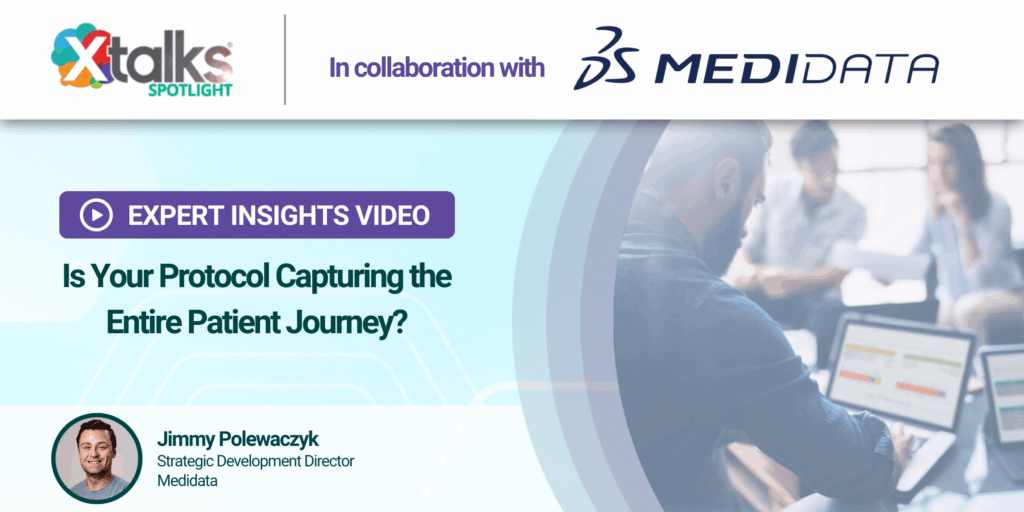
Clinical trials provide the foundation for evaluating new therapies, but are they capturing the full scope of a patient’s experience?

Strategic Development Director
Medidata
While randomized controlled trials deliver essential safety and efficacy data, they’re limited to a defined period and often miss what happens before enrollment or after the study concludes. This leaves important gaps around treatment durability, disease progression and how therapies perform in the real world.
In this Xtalks Spotlight, Jimmy Polewaczyk, Strategic Development Director at Medidata, discusses how sponsors can extend the view beyond the trial protocol by connecting clinical trial data with real-world data (RWD) at the patient level.
This integrated approach supports more robust safety tracking, enhances regulatory and payer engagement, and unlocks insights that reduce operational burden and elevate trial impact — all while protecting patient privacy.
Reconstructing the Full Patient Journey
While clinical trials are structured for precision, their narrow focus on specific criteria and endpoints means they often reflect just a fraction of the patient’s full healthcare journey.
“They really only represent a snapshot of a limited timeframe during a trial participant’s life,” said Polewaczyk. “And because trials are defined by highly specific protocols, stringent eligibility criteria and predefined endpoints, that snapshot is taken under rigid and controlled conditions.”
However, valuable insights can be gained by looking beyond the protocol. Patient experiences before and after a trial — from historical diagnoses to long-term outcomes and treatment durability — are often documented in RWD sources such as electronic health records (EHRs), pharmacy claims and even wearable technologies. These datasets, though powerful, are frequently fragmented and challenging to integrate.
“But when linked together, these data types can provide really valuable insight into the patient’s longitudinal healthcare journey, so before, during and after their participation in the clinical trial,” Polewaczyk explained.
This growing challenge has prompted sponsors to seek scalable, privacy-preserving ways to connect participant-level clinical data with real-world sources. As record linkage becomes more common, particularly since the COVID-19 pandemic, organizations are increasingly embracing these approaches to enrich traditional trial designs with broader, more meaningful insights.
Insights That Go Beyond the Protocol
Linking clinical trial data with RWD offers sponsors a richer understanding of the patient journey — before, during and after the trial.
“It really comes down to that comprehensive longitudinal view of the participant’s total healthcare journey,” said Polewaczyk.
By accessing pre-trial data, researchers can identify comorbidities or historical diagnoses that weren’t initially captured by eligibility criteria, potentially explaining differences in outcomes across patient subgroups.
During the trial, linked claims data may surface critical events like hospitalizations that influence endpoints but fall outside the scope of standard trial reporting.
And post-trial, these connections can reveal treatment switches, disease progression and long-term effectiveness signals that would otherwise be missed.
To explore the real-world applications of these approaches, Medidata researchers and other experts conducted a recent scoping review titled Linkage of Clinical Trial Data to Routinely Collected Data Sources. Published in JAMA Network, the study analyzed over 70 trials that leveraged clinical-to-RWD linkage across a variety of use cases.
Polewaczyk pointed to three key use cases that are resonating with sponsors:
- Long-term safety and effectiveness: Following participants after the trial ends is often costly and resource intensive. Linked data allows sponsors to passively track outcomes without additional site visits, easing the burden while expanding insight.
- Healthcare resource utilization: Trials rarely capture cost and utilization data needed for payer discussions. With linked datasets, researchers can immediately explore inpatient and outpatient activity, prescribing trends and economic burden across the full care continuum.
- Support for label expansion: Linked datasets allow researchers to explore outcomes beyond those originally defined in the trial protocol. By passively capturing real-world treatment patterns and responses, these insights can reveal additional clinical benefits or subgroup effects that might otherwise go unnoticed, providing valuable evidence to support new indications or expanded labeling.
These capabilities strengthen evidence generation and enable sponsors to make faster, data-driven decisions on lifecycle planning, market access and real-world performance, without waiting years for post-commercialization data.
Solving Follow-Up Challenges with RWD Continuity
Loss to follow-up is a persistent and costly challenge in clinical research. When participants disengage before a trial concludes, it can introduce data gaps, increase the risk of bias and potentially compromise the statistical power of the study. In some cases, it may even force sponsors to extend recruitment timelines or enrollment targets to compensate.
Polewaczyk explains that linking clinical trial data with RWD offers a valuable solution. By passively monitoring consenting participants through RWD sources, such as claims or EHRs, researchers can continue to track key clinical endpoints like overall survival, progression-free survival and treatment changes, even if the individual no longer attends study visits.
Beyond maintaining visibility into outcomes, this passive monitoring can also help uncover why a participant dropped out in the first place — offering useful feedback for optimizing study design or informing regulatory discussions. Critically, it allows this information to be gathered without requiring the participant to return to a physical site.
“All of this can be done through the monitoring of that real-world data that’s generated as that participant moves through their routine care system, all without having them come back in for follow-up appointments,” said Polewaczyk.
This approach not only preserves data integrity but also reduces operational burden on both sites and patients, supporting a more flexible and sustainable model for longitudinal evidence generation.
A Flexible, Scalable Approach to Data Linkage
Scalability remains a key challenge in linking RWD with clinical trial data. Traditional methods often involve custom workflows, fragmented systems and added operational burden, making it hard for sponsors to expand linkage across multiple studies.
To address this, Medidata built flexibility into the core design of its platform. It was developed to support diverse study designs, therapeutic areas and site environments, all while integrating seamlessly into existing clinical workflows.
Sponsors can manage core linkage tasks, such as informed consent and personally identifiable information (PII) capture, within the familiar eCRF systems used by site staff. This integration, which includes single sign-on and a user-friendly interface, minimizes disruption and reduces the need for additional training.
“That really minimizes the impact of using Link on the trial itself and really helps the data entry process feel like business as usual,” explained Polewaczyk.
The platform supports both tokenized linkage (using encrypted, non-reversible tokens to protect privacy) and identified linkage (where participants consent to share PII with a covered entity to access datasets like Medicare). Medidata’s partnerships with leading token vendors also expand sponsor access to a broad range of RWD sources without locking them into a single solution.
This infrastructure combines flexibility with seamless integration, allowing sponsors to scale data linkage efficiently across individual studies or entire portfolios. It also maximizes access to high-quality RWD.
What’s Next: Trial Linkage as the Future of Clinical Research
As clinical research grows more complex, data linkage is becoming central to how evidence is generated and applied. By connecting trial data with routinely collected healthcare data, sponsors gain a more complete view of treatment safety, effectiveness and patient outcomes across real-world settings.
Sponsors, regulators and payers increasingly recognize the value of incorporating data beyond the protocol to better evaluate therapeutic impact.
“The regulatory landscape in terms of how real-world evidence can be leveraged is rapidly evolving,” said Polewaczyk. “So I’d expect the number of trials that are leveraging these types of linked analysis to grow exponentially over the next few years.”
Ease of use will drive adoption. As platforms mature, linkage can be embedded into trials without redesigning protocols or disrupting workflows. “Platforms like Link can help sponsors manage this data easier and basically make it feel like business as usual… so they’re not uprooting what they’re already doing.”
Globally, implementation is more complex. Outside the US, varying privacy laws affect consent, data retention and permissible analyses. Still, countries with centralized healthcare systems provide a strong basis for identified linkage through rich national datasets.
As regulatory and technical frameworks change, trial linkage is quickly shifting from an emerging capability to a research standard.
As Polewaczyk noted, “The sky’s the limit with trial linkage, and I believe it’ll become more integrated into routine clinical research just as time goes on.”
This article was created in collaboration with the sponsoring company and the Xtalks Editorial team.




Join or login to leave a comment
JOIN LOGIN