
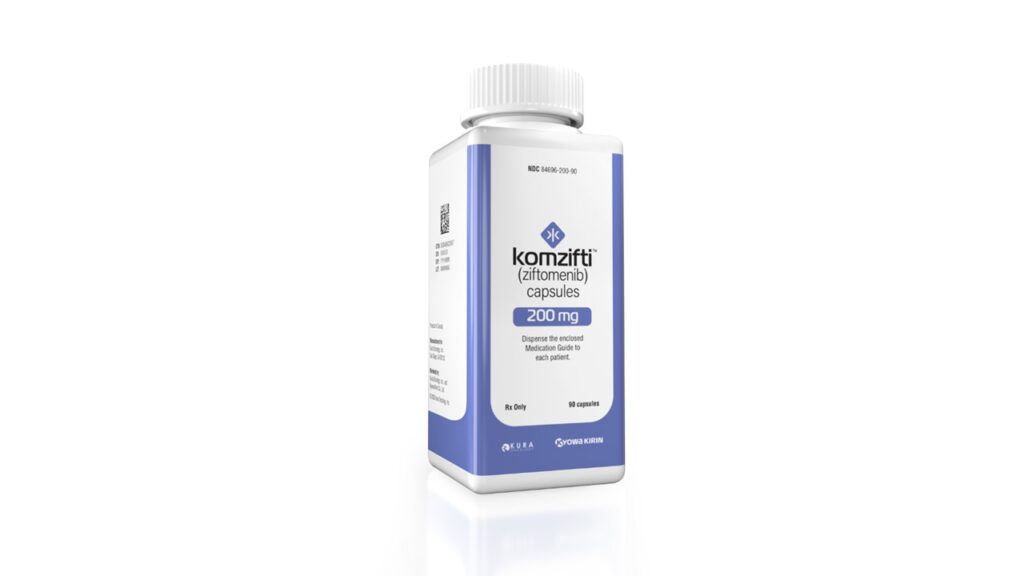
The FDA has approved Kura Oncology and Kyowa Kirin’s Komzifti (ziftomenib) for the treatment of adults with relapsed or refractory acute myeloid leukemia (AML) harboring a susceptible nucleophosmin 1 (NPM1) mutation who have no satisfactory alternative treatment options.
The FDA nod marks the second approval of a menin inhibitor in the NPM1-mutated AML setting this year. In October, Syndax Pharmaceuticals’s Revuforj (revumenib) received a milestone FDA approval as the first menin inhibitor for this indication.

Revuforj had previously received FDA approval in November 2024 for a genetically defined form of leukemia involving lysine methyltransferase 2A (KMT2A) alterations.
Komzifti and Revuforj, both oral menin inhibitors, will thus go head-to-head in this indication.
The NPM1 mutation is among the most common genetic aberrations in adult AML, found in approximately 25% to 30% of newly diagnosed cases.
Patients with NPM1-mutated AML typically respond well to frontline therapy, particularly intensive chemotherapy, but relapse remains a major challenge, especially once the disease becomes relapsed or refractory.
According to Kyowa Kirin and Kura Oncology’s joint press release announcing the approval, about 20% of patients with NPM1-mutated AML fail to respond to frontline therapy, and among those who initially respond, roughly 70% will relapse within three years.
Until this year, there had been no therapy approved specifically for relapsed/refractory (R/R) AML defined by an NPM1 mutation, representing a significant unmet clinical need.
XTALKS WEBINAR: FIH Clinical Trial Planning for Radiopharmaceuticals: From IND to Patient Dosing
Live and On-Demand: Wednesday, December 10, 2025, at 1pm EST (10am PST)
Register for this free webinar to gain guidance and real-world examples designed to help radiopharmaceutical therapy (RLT) developers avoid common pitfalls, accelerate timelines and build a strong foundation for success.

“The approval of Komzifti underscores our commitment to advancing precision medicines to address the genetic drivers of disease in hematology and oncology,” said Takeyoshi Yamashita, PhD, executive vice president and chief medical officer of Kyowa Kirin, in the joint press release.
“In AML, where many patients face severe disease progression and limited treatment options, the evolution toward targeted therapies such as Komzifti represents a major step forward and offers potential to transform existing standards of care. We are proud to partner with Kura Oncology in bringing this important therapy to patients and their families.”
Ziftomenib is an oral, once-daily inhibitor of menin (encoded by MEN1), disrupting the interaction between menin and mixed-lineage leukaemia (MLL/KMT2A) fusion proteins or aberrant HOX gene expression programs.
Menin is a scaffold protein that regulates gene transcription, cell signaling and is involved in many cellular processes like cell cycle control, DNA repair and cell differentiation.
The menin complex has been increasingly recognized as a critical driver in AML with NPM1 mutations (and KMT2A rearrangements) by maintaining leukemogenic transcriptional programs. By targeting this dependency, ziftomenib aims to induce leukemic cell differentiation or death, addressing the disease at the molecular level.
Ziftomenib’s approval was based on results from the pivotal KOMET-001 trial that included 112 adults with R/R AML with NPM1 mutation.
The primary endpoint was complete remission (CR) plus CR with partial hematologic recovery (CRh). The CR+CRh rate was 21.4% in patients treated with ziftomenib and the duration of CR+CRh was a median of ~5.0 months.
Among patients who achieved CR or CRh, 88% reached remission within six months of initiating treatment with ziftomenib.
And among 66 patients with baseline transfusion dependence, 14 (21.2%) became red blood cell (RBC)/platelet-transfusion independent during a 56-day post-baseline period.
“Komzifti combines compelling efficacy, a favorable safety profile, compatibility with concomitant medications and convenient once-daily oral administration in a population with few effective treatment options,” Troy Wilson, PhD, CEO of Kura. “These features highlight Komzifti’s potential to serve as the menin inhibitor of choice in its approved indication.”
Komzifti includes a boxed warning for differentiation syndrome, which Kyowa Kirin and Kura Oncology say is a well-studied mechanism-based risk in drugs that restore differentiation.
The label also includes warnings about QTc interval prolongation and embryo-fetal toxicity.
Syndax’s Revuforj carries similar cautions, with boxed warnings that highlight the risks of differentiation syndrome, QTc prolongation and torsades de pointes, a potentially life-threatening rapid heart rhythm.
According to analysts and Mizuho Securities (reported by Fierce Pharma), the safety profile of Kura and Kyowa’s drug “overall looks a bit better” than that for Revuforj, reiterating that a differentiation syndrome boxed warning for the menin inhibitor class is no “real surprise.”
Japan-based Kyowa Kirin and US biopharma company Kura Oncology struck a strategic collaboration in November 2024 to develop and commercialize Komzifti. Kyowa paid Kura $330 million upfront to share development and commercialization costs, and committed up to $1.1 billion in potential milestones.
According to the partners, under the terms of the agreement, Kura leads development, regulatory and commercial strategy in the US and will also take on manufacturing of the therapy. The duo said “the companies will jointly perform certain commercialization activities in accordance with a co-created US territory commercialization plan.”
Outside the US, Kyowa Kirin oversees Komzifti’s development, regulatory strategy and commercial efforts.













Join or login to leave a comment
JOIN LOGIN