
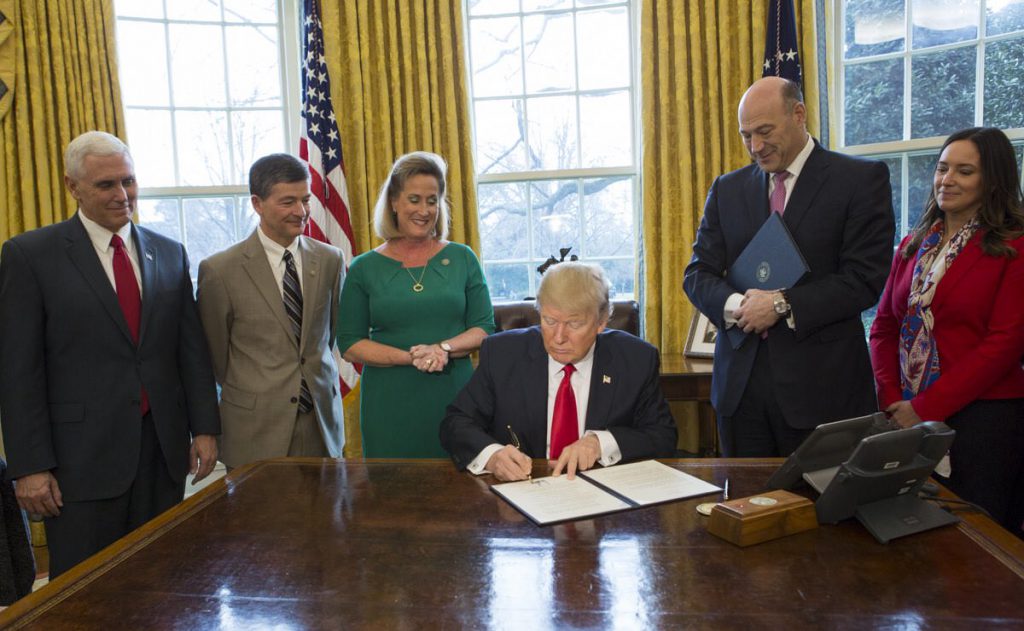
Over two months after US President Donald Trump announced his plans to declare the opioid crisis a national emergency, he signed the directive on Thursday. While President Trump has not yet provided additional funding towards initiatives designed to curb the epidemic, his declaration does include provisions to allow for the prescription of certain medications through telemedicine to help reach those affected by opioids living in rural areas.
“Effective today, my administration is officially declaring the opioid crisis a national public health emergency under federal law, and why I am directing all executive agencies to use every appropriate emergency authority to fight the opioid crisis,” said President Trump in his remarks on the opioid crisis. “This marks a critical step in confronting the extraordinary challenge that we face.”
According to the US Department of Health and Human Services (HHS), the public health emergency fund which will be used to finance the fight against the opioid crisis is currently worth just $57,000. It unclear whether President Trump will ask for additional funds, however the declaration will allow government agencies to rethink how they’re currently dividing their resources.
“The federal government is aggressively fighting the opioid epidemic on all fronts,” said President Trump. “We’re working with doctors and medical professionals to implement best practices for safe opioid prescribing, and we will do something very, very special. We are requiring federally employed prescribers to receive, finally, special training.”
President Trump also announced plans to overcome a rule that currently prevents psychiatric faculties with more than 16 beds from being reimbursed by Medicaid. This could remove an important barrier to addressing opioid abuse and help states expand treatment centers for addiction and mental health.
He also proposed that more emphasis be placed on educating the public – and specifically, young people – about the dangers of drug abuse to prevent individuals from becoming addicted in the first place. “If we can teach young people – and people, generally – not to start, it’s really, really easy not to take them,” he said.
While drug education has been a tool used for prevention in the past, critics say that it ignores the fact that many individuals are becoming dependant on opioids after filling a completely legitimate prescription for the medication from their physician. President Trump himself quoted the statistic that while 1 million Americans used heroin in 2015, 11 million abused prescription opioids.
“We want the next generation of young Americans to know the blessings of a drug-free life,” said President Trump. “We have a total responsibility to ourselves, to our family, to our country, including those who are struggling with this addiction.”














Join or login to leave a comment
JOIN LOGIN