

From GSK’s hepatitis B functional cure data to the first FDA-approved hepatitis D treatment, 2026 is bringing new clinical and regulatory momentum in viral hepatitis.
Every July 28, the world observes World Hepatitis Day. This day raises awareness about viral hepatitis, a group of infections that cause liver inflammation and can lead to serious liver disease or liver cancer.
For 2026, the WHO’s theme is “Hepatitis: Let’s break it down.” The campaign focuses on removing the barriers that block people from getting prevention, testing, treatment and care.
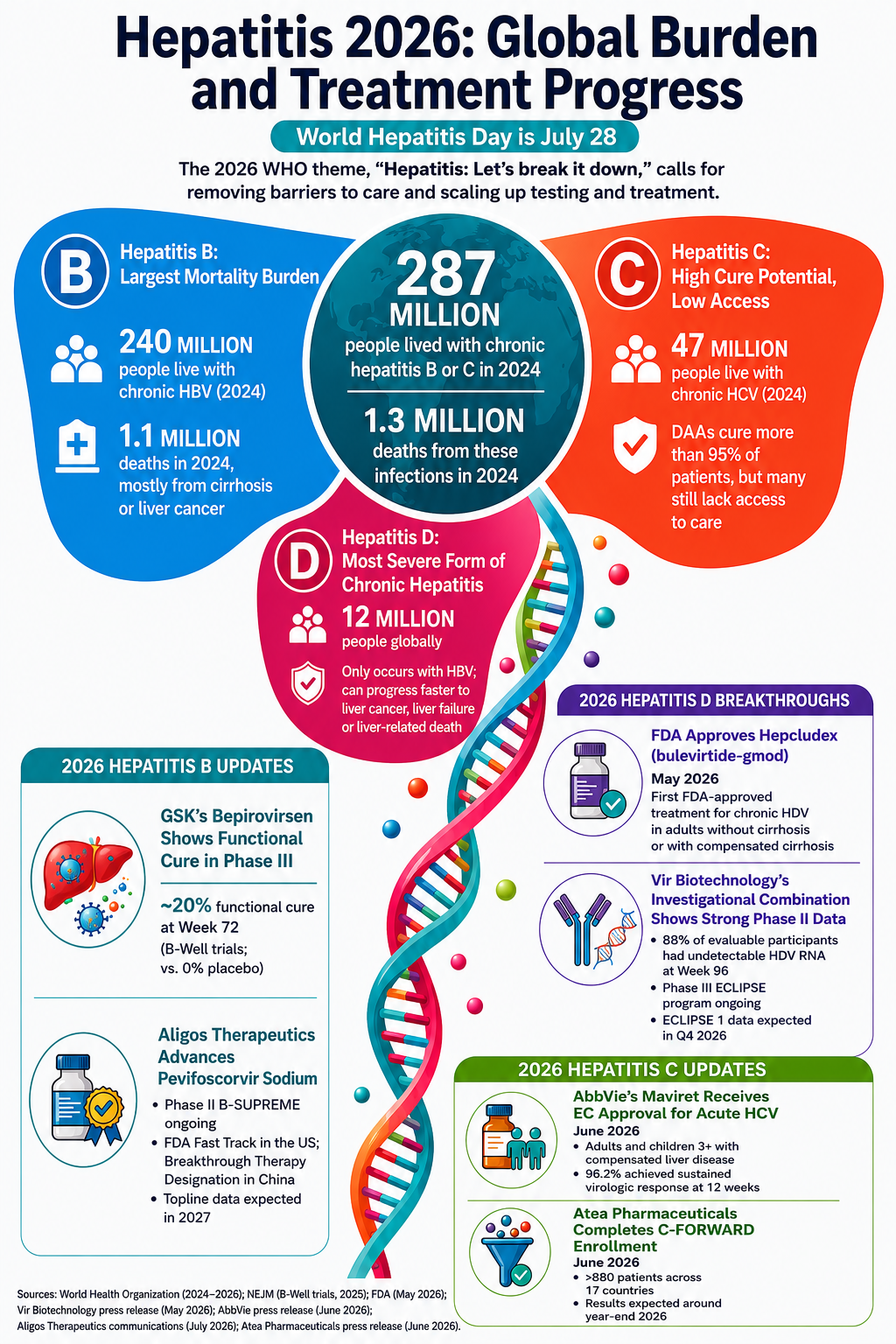
According to WHO estimates, 287 million people lived with chronic hepatitis B or C in 2024, and 1.3 million people died from these infections that same year.
What Is Hepatitis and Who Does It Affect?
Hepatitis, or liver inflammation, is mainly caused by the A, B, C, D and E viruses. Types B, C and D carry much of the long-term global burden because they can become chronic, staying in the body for months or years.
Hepatitis B spreads through mother-to-child transmission at birth, in early childhood or through infected blood and body fluids.
Hepatitis C typically spreads through infected blood, including unsafe injections, unscreened transfusions or shared needles. While direct-acting antivirals cure more than 95% of patients, many still lack access to diagnosis and treatment.
Hepatitis D only affects those already living with hepatitis B. It is considered the most severe form of chronic viral hepatitis because it can progress more quickly to liver cancer, liver failure or liver-related death. Hepatitis D virus (HDV) testing is often unavailable in many low- and middle-income countries.

Get industry leading pharma and biotech news, events and expert insights delivered to your inbox.
Hepatitis Treatment Updates to Watch
A major update for hepatitis B comes from GSK’s bepirovirsen program. This investigational antisense medicine is designed to bind to the virus’s genetic instructions and lower viral protein levels.
In two Phase III B-Well trials, bepirovirsen achieved a functional cure for some patients with chronic hepatitis B. This means the virus stays under control without the need for ongoing therapy after treatment ends. Results published in the New England Journal of Medicine showed that 20% and 19% of patients across the two studies reached this endpoint by Week 72, compared to zero in the placebo groups.
For hepatitis D, the FDA approved Gilead Sciences’ Hepcludex (bulevirtide-gmod) in May 2026. It is the first FDA-approved treatment for chronic HDV in adults with either no cirrhosis or compensated cirrhosis, where the liver is scarred but still works. The Phase III MYR301 trial supported the approval by comparing immediate treatment with delayed treatment.
Vir Biotechnology is also developing a combination therapy for hepatitis D. Its Phase II SOLSTICE trial is testing tobevibart, an investigational antibody, with elebsiran, an investigational small interfering RNA therapy. This RNA technology helps “silence” specific viral messages inside cells. At Week 96, 88% of evaluable participants in the Phase II SOLSTICE trial had undetectable HDV RNA, meaning the virus was no longer detectable in the blood. Vir’s Phase III ECLIPSE program is ongoing, with ECLIPSE 1 data expected in Q4 2026.
In hepatitis C, AbbVie received European Commission approval in June 2026 for Maviret (glecaprevir/pibrentasvir). It is approved for acute hepatitis C in adults and children ages three and older whose liver disease is still compensated, meaning the liver is still functioning. A Phase III study supported the approval, with 96.2% of patients showing no detectable virus 12 weeks after treatment, a standard marker of cure in hepatitis C.
Atea Pharmaceuticals completed enrollment in the Phase III C-FORWARD trial for chronic hepatitis C in June 2026. The study is testing whether bemnifosbuvir and ruzasvir can perform as well as an existing hepatitis C treatment in more than 880 previously untreated patients across 17 countries. Results are expected around year-end 2026.
Aligos Therapeutics also shared progress for pevifoscorvir sodium, an oral drug candidate for chronic hepatitis B. In July 2026, the company received a $25 million upfront payment through a licensing deal with Xiamen Amoytop Biotech for Greater China. It is currently being evaluated in the Phase II B-SUPREME study, with topline data expected in 2027.
If you want your company to be featured on Xtalks.com, please email [email protected].













Join or login to leave a comment
JOIN LOGIN