
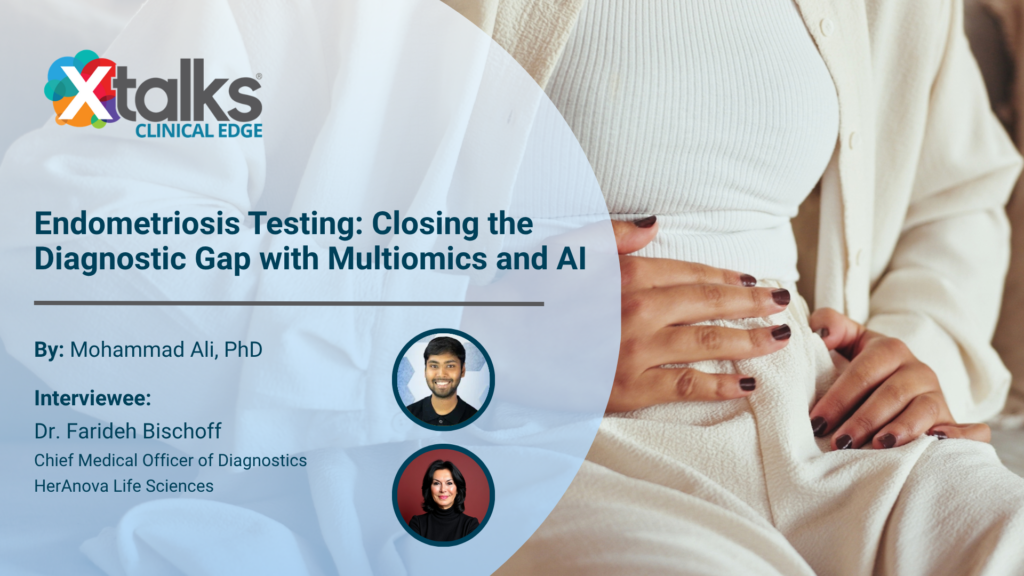
Dr. Farideh Bischoff of HerAnova Life Sciences discusses why endometriosis remains difficult to diagnose and how multiomics, biomarkers and AI could help advance non-invasive endometriosis testing.
Endometriosis affects an estimated 190 million women of reproductive age worldwide, representing approximately 10 percent of this population. Despite its prevalence, diagnosis can remain a lengthy process. A 2024 scoping review of 23 studies reported an average diagnostic delay of 6.8 years, highlighting the persistent challenges patients can face in getting answers.
Symptoms can overlap with other conditions, disease severity does not always correspond with symptom severity and existing diagnostic approaches may not identify every presentation of the disease. These challenges have created growing interest in endometriosis testing that could identify the condition non-invasively and potentially much earlier in the patient journey.
Dr. Farideh Bischoff, Chief Medical Officer of Diagnostics at HerAnova Life Sciences, has spent more than three decades working in women’s health and diagnostic development. Her research into endometriosis began about 35 years ago, with an interest in the genetic drivers of the disease.

Chief Medical Officer of Diagnostics
HerAnova Life Sciences
Speaking on the Xtalks Life Science Podcast, Dr. Bischoff discussed why endometriosis remains difficult to recognize and how advances in multiomics, AI and machine learning could help researchers develop more precise diagnostic tools.
Why Is Endometriosis So Difficult to Diagnose?
One of the fundamental challenges in diagnosing endometriosis is that its symptoms are not necessarily specific to the condition.
Pelvic pain, abnormal uterine bleeding and infertility may occur with endometriosis, but symptoms can overlap with other conditions. Dr. Bischoff pointed specifically to irritable bowel syndrome (IBS) and adenomyosis as examples that can complicate recognition of the disease.
The diagnostic process itself presents another challenge. Historically, surgery has played a central role in confirming endometriosis, although diagnostic pathways have evolved to incorporate clinical assessment and imaging. Current European Society of Human Reproduction and Embryology (ESHRE) guidelines recommend ultrasound or MRI as part of the diagnostic work-up and suggest considering laparoscopy when imaging is negative and empirical treatment is unsuccessful or inappropriate.
Get industry leading pharma and biotech news, events and expert insights delivered to your inbox.

For Dr. Bischoff, the limitations of existing approaches highlight why reliable non-invasive tools could be valuable.
“The only way to definitively diagnose the condition is through surgery,” Dr. Bischoff said, describing the role of surgery in establishing disease status. “Therefore, surgery in the place where you have a high rate of infertility is often left as the last resort to definitively determine whether or not a woman has this condition.”
— Farideh Bischoff, PhD, Chief Medical Officer of Diagnostics at HerAnova Life Sciences
Endometriosis Is Not a One-Size-Fits-All Disease
Developing better endometriosis testing is also complicated by the disease’s heterogeneity.
Endometriosis is multifactorial, with genetics, hormonal dysfunction, immune dysfunction and environmental factors potentially contributing to its biology. Importantly, symptoms do not necessarily indicate how extensive the disease is.
A woman experiencing severe pain or bleeding may have relatively mild disease, while someone with clinically mild disease may have a different or more extensive presentation.
“We know it’s a very complex disease. We know that symptoms don’t correlate with the disease severity,” Bischoff said.
A single genetic or biological marker may not capture the many ways endometriosis presents across different patients. Dr. Bischoff noted that factors such as age, body mass index (BMI) and ethnicity may also need to be considered when evaluating biomarkers.
This heterogeneity is helping shift research away from expecting a single universal biological signal and toward approaches that can examine multiple dimensions of disease simultaneously.
Where Imaging Helps and Where It Can Fall Short
Imaging remains an important component of evaluating patients with suspected endometriosis.
According to Dr. Bischoff, imaging can identify ovarian endometriosis and deep infiltrating endometriosis and can be valuable for initial patient screening. The challenge lies in less visible presentations.
Early-stage disease can involve very small lesions, including lesions located in the peritoneum. Their size, location and depth can make them harder to detect with routine imaging.
“Although these tools are essential, they’re not enough to definitively identify disease in all cases, specifically your superficial case,” Dr. Bischoff said.
This limitation is reflected in ESHRE guidance, which cautions that a negative imaging result does not exclude endometriosis, particularly superficial peritoneal disease.
Emerging diagnostic tools could potentially provide another source of information when symptoms and clinical history raise suspicion but imaging does not provide a clear answer.
Could Multiomics Change Endometriosis Testing?
If no single biomarker can capture the biological complexity of endometriosis, examining multiple biological signals may offer a different path forward.
That is where multiomics comes in.
In contrast to using a single biomarker, multiomic approaches can examine different layers of biological information, potentially providing a broader picture of disease-associated processes.
“A single marker is unlikely to be the answer,” Dr. Bischoff said.
She explained that a multiomic approach could potentially capture a broader spectrum of endometriosis, from very small lesions and early-stage disease to more advanced presentations.
For endometriosis testing, there is value in accounting for heterogeneity. If different biological processes contribute to disease in different patients, patterns across multiple signals could potentially provide information that a single marker cannot.
— Farideh Bischoff, PhD, Chief Medical Officer of Diagnostics at HerAnova Life Sciences
AI and Machine Learning Expand What Researchers Can Analyze
The growing volume of biological information generated by multiomic research introduces another barrier to overcome.. With AI being more commonly used, analyzing large amount of data is becoming more efficient.
“In today’s time, we also have AI and machine learning tools, and this allows scientists to look at a vast number of biomarkers simultaneously in a sample,” Dr. Bischoff said.
She described these technologies as one of the “biggest game changers” in the field because of their potential to support diagnostic assay development.
Instead of evaluating candidate biomarkers individually, computational approaches can help researchers explore patterns across larger, more complex datasets.
While these findings illustrate the potential of machine learning, the researchers emphasized the need for high-quality prospective studies and external validation before broader clinical translation.
Validation Is Critical for Emerging Endometriosis Tests
For Dr. Bischoff, sophisticated biomarkers and algorithms are just one element of the broader diagnostic development process. . A potential test must also demonstrate that its results are reliable, reproducible and clinically meaningful.
She emphasized the importance of establishing an appropriate ground truth against which an emerging test can be evaluated. Dr. Bischoff discussed laparoscopic surgery and histological confirmation as an important reference when validating new laboratory-developed tests.
“The real necessity is in how you validate your diagnostic and how you define what the ground truth is for classifying a case as either positive or negative,” Dr. Bischoff said.
Dr. Bischoff also highlighted the importance of large patient cohorts representing different populations and ethnicities.
For a disease characterized by substantial biological and clinical heterogeneity, demonstrating that a test performs reliably across diverse populations could be key to clinical use.
— Farideh Bischoff, PhD, Chief Medical Officer of Diagnostics at HerAnova Life Sciences
Bringing Earlier Testing into the Patient Journey
Earlier answers could give patients and clinicians more time to discuss next steps.
This is particularly relevant in reproductive medicine. Endometriosis and infertility are closely associated.
Dr. Bischoff explained that fertility clinics may therefore encounter patients whose endometriosis has not previously been identified. In some cases, infertility may be the point at which previously overlooked symptoms prompt further investigation.
“If we were able to identify these patients earlier, they would then have the opportunity to talk with their physician about what they want to do next, what type of planning they want to do with regards to pregnancy or life decisions,” Dr. Bischoff said.
Earlier testing could therefore provide information that supports clinical judgment and more informed discussions between patients and their medical teams.
Building the Evidence for Earlier Endometriosis Diagnosis
Dr. Bischoff sees multicenter research and larger prospective clinical studies as important parts of the path ahead, including studies involving patients from multiple clinical locations within and outside the US.
Broader datasets could help researchers evaluate how multiomic approaches perform across different patient populations and clinical settings while building the evidence necessary to understand their potential role in practice.
“We have the tools. We have AI-based testing and development,” Dr. Bischoff said. “And of course, we now have a spotlight on the fact that we’ve got these big gaps in women’s health.”
Closing those gaps will depend on rigorous validation, appropriately diverse clinical studies and a better understanding of the biological complexity underlying endometriosis.
A single symptom, image or biomarker may not provide all the answers. Emerging research is examining whether multiple sources of biological and clinical information can work together.
For patients who currently spend years searching for an explanation for their symptoms, advances in endometriosis testing could ultimately help shorten the path to diagnosis and support earlier, more informed conversations about their health and reproductive choices.











Join or login to leave a comment
JOIN LOGIN