
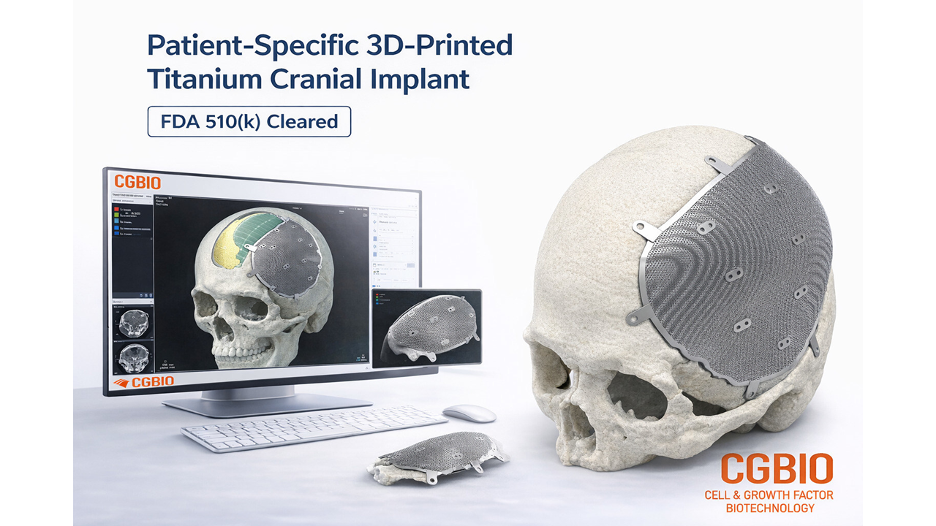
The clearance adds another customized 3D-printed implant option for surgeons repairing skull and facial defects after trauma or surgery.
The FDA has cleared a custom-made titanium implant that can be used to help repair certain defects in the skull and face.
The device, called EASYMADE TI, is made by CGBIO, a medical technology company based in South Korea. It is designed for cranial and craniofacial reconstruction, which means surgery to rebuild parts of the skull or face after injury, disease or another medical procedure.
EASYMADE TI is intended for cranial defects and non-load-bearing craniofacial defects. This means it is meant for areas of the skull or face that need structural repair but are not expected to carry major mechanical force.
Such reconstruction may be needed after traumatic injury, tumor removal or earlier cranial surgery.
Back in 2012, an 83-year-old woman in Belgium received what CBS News described as the world’s first 3D-printed titanium lower jaw transplant after an infection severely damaged her lower jaw. The custom implant helped restore facial contour, speech, swallowing and jaw movement.
A 2026 study in the Journal of Oral and Maxillofacial Surgery estimated 965,750 facial fracture-related emergency department visits in the US between 2021 and 2022. Not all facial fractures require cranial or craniofacial implants, however.
Get industry leading pharma and biotech news, events and expert insights delivered to your inbox.

CGBIO’s implant is made from medical-grade titanium alloy. Titanium is commonly used in implants because it is strong, lightweight and compatible with the body.
CGBIO said the device is created using Laser Powder Bed Fusion, a metal 3D printing process that uses a laser to build the implant layer by layer from titanium powder.
EASYMADE TI is designed using an individual patient’s CT scan data, so the implant can be shaped to that person’s anatomy.
For hospitals and surgeons, the delivery model is a key practical detail. According to CGBIO, US clinicians provide patient CT images, and the customized design is completed at the company’s design center in Korea. The finished implant is then delivered to US hospitals within five days.
The implant must still be sterilized at the hospital before it can be used in surgery.
CGBIO said it is the first Korean company to obtain FDA 510(k) clearance for a customized titanium implant intended for the US market. The company plans to use the clearance to expand its patient-specific cranial and craniofacial implant business in the US.
What Is Driving Growth in the Patient-Specific Implant Market?
Titanium implants are often used when surgeons need a strong, durable material. The FDA had previously cleared another patient-specific titanium implant from Meticuly for certain bony defects in the skull and face. Like EASYMADE TI, Meticuly’s device is designed from patient CT data and manufactured with Laser Powder Bed Fusion., a metal 3D-printing process.
Across the world, titanium implants have found applications beyond the skull. In Chennai, India, surgeons recently used a custom 3D-printed titanium implant to repair a large chest wall gap in a 59-year-old man after tumor surgery. The implant was built from the patient’s CT-based model and used after part of his sternum, ribs and surrounding tissue had been removed.
The global market for patient-specific implants has been expanding steadily, driven by advances in 3D printing, imaging software and surgical planning tools. The PEKK (poly-ether-ketone-ketone) implant material market alone is projected to reach $1.12 billion by 2033.
Companies such as Stryker and Zimmer Biomet have also invested heavily in customized implant solutions, particularly in joint reconstruction and complex trauma cases.
Stryker’s SOMA (Stryker Orthopaedic Modeling and Analytics) modeling system and its Mako robotic platform enable patient-specific surgical planning and implant positioning, while products like its 3D-printed Incompass ankle system incorporate porous titanium designs for improved fit and bone integration.
Zimmer Biomet’s Persona “Personalized Knee” system and ROSA robotic platform tailor procedures to individual joint mechanics. The company has also expanded its capabilities through recent investments in robotics and AI-driven surgical planning.
FAQs
Does FDA 510(k) clearance mean a device has been tested in new clinical studies?
Not always. A 510(k) clearance usually means the FDA found the device similar enough to another device already sold in the US. It does not always require a new clinical study.
Why are some craniofacial implants described as “non-load-bearing”?
It means the implant is not meant for areas that take heavy force, like a hip or knee. For skull and facial repair, it helps define where the implant can safely be used.
Are 3D-printed implants made inside the hospital?
Usually not. They are often made by specialized manufacturers and shipped to the hospital, where the surgical team prepares them for use.
If you want your company to be featured on Xtalks.com, please email [email protected].










Join or login to leave a comment
JOIN LOGIN