
As scientific innovation continues to accelerate across cell and gene therapy (CGT), one of the most persistent challenges is not discovery, but ensuring real-world access.
A growing number of clinically promising CGTs, particularly for ultra-rare diseases, have struggled to progress beyond development due to financial, operational and market constraints.
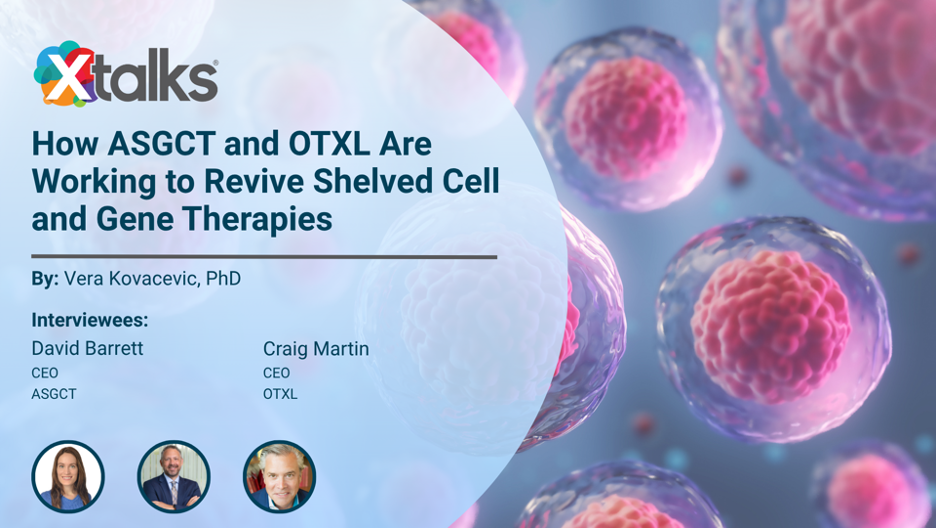
In a recent conversation with Xtalks, David Barrett, CEO of the American Society of Gene & Cell Therapy (ASGCT), and Craig Martin, CEO of Orphan Therapeutics Accelerator (OTXL), discussed how the newly launched CGTxchange platform is designed to address these systemic barriers.
Their insights highlight how technology-enabled collaboration and new investment models could help bring previously shelved CGTs back into development and closer to patients.
Commercial Barriers Are Slowing Progress in Ultra-Rare Disease Therapies
Despite robust scientific advances, many CGT programs targeting ultra-rare conditions have been deprioritized or discontinued. According to Barrett, this trend is not driven by shortcomings in therapeutic efficacy or clinical science. Instead, it reflects structural pressures within the drug development ecosystem.
He explained that developers often face extremely small patient populations, which translates into limited commercial markets. These challenges are compounded by uncertainty around reimbursement coverage and investor expectations for substantial financial returns following costly development programs.
As Barrett noted, these were therapies “that by all accounts were successful,” yet some were still deprioritized or withdrawn due to “market pressure and concerns about the commercial aspects of these drugs.”
As a result, even therapies that demonstrate clinical benefit and regulatory approval may struggle to remain viable on the market. This dynamic creates a paradox in which transformative medical innovation exists but fails to reach patients due to financial feasibility concerns.
Get industry leading pharma and biotech news, events and expert insights delivered to your inbox.

Extending ASGCT’s Mission Beyond Scientific Discovery
For ASGCT, addressing these barriers aligns closely with its broader mission to advance education, awareness and clinical adoption of CGTs. Barrett emphasized that the organization’s focus extends beyond scientific breakthroughs to ensuring that therapies ultimately reach the individuals who need them.
ASGCT’s membership spans scientists, clinicians, industry professionals and patient advocates, many of whom have played a direct role in developing the therapies now facing commercialization challenges. “Our primary concern really is getting the science to the patients,” Barrett said, underscoring the society’s commitment to tackling not only scientific hurdles but also the commercial and environmental obstacles that can limit access.
From Barrett’s perspective, there is a shared commitment across stakeholders to ensure that the effort invested in advancing CGT science translates into real-world patient benefit.
How CGTxchange Uses AI and Expertise to Re-Evaluate Therapeutic Assets
Craig Martin described CGTxchange as a technology-enabled matchmaking platform that integrates AI with the scientific expertise and industry of ASGCT and OTXL.
The platform analyzes both confidential and publicly available data related to therapeutic programs, generating structured profiles that highlight key clinical, regulatory and commercial insights. Importantly, the system is designed to surface meaningful information without disclosing sensitive proprietary details.
Martin explained that the aim is to “analyze particular therapeutic assets, surface the most meaningful information related to those assets for investors or partners,” and predictively model the pathway toward approval.
Martin likened the user experience to a digital marketplace for previously shelved CGTs, where potential partners can explore summarized asset “cards,” refine searches based on investment priorities and access deeper program profiles after providing relevant background information.
This approach aims to democratize diligence processes that traditionally require extensive in-house expertise. While large venture capital firms may employ teams of PhD-level analysts to evaluate development assets, smaller investors, including impact investors and philanthropic funders, often lack comparable resources. By streamlining asset evaluation, CGTxchange seeks to broaden the pool of stakeholders capable of supporting continued development.
Re-Positioning Programs for Development Readiness
Therapies may be shelved for a variety of strategic reasons unrelated to clinical performance. Martin noted that companies frequently reallocate resources toward assets targeting larger patient populations or pivot into different therapeutic areas altogether. In other cases, the anticipated cost of advancing a program through late-stage development may appear disproportionate to projected returns.
To address these constraints, OTXL offers access to a network of CROs and CDMOs willing to collaborate on deferred-cost models. This, Martin explained, can “change a little bit of the calculus of what will it take to get this program through to approval,” potentially opening development pathways for a broader range of investors or sponsors.
By enabling stakeholders to reassess both financial pathways and operational feasibility, CGTxchange is intended to reopen opportunities for therapies that might otherwise remain dormant.
Improving the Probability of Patient Access
From a patient access standpoint, Martin emphasized that the platform’s primary value lies in increasing the likelihood that clinically advanced therapies can move forward. Many of the programs featured on CGTxchange have already generated human safety or efficacy data, which can strengthen predictive modeling of development success.
“We offer an opportunity to breathe new life into them,” Martin said, referring to therapies that have been shelved or deprioritized. The platform’s structured analytics and matchmaking capabilities aim to make these assets more understandable — and therefore more investable — for organizations with limited biotechnology experience.
Ultimately, the goal is to translate renewed investment interest into tangible progress toward regulatory approval and clinical availability.
For ultra-rare disease communities, this could represent a critical pathway to treatment where none previously existed.
Empowering Patient Communities and Non-Traditional Investors
Martin also highlighted the emotional and strategic significance of CGTxchange for patient advocacy groups. In many rare disease areas, patient communities play an active role in early drug development, funding preclinical research and connecting investigators with affected families.
When programs stall due to commercial barriers, these communities often lack the infrastructure or networks to identify alternative development partners. He noted that the platform can help facilitate opportunities for patient groups that otherwise “would have no way of moving a program forward.”
The initiative has already generated enthusiasm among rare disease stakeholders, reflecting a broader recognition that new funding models and collaborative frameworks are essential to sustain progress in advanced therapies.
A New Model for Translating Innovation into Real-World Impact
Together, ASGCT and OTXL are positioning CGTxchange as a mechanism to bridge the longstanding gap between scientific success and patient access in CGT. By combining AI-driven analytics, expert scientific review and innovative partnership models, the platform represents an evolving approach to commercialization in ultra-rare disease development.
As advanced therapies continue to reshape treatment paradigms, initiatives like CGTxchange emphasize the importance of aligning scientific innovation, investment strategies and patient-centered priorities.
For stakeholders across the life sciences ecosystem, the success of such models may help determine whether groundbreaking therapies ultimately achieve their intended impact: improving outcomes for patients who currently have limited or no treatment options.












Join or login to leave a comment
JOIN LOGIN