
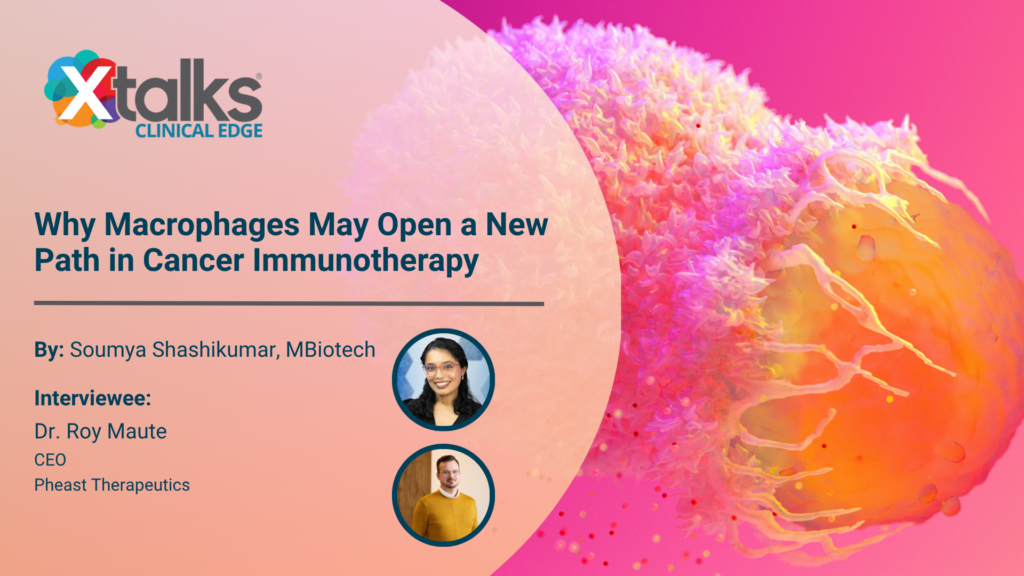
Macrophage-focused immunotherapy offers a parallel way to help the immune system fight cancer. Pheast Therapeutics is studying PHST001, an anti-CD24 macrophage checkpoint inhibitor, to block a “don’t eat me” signal that may help some tumors avoid immune attack.
Many cancer immunotherapies are built around T cells, but tumors are shaped by other immune cells, too. Macrophages, immune cells that help clear threats and support tissue repair, can be abundant in the tumor microenvironment. In some cancers, they can even outnumber cancer cells themselves, said Dr. Roy Maute, a scientist, biotechnology entrepreneur and Co-Founder and CEO of Pheast Therapeutics.
In a new Xtalks Clinical Edge interview, Dr. Maute discussed why macrophages remain underused in oncology and what earlier setbacks have taught the field. He also shared why CD24 may be relevant in aggressive cancers and how early clinical data are shaping the company’s next steps.

CEO
Pheast Therapeutics
Pheast Therapeutics is built around macrophage biology and its potential role in helping the immune system push back against cancer. The company is developing immunotherapies that block signals tumors use to avoid immune attack. Its lead candidate, PHST001, is an anti-CD24 checkpoint inhibitor being tested in clinical trials for advanced solid tumors.
Why Macrophages Are Drawing More Attention in Cancer Immunotherapy
While T-cell-focused therapies have changed cancer care, they do not work for every tumor type. Dr. Maute said some tumors do not have the conditions needed for T cells to respond. T cells are often not present in these cancers, while macrophages are usually already there.
“I think the history of oncology is really a story of finding new mechanisms to put together in parallel, and we think macrophages are an important part of that story.”
— Dr. Roy Maute
Macrophages are part of the body’s normal wound-healing response. In cancer, tumors can take advantage of the same signals that would usually help repair tissue.
“They detect the tumor as a wound and they’re part of the normal immune cell wound healing response,” said Dr. Maute. “They try to do what they would do for a normal tissue that’s healing, which is to promote its growth.”
This may be one reason macrophages can be common in tumors without automatically helping the immune system attack cancer. Pheast’s approach is not to remove these cells from tumors, but to redirect them.
The company aims to engage macrophages directly and induce them to attack cancer cells.
“In almost no case are we trying to replace a T-cell-focused immunotherapy,” said Dr. Maute. “Rather, we think that this is a completely parallel pathway that we can activate.”
This reflects a broader pattern in cancer treatment, where progress often comes from adding new mechanisms that can work alongside existing ones.
“Ultimately, one can only do so much by pushing on the same lever,” he said. “I think the history of oncology is really a story of finding new mechanisms to put together in parallel, and we think macrophages are an important part of that story.”

Get industry leading pharma and biotech news, events and expert insights delivered to your inbox.
Learning From Earlier Macrophage Therapy Setbacks
Macrophage-focused cancer therapies have faced skepticism, in part because earlier approaches targeting pathways such as CD47–SIRPα ran into therapeutic-window challenges.
“In biotech and pharma, things fail, things fail, things fail, and then they work when you find the right approach,” said Dr. Maute.
The key lesson was to keep the potential of macrophage activation, while choosing a target that may avoid some earlier safety problems.
Dr. Maute said CD47-directed drugs helped show that macrophages could be activated. However, those drugs could also activate macrophage attack on sensitive blood cells, contributing to anemia, thrombocytopenia and other hematopoietic effects.
“We see that those previous attempts, particularly drugs that were aimed at the CD47–SIRPα pathway, it’s the right biology, but the wrong target and perhaps the wrong drug,” said Dr. Maute.
PHST001 targets CD24, a cell surface protein that can act as a macrophage checkpoint. According to Dr. Maute, CD24 is not expressed on red blood cells or platelets, which may help Pheast avoid some of the safety limitations seen with earlier macrophage checkpoint approaches.
“When we block CD24, we do not induce a macrophage attack of those cells, which we think helps to broaden the therapeutic window,” he said.
Why CD24 May Matter in Difficult-to-Treat Tumors
The focus on CD24 began in Dr. Irving Weissman’s lab at Stanford University, where Dr. Maute studied how immune cells decide which cells to attack and which to protect. That work centered in part on “don’t eat me” signals, molecular cues that tell macrophages not to attack. While these signals normally help protect healthy tissue, cancer cells can use them to avoid immune attack.
“Macrophages have these so-called ‘don’t eat me’ signals, just suppressive signals that they see on cells that tell them not to attack it,” said Dr. Maute.
Pheast then looked at where CD24 is highly expressed and linked with poor outcomes.
“We really have followed those signals rather than looking at the landscape and saying, ‘Where would we like to develop a drug?’” said Dr. Maute. “We said, ‘Okay, CD24 is a really interesting biological activity. Where do we see it expressed? Where do we see it associated with poor clinical outcome?’”
That led the company toward ovarian cancer, endometrial cancer and cholangiocarcinoma. These are cancers where Dr. Maute said new therapies would be welcomed by clinicians and patients, and where CD24 expression may point to a relevant macrophage biology.
Pheast is not building around one cancer type alone.
“We don’t consider ourselves an ovarian-focused company necessarily,” said Dr. Maute, “but rather one that, per target, we really want to look to the cancer to tell us where it might be relevant.”
Reading Early Phase I Data Carefully
Pheast presented initial Phase Ia data for PHST001 at the American Association for Cancer Research Annual Meeting 2026. The early dataset showed target engagement, innate immune activation and early signs of clinical activity, according to the company.
Dr. Maute said the first priority in this type of early-stage trial is safety, especially for a novel target and a relatively new mechanism of action.
“Safety is number one,” said Dr. Maute. “Classically, that’s the only reason to do a Phase Ia study of this type.”
In the interview, he shared that the early study was meant to show whether PHST001 could be dosed safely while activating macrophage biology as intended.
“Do we have a safe enough drug, and do we have an active enough drug to justify further development?” said Dr. Maute.
“This is a mechanism of action that can be relevant to the diseases where we’re currently operating, where new therapies are desperately needed, but also across the cancer landscape.”
— Dr. Roy Maute
He pointed to changes in cytokines and chemokines as one way to see whether the therapy is activating macrophages. Cytokines and chemokines are immune signaling molecules that can help show whether a drug is affecting the immune system as intended.
“What we see is that across all patients when we treat with PHST001 and block CD24, we get a really strong immune activation,” said Dr. Maute.
Early oncology trials can be difficult to interpret because many participants have advanced disease and few remaining treatment options. Dr. Maute said some patients have shown long-term stable disease and tumor shrinkage, though the findings are still early and need further study.
“We think overall this is a picture very consistent with further development,” said Dr. Maute.
Patient Selection, Combinations and the Next Clinical Questions
As PHST001 moves into Phase Ib combination studies, Pheast is studying the drug with chemotherapy in ovarian cancer, endometrial cancer and cholangiocarcinoma. This part of the study is testing whether macrophage activation can pair safely with chemotherapy and produce stronger anti-cancer activity.
In some cancers, CD24 expression may be broadly relevant. In others, biomarker selection could become more important.
“There will be certain indications, like ovarian, where we don’t think that CD24 expression per se is going to be a necessary biomarker selection,” said Dr. Maute.
Non-small cell lung cancer could be a possible future setting where CD24 expression may help identify a subset of patients. But future development will depend heavily on what Pheast learns from the current clinical program.
The broader goal is to add a new immune mechanism that could work alongside existing treatments. Pheast is focused on chemotherapy and antibody-drug conjugates for now, while also seeing broader opportunities.
“This is a mechanism of action that can be relevant to the diseases where we’re currently operating, where new therapies are really desperately needed, but really across the cancer landscape,” said Dr. Maute.
For now, the focus is on early clinical steps in cancers with high unmet need. Dr. Maute said many patients in these studies have already run out of other options.
“Clinicians, patients really, really need new options,” said Dr. Maute. “And that’s what we hope to provide.”












Join or login to leave a comment
JOIN LOGIN