
Skin health is often discussed in the context of visible symptoms, short-term flares or cosmetic concerns. But for many women, chronic dermatologic conditions are closely tied to broader physiological changes across life stages, including pregnancy, postpartum and menopause.
These transitions can affect hormone levels, immune function, skin barrier integrity, circulation, sleep, stress and inflammatory pathways. Yet their impact on conditions such as atopic dermatitis, other forms of eczema and psoriasis remains underrecognized in both clinical practice and research.
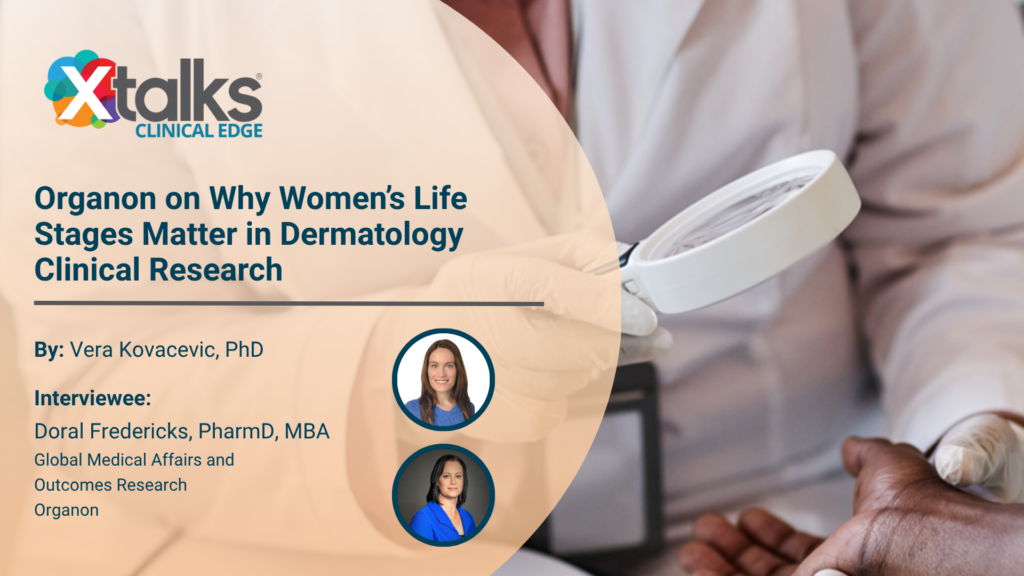
To explore the connection between women’s health and dermatology, Xtalks spoke with Doral Fredericks, PharmD, MBA, Global Medical Affairs and Outcomes Research at Organon.
Fredericks discussed why hormonal biology should be more systematically considered in dermatology research, how chronic skin conditions can affect quality of life and why clinical trials and real-world studies need to better reflect women’s lived experiences.

Global Medical Affairs and
Outcomes Research
Organon
Skin Health as Part of Women’s Health
Fredericks said women’s skin health should not be viewed separately from women’s health overall. Hormonal shifts across the lifespan can influence how dermatologic conditions develop, flare and respond to treatment.
That complexity matters because much of the historical evidence base in medicine has not consistently accounted for female physiology, reproductive status or hormonal variability. In dermatology, this gap is particularly important because the skin is highly responsive to hormones and immune changes.
“We have to recognize that women’s skin health is inseparable from women’s health overall,” Fredericks said. “The experience with skin conditions is genuinely different and often more complex because of the hormonal shifts that women have across their life stages.”
When chronic skin conditions are not well controlled, the effects can extend far beyond the skin. Fredericks pointed to anxiety, depression, sleep disruption, sexual well-being, self-esteem and daily functioning as important dimensions of disease burden.
She added that the mental health effects associated with chronic dermatologic conditions should not be minimized, particularly given the broader health risks linked to depression and cardiovascular outcomes.
Get industry leading pharma and biotech news, events and expert insights delivered to your inbox.

Pregnancy, Postpartum and Menopause Bring Distinct Dermatologic Changes
Pregnancy, postpartum and menopause are among the life stages where skin changes can be especially pronounced. During pregnancy, rapid shifts in estrogen, progesterone, immune activity and circulation can influence inflammatory pathways, skin hydration, sensitivity and barrier function.
These changes can trigger new dermatologic conditions, worsen existing symptoms or, in some cases, alter the course of inflammatory diseases.
For example, psoriasis may temporarily improve during pregnancy in some patients, while postpartum worsening is commonly reported. In the postpartum period, hormone levels can drop sharply while immune function rebounds. Sleep disruption and stress can further contribute to disease flares or changes in pigmentation and skin texture.
Menopause introduces a different biological context. Sustained declines in estrogen can make the skin thinner, drier and less elastic. These changes may increase sensitivity, slow healing and contribute to changes in inflammatory skin conditions, including psoriasis, although individual disease patterns can vary.
“Across all these stages, the one common thread is that major hormonal changes drive these major dermatologic changes, but these phases haven’t really been systematically studied,” Fredericks said.
For clinical researchers, this creates an important evidence gap. Pregnancy, postpartum and menopause are not interchangeable categories. Each represents a distinct biological state that may influence disease activity, treatment needs and patient-reported outcomes in different ways.
Eczema, Psoriasis and Hormone-Linked Disease Patterns
Atopic dermatitis, other forms of eczema and psoriasis provide examples of how hormonal and immune changes can influence chronic dermatologic disease.
During pregnancy, higher levels of estrogen and progesterone can shift immune responses. Fredericks explained that this may worsen some conditions, such as atopic dermatitis, while improving others, including psoriasis, depending on the underlying immune pathways involved.
In menopause, sustained lower levels of estrogen may be associated with changes in psoriasis severity for some women, including more frequent or harder-to-control flares. Lower estrogen can also impair the skin barrier, while immune aging may contribute to the onset or worsening of atopic dermatitis, particularly on the hands, face and flexural areas such as the creases of the elbows.
“It’s really important to understand the impact of these, like the real-world impact of these diseases,” Fredericks said. “I’ve heard from patients about challenges in, for example, getting their hair done, because they have a lesion on their scalp and the hairdresser doesn’t know what it is, or not being welcome in a nail salon because of how their nails look.”
These examples underscore why dermatology research increasingly needs to consider outcomes beyond lesion counts or surface-level clinical severity. For patients, chronic skin disease can affect employment, social interactions, self-confidence and basic activities of daily living.
Why These Gaps Persist in Clinical Research
The underrecognition of women’s dermatologic health reflects broader patterns in clinical research. Fredericks noted that women have historically been underrepresented or insufficiently studied in ways that account for sex-specific biology across therapeutic areas, not only dermatology. She also pointed to the relatively limited level of private healthcare investment directed toward women’s health.
Despite women representing about half of the global population, Fredericks said women’s health receives only about 6% of private healthcare investment. This underinvestment can influence what gets studied, how trials are designed and which clinical questions are prioritized.
In traditional clinical development, hormonal variability, reproductive status and life-stage-specific needs were often not treated as essential variables. In dermatology, this can limit the applicability of treatment guidelines for women during pregnancy, lactation, postpartum recovery or menopause.
Pregnant and postpartum patients can be difficult to include in clinical trials because of concerns about potential risks to the fetus or newborn. As a result, much of the evidence in these populations is generated after the fact rather than built into prospective trial designs.
“Pregnant and postpartum patients can be difficult to identify for clinical trial enrollment,” Fredericks said. “We typically garner that information through either patient registries or exposure data over time, but that’s type of information can take a while to get.”
Another barrier is cultural and clinical normalization. Symptoms that emerge during pregnancy, postpartum or menopause may be dismissed as expected or inevitable, reducing the urgency to study them in a rigorous way.
Building Better Dermatology Evidence for Women
To better capture the lived experience of women with chronic dermatologic conditions, Fredericks said clinical trials and real-world studies should include women across life stages and account for hormonal variability and reproductive status.
This does not mean simply enrolling more women. It means designing studies that prospectively track relevant biological and life-stage factors, including pregnancy status, postpartum timing, menopause status and hormonal changes where appropriate.
Fredericks acknowledged that this is not always easy operationally. However, she said the industry needs to be more thoughtful about how women’s hormonal biology is incorporated into trial design, especially for conditions known to be influenced by immune and endocrine changes.
“The real-world evidence piece is also critical because a trial that doesn’t take into account real-world evidence can’t produce solutions in the real world,” Fredericks said.
Partnerships with patient advocacy and professional organizations can also help ensure that research reflects the day-to-day realities of women living with chronic skin conditions. Fredericks pointed to advocacy and patient organizations focused on eczema, psoriasis and women’s dermatology as important collaborators in aligning clinical studies with patient experience.
For organizations, this represents both a scientific and methodological opportunity. More life-stage-specific data could support better trial design, more relevant endpoints, improved patient-reported outcome measures and ultimately more informed treatment decisions in practice.
Toward More Precise Approaches in Dermatology
The broader opportunity for life sciences companies is to move beyond one-size-fits-all approaches in dermatology. For women, this includes understanding how hormonal changes at different life stages interact with skin biology, immune function and chronic inflammatory disease.
Fredericks said the field should continue evaluating a broad range of treatment options, including steroidal and nonsteroidal therapies as well as topical and systemic approaches. The right approach may vary depending on disease severity, patient preference, reproductive status, pregnancy, lactation or menopause-related changes.
For clinical development, the message is clear: dermatology research that accounts for women’s life-stage biology could generate evidence that is more clinically relevant and more reflective of real-world care.
As women’s health gains greater attention across the life sciences industry, dermatology is one area where better evidence generation can help close a long-standing gap.













Join or login to leave a comment
JOIN LOGIN