

Experts from Cognizant and Google Cloud discuss why AI productivity gains can disappear across fragmented life sciences workflows and how organizations can turn efficiency into measurable, compounding enterprise value.
AI is increasingly embedded across life sciences organizations, helping teams draft documents, analyze information, generate content and automate everyday tasks. As adoption expands, the focus shifts to whether these productivity gains are enhancing enterprise performance.
“Activity isn’t value. If it wasn’t on a scorecard before AI, you actually found motion, not value,” said Shweta. Unless productivity gains contribute to established outcomes such as shorter clinical development timelines, faster deviation closures, improved submission readiness or lower costs, the benefit may never appear at the enterprise level.
In an Xtalks webinar featuring experts from Cognizant and Google Cloud, the panel talked about this disconnect. Gaurav Sharma, Global Market Leader at Cognizant, moderated a discussion with Shweta Singh Maniar, who leads the Life Sciences Strategic Industries practice at Google Cloud, and Akshat Jhaveri, Vice President and member of the executive leadership team at Cognizant.
Their discussion explored what they described as the “productivity illusion”: the growing gap between visible AI activity and the ability to demonstrate that this activity is creating meaningful enterprise value.
From AI Activity to Business Value
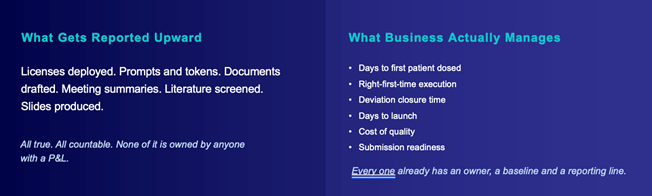
AI adoption can be relatively easy to quantify. Organizations can measure licenses deployed, prompts submitted, tokens consumed and documents generated. However, Shweta says these metrics primarily measure activity.
When evaluating AI productivity, Shweta suggested asking, “Who owns it? What was the baseline before AI? Which existing reporting line does it appear on?” The questions shift the focus from AI activity toward outcomes the organization already tracks.
Metrics such as documents drafted or prompts submitted often struggle to answer those questions. By contrast, measures such as days to first patient dosed, deviation closure time, cost of quality and submission readiness already have baselines and accountable owners.
“The leak isn’t the model per se, it’s the system that the model might be dropped into.”
– Shweta Singh Maniar
These metrics change how organizations might think about AI return on investment (ROI). Organizations can examine whether AI is moving business measures they already use.
In life sciences, productivity improvements frequently occur within larger processes involving multiple teams, systems and validation requirements. An AI tool might accelerate one step considerably, but the overall process may not speed up (Fig. 1).
Where Does AI Value Get Lost?
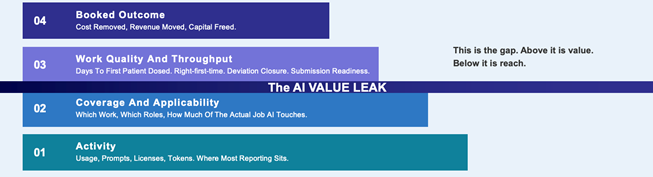
AI value can be lost in the systems and workflows surrounding the technology (Fig. 2). “The leak isn’t the model per se, it’s the system that the model might be dropped into,” Shweta said.
Consider an AI system that reduces the time required to draft an investigation. The output may still require human review, validation and transfer between systems that do not communicate effectively. It may then enter a queue governed by a fixed timeline. Even if the original task becomes substantially faster, downstream friction can absorb much of that gain.
Fragmented data, disconnected tools, organizational handoffs and isolated AI pilots can therefore separate task productivity from enterprise productivity.
This was reflected in an audience poll during the webinar. When attendees were asked which source of friction was costing their organizations the most, 38% selected fragmentation across tools, data and workflows. Another 31% selected function-to-function barriers, while 23% said they did not yet have a reliable way to measure AI value.
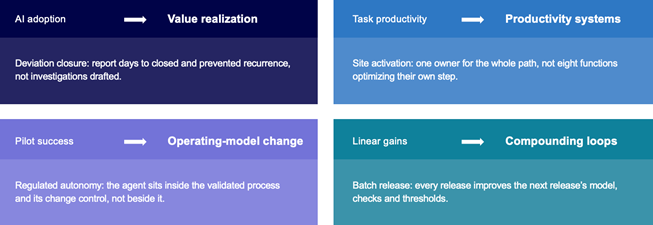
For Shweta, these issues were less separate from the broader challenge, which is that AI has often been introduced alongside existing operating models. The objective, she said, should be to embed “AI in your operating model instead of next to it.”
Why Faster Work Does Not Automatically Create ROI
Even when AI successfully frees employee capacity, organizations still need to determine what happens to that capacity.
If a task that previously required ten hours can now be completed in seven, the three hours saved do not automatically become enterprise value. The employee may simply have more available time. At the organizational level, the reclaimed capacity may need to be intentionally redirected toward additional throughput, shorter cycle times or other measurable outcomes.
Akshat emphasized that organizations should also look beyond simple adoption metrics when evaluating AI. Reliability, accuracy, employee experience and the ability to learn from experimentation can all contribute to value creation over time.
Another consideration is the foundational data environment. Organizations may be able to rapidly develop AI proofs of concept while postponing more difficult work involving data modernization, metadata, ontologies, taxonomies and governance. While this makes experimentation relatively easy, it does make enterprise-scale deployment harder.
As organizations move from proof-of-concept to production, they need to understand whether the surrounding infrastructure can consistently support AI’s capabilities at scale.
Moving From Fragmented AI to Reusable Systems
Akshat outlined several areas organizations can consider when building AI at an enterprise scale, including interoperability between models and systems, stronger integration, reusable AI services, outcome-focused KPIs and organizational change management.
Instead of letting individual functions build similar capabilities independently, organizations can develop reusable services that teams can access under appropriate controls.
A successful AI implementation needs to perform consistently within validated processes while producing evidence that supports confidence in how the system operates. This idea of “qualified evidence” came up throughout the webinar.
In regulated environments, Shweta argued, reusing evidence may be one of the most important mechanisms for creating compounding value.
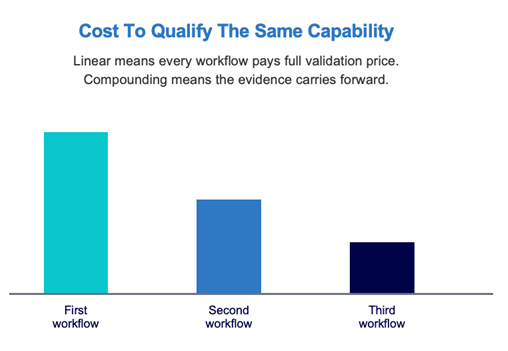
If each new AI deployment requires organizations to repeat the same qualification work from the beginning, every implementation remains an isolated project. By contrast, reusable validation packages, components, evaluation libraries, decision frameworks and baselines can potentially make subsequent deployments easier to qualify.
“Redesign changes the how, re-imagine changes the what,” Shweta said. “Neither compounds by itself or on its own.” What can compound is evidence that organizations can reuse components and requalify them rather than rebuild them.
Shweta offered a way to assess whether AI capabilities are becoming reusable across the organization: “Is the second deployment cheaper to qualify than the first?” If not, she explained, organizations may be building a series of individual projects rather than a system (Fig. 3).
From Successful Pilots to Operating Model Transformation
Pilots can demonstrate what AI is capable of under favorable conditions. Scaling those capabilities across an organization is often more difficult.
In another audience poll, 43% of respondents identified the move from pilot success to operating model transformation as the shift that could unlock the most value.
Shweta noted that pilots often benefit from conditions that disappear when a technology is industrialized. They may receive strong data, specialized personnel and exemptions from processes that become unavoidable during broader deployment.
Scaling AI therefore requires organizations to consider not only the technology, but also who owns the relevant business outcome, how the process itself should change and how AI fits within existing governance structures (Fig. 4).
Cognizant has emphasized outcome-based approaches in which AI initiatives are tied to enterprise business cases. Akshat stressed the importance of having a business leader accountable for the relevant KPI. It is not enough to begin with the technology simply because AI can be applied to a particular process.
This means we shift from asking “Where can we use AI?” to asking “Which business outcome are we trying to improve, and what role should AI play in getting there?”
Governance Can Become Part of the Value Equation
Governance becomes important as AI adoption expands in regulated environments.
During the webinar Q&A, an attendee asked how organizations can establish AI governance while regulators and governing bodies are still developing their own frameworks.
“Activity isn’t value. The leak is in the system, not in the model. What compounds is qualified evidence, not the model.”
– Shweta Singh Maniar
Shweta pointed out that organizations do not necessarily need to wait for every regulatory framework to be finalized before establishing fundamental governance principles.
Organizations can already ask what an AI system does, who determines whether its performance is acceptable, what evidence supports that determination and whether its behavior can be reproduced.
Building evidence packages, baselines and decision structures early turns governance into a mechanism for scaling AI, not just a compliance burden.
Her advice was, “Govern the principles, not the document.”
Turning AI Productivity Into Compounding Enterprise Value
The productivity illusion highlights the difference between accelerating isolated tasks and improving the performance of an interconnected enterprise. It does not suggest that AI is failing to speed up work.
Instead of measuring success primarily through adoption, prompts, tokens or hours saved, organizations can connect AI initiatives to established business outcomes. Instead of repeatedly launching isolated pilots, they can build reusable infrastructure and evidence of qualification. And instead of placing AI beside existing processes, they can examine where workflows themselves need to be redesigned.
The goal is to make productivity gains repeatable and scalable across the organization. Near the end of the webinar, Shweta reiterated three main points: “Activity isn’t value. The leak is in the system, not in the model. What compounds is qualified evidence, not the model.”
For life sciences organizations investing in AI, the key is translating individual productivity gains into measurable enterprise value.
This article was created in collaboration with the sponsoring organizations and the Xtalks editorial team.







Join or login to leave a comment
JOIN LOGIN