
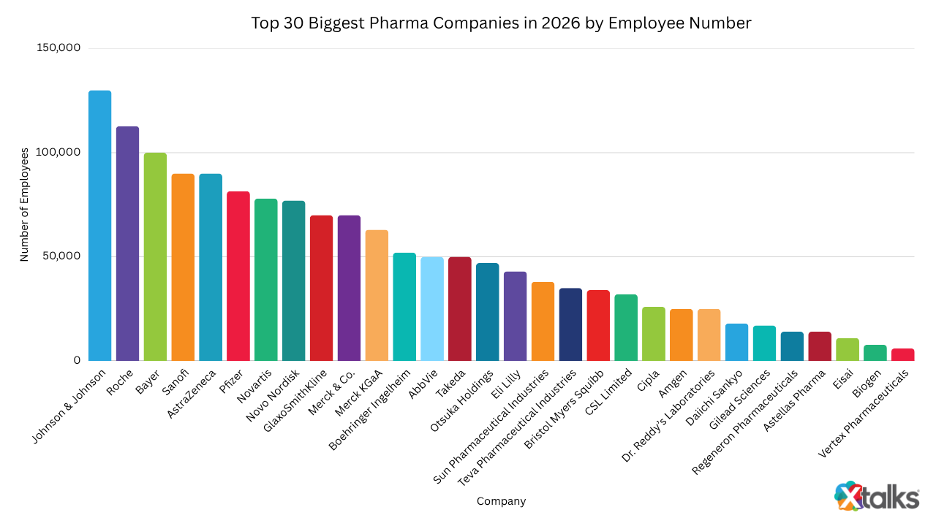
When people think about the scale of the pharmaceutical industry, revenue and blockbuster drugs usually dominate the conversation. But another powerful indicator of global reach and operational complexity is workforce size.
In 2026, the world’s largest pharmaceutical companies employ hundreds of thousands of people across R&D, manufacturing, regulatory and commercial operations, reflecting the immense infrastructure required to bring medicines to market.
Using data from CompaniesMarketCap, we’ve ranked the top 30 largest pharma companies by employee count.

1. Johnson & Johnson
Johnson & Johnson (J&J) has over 130,000 employees globally, with its pharma division contributing to 2025 revenues of $94.19 billion. The company has implemented select layoffs post-spinoff of its consumer health business (Kenvue), streamlining operations. J&J continues to invest in advanced therapeutics manufacturing, including cell and gene therapy. Its dealmaking remains aggressive, with acquisitions and partnerships across oncology and immunology.
2. Roche
With approximately 112,774 employees in 2025, Roche remains one of the largest pharma employers globally. The company reported ~$78 billion in 2025 revenue. Roche has undergone targeted layoffs, including cuts at its Genentech unit and diagnostics division in the Bay Area, California. At the same time, it is aggressively expanding manufacturing, announcing a $50 billion investment in US production and R&D, including gene therapy and weight-loss drug facilities. Strategically, Roche continues to invest in oncology and precision medicine, building on its long-standing acquisition of Genentech.
3. Bayer
Bayer’s workforce spans roughly 100,000 employees, which includes its diversified operations. Its pharmaceutical segment contributes to total revenues of approximately $45.5 billion in 2025. The company has seen a reduction of over 12,000 employees between 2023 and 2025 as part of a sweeping organizational overhaul.
4. Sanofi
Sanofi has about 90,000 people globally, with 2025 revenue around $46 billion to $48 billion. The company has undergone ongoing restructuring, including targeted workforce reductions as it pivots toward immunology and specialty care. Sanofi has also made major manufacturing investments, including biologics production and vaccine infrastructure expansion. Strategic deals include partnerships in immunology and acquisitions aimed at strengthening its pipeline in rare diseases and inflammation.
5. AstraZeneca
AstraZeneca has a workforce of approximately 90,000 employees, with 2025 revenues estimated at $58.5 billion. AstraZeneca has been focused on expansion rather than contraction, scaling manufacturing to support oncology and biologics. The company continues to invest in global production hubs, including the US and Asia, while advancing strategic collaborations in oncology and rare diseases. AstraZeneca kicked off 2026 with a couple of major manufacturing investments, including plans to invest $15 billion in China through 2030 to expand its R&D and manufacturing footprint, with a focus on advanced areas like cell therapy and radioconjugates. AstraZeneca also struck a $1.2 billion upfront deal (worth up to ~$18.5 billion total) with CSPC Pharma to license and co-develop eight obesity and metabolic disease programs, including next-generation GLP-1-based therapies, as it looks to strengthen its position in the fast-growing weight-loss market.
6. Novartis
Novartis employs 78,000 people globally, following its transition to a pure-play innovative medicines company. Its 2025 revenue is estimated at $54.5 billion. The company has been deeply engaged in restructuring, with thousands of layoffs. In 2022, the company announced plans to cut up to 8,000 roles globally, about 7% of its total workforce, to save $1 billion by 2024. This has included site closures and workforce reductions in the US and Europe. On the other hand, the Switzerland-based company has been heavily investing in its manufacturing operations to support high-value biologics and gene therapies. In February, Novartis broke ground on a $23 billion biomedical research hub in San Diego. To bolster its oncology pipeline, Novartis acquired oncology biotech MorphoSys for $2.9 billion in 2024.
7. Pfizer
Pfizer employs approximately 80,000-83,000 people globally. In 2025, it earned $62.6 billion billion following the post-COVID normalization period. The company has implemented significant cost-cutting, including over 1,700 layoffs tied to a multibillion-dollar savings program. Manufacturing remains a priority, with Pfizer continuing to optimize its global network while scaling mRNA and oncology capabilities. On the deals front, Pfizer has remained active in business development to offset declining COVID product revenues, particularly in oncology and rare disease pipelines. It’s also looking to enter the obesity space after acquiring obesity biotech Metsera last year, after a showdown with Novo Nordisk, which threw in a last-minute offer that Pfizer slammed for potentially violating antitrust and anti-competitive laws.
8. Novo Nordisk
Novo Nordisk employs over 77,000 people, driven by explosive growth in GLP-1 therapies. Its 2025 revenue amounted to $46.7 billion. The company has made massive manufacturing investments, including multi-billion-dollar expansions in the US, Brazil and Denmark to meet demand for obesity drugs. However, after rapid expansion, Novo has also signaled cost pressures, with plans to cut up to 9,000 jobs globally to streamline operations.
9. GlaxoSmithKline
GSK employs roughly 70,000 employees, with 2025 revenue estimated at $38 billion to $40 billion. The company has implemented selective layoffs as part of efficiency initiatives following its consumer health spin-off. In February 2026, GSK announced planned R&D cuts that will impact up to 350 roles across the US and UK. Last year, it cut 150 jobs at a Massachusetts vaccine development and manufacturing facility that will now be entirely dedicated to R&D. GSK continues to invest heavily in vaccine manufacturing and infectious disease infrastructure, including next-generation mRNA platforms. Last year, GSK announced it will invest $30 billion in the US over five years to expand R&D and manufacturing, including new advanced facilities, AI-enabled production and supply chain upgrades, to boost drug development, clinical trials and domestic production capacity.
10. Merck & Co.
Merck & Co. employs roughly 70,000 people, with 2025 revenue of around $60 billion to $63 billion, largely fueled by oncology blockbuster Keytruda. The company has seen limited layoffs, instead focusing on redeployment and growth areas. Merck is investing heavily in vaccine and biologics manufacturing, including US-based expansions. Its strategy includes major partnerships and licensing deals in oncology and immunology, as it prepares for eventual Keytruda patent expiry.
Related: Top 15 Pharma & Biotech Companies to Work For in 2026, According to Forbes
11. Merck KGaA
Merck KGaA has approximately 63,000 employees across healthcare, life sciences and electronics, with 2025 sales hitting $65 billion. The company has undertaken select restructuring efforts, particularly within its life sciences tools business. Manufacturing investments remain strong, especially in biologics and CDMO capabilities. Last year, as part of a broad cost-cutting programme intended to generate $3 billion in annual savings by 2027, Merck confirmed workforce reductions affecting roughly 8% of its global headcount, around 6,000 employees, affecting select administrative, sales and R&D roles in the first round. Also, last year, Merck announced the closing of its manufacturing facility in Pennsylvania, which led to 63 job cuts with a total of 300 jobs impacted.
12. Boehringer Ingelheim
Boehringer Ingelheim has a workforce of about 52,000 individuals. The company’s half-year revenue for 2025 totalled $14.7 billion. The company has pursued limited restructuring, maintaining workforce stability. It continues to invest in biologics manufacturing and animal health infrastructure. At the end of 2025, Boehringer reached an agreement with the US government to lower drug prices for American patients, including offering discounted medicines through a direct purchasing platform. It also committed to invest $10 billion in US R&D and manufacturing through 2028.
13. AbbVie
AbbVie is home to more than 50,000 people, and its 2025 earnings registered at $16.6 billion, driven by continued performance in immunology and oncology. Like other major pharma companies, AbbVie has also been cutting some of its workforce, but not as heavily as it navigates post-Humira erosion, trimming commercial and support roles. Last year, AbbVie terminated its 11-year R&D partnership with Alphabet (parent company of Google)-backed Calico Life Sciences and laid off about 100 Calico scientists as a result. AbbVie continues to invest in manufacturing, particularly in biologics and aesthetics production. Strategically, it has leaned heavily on acquisitions, including its earlier Allergan deal, and continues to pursue partnerships to strengthen its neuroscience and oncology pipelines.

14. Takeda Pharmaceutical Company
Takeda has a workforce of approximately 50,000. Its 2025 global sales amounted to about $30 billion. The company has implemented ongoing restructuring and workforce reductions to streamline post-Shire acquisition integration. Takeda continues to invest in plasma-derived therapies and biologics manufacturing. This year, Takeda announced another round of layoffs impacting 243 field-based commercial employees across 47 states and Washington, DC, tied to the upcoming US patent expiration for its antidepressant Trintellix (vortioxetine) at the end of this year. In October 2025, the company laid off 137 employees due to the shuttering of its cell therapy facility at its Massachusetts R&D site.
15. Otsuka Holdings
Otsuka Holdings is home to around 47,000 employees. Its 2025 annual sales were near $15 billion to $17 billion. The company has seen limited layoffs, maintaining steady growth. Manufacturing investments include pharmaceuticals and nutraceuticals. Its partnerships, including collaborations on CNS drugs, remain central.
16. Eli Lilly and Company
Eli Lilly and Company employs approximately 43,000 people, with 2025 revenue estimated at $65.2 billion, driven by diabetes and obesity drugs. Lilly has largely avoided large-scale layoffs, instead expanding its workforce. The company is investing billions into new manufacturing plants in the US and Europe to meet demand for GLP-1 therapies. Strategic partnerships and acquisitions continue to bolster its pipeline.
17. Sun Pharmaceutical Industries
Sun Pharmaceutical Industries employs approximately 38,000 people, with 2025 sales reaching $6.48 billion. The company has seen minimal layoffs, focusing on growth. Manufacturing investments include expanding specialty drug production.
18. Teva Pharmaceutical Industries
Teva Pharmaceutical Industries employs around 35,000 people, with 2025 revenue of $14 billion to $15 billion. Teva has undergone significant layoffs over recent years, including an 8% reduction to its workforce announced last year.
19. Bristol Myers Squibb
Bristol Myers Squibb employs around 34,000 people, with 2025 revenue of $48.2 billion. The company announced significant layoffs affecting thousands of roles last year as part of cost-cutting efforts, likely tied to upcoming patent cliffs. Manufacturing investments include biologics and cell therapy facilities. Bristol Myers Squibb remains highly active in M&A, continuing to build on its Celgene acquisition with additional oncology-focused deals.
20. CSL Limited
CSL Limited employs approximately 32,000 people, with 2025 revenue of $29.4 billion. The company has seen limited layoffs, focusing instead on integration following acquisitions. CSL continues to invest in plasma fractionation facilities globally. Its acquisition of Vifor Pharma has strengthened its nephrology portfolio.

21. Cipla
Cipla employs approximately 26,000 people, with 2025 revenue of around $3 billion to $4 billion. Cipla has seen limited layoffs, focusing on steady growth. Manufacturing investments include respiratory and generic drug production. Partnerships continue to support expansion into regulated markets.
22. Amgen
Amgen employs roughly 25,000 people, and its total 2025 revenue clocked in at $36.8 billion. The company has made select layoffs to optimize operations while integrating acquisitions. Amgen continues to invest in biomanufacturing capacity, particularly in the US. Its major strategic move includes the acquisition of Horizon Therapeutics, strengthening its rare disease portfolio. It’s also making major manufacturing investments, which include a $650 million expansion at its Puerto Rico manufacturing facility.
23. Dr. Reddy’s Laboratories
Dr. Reddy’s Laboratories has about 25,000 employees. Its 2025 revenue was about $3 billion to $4 billion. The company has maintained workforce stability. Manufacturing investments focus on generics and biosimilars. Last year, the India-based company struck a strategic collaboration with Immutep to commercialize oncology drug eftilagimod alfa, a soluble LAG-3 protein and MHC class II agonist.
24. Daiichi Sankyo
Daiichi Sankyo employs around 18,000 people, with 2025 revenue of over $12 billion, with its fiscal year officially ending March 31. The company has not seen major layoffs and instead has been focused on expanding in oncology. Manufacturing investments focus on antibody-drug conjugates (ADCs). Its partnership with AstraZeneca remains a cornerstone of its oncology growth.
25. Gilead Sciences
Gilead Sciences employs around 17,000 people, with 2025 revenue of around $28.9 billion. Gilead has implemented some layoffs, particularly in its oncology and research units. In November 2025, it announced the cutting of 17 positions stemming from a halt to the expansion of its biologics manufacturing operations in Oceanside, California, and redirecting that work to its Foster City site instead. The company had already made five additional Oceanside layoffs that year, and in December 2023, announced a 7% cut to its workforce. Manufacturing investments include cell therapy production. The company continues to pursue oncology partnerships and acquisitions, building on its Kite Pharma platform.

26. Regeneron Pharmaceuticals
Regeneron Pharmaceuticals employs about 14,000 people, with 2025 sales at $14.34 billion. The company has largely avoided layoffs and is instead continuing to expand. Manufacturing investments include large-scale biologics facilities in the US. Its long-standing partnership with Sanofi continues to drive immunology growth.
27. Astellas Pharma
Astellas Pharma employs roughly 14,000 people, with 2025 revenue of around $10 billion to $11 billion. The company has undertaken select layoffs amid restructuring. Manufacturing investments focus on oncology and gene therapy. Astellas continues to expand through partnerships and licensing deals.
28. Eisai
Eisai has approximately 11,000 employees, with 2025 revenue of around $8 billion to $9 billion. The company has undergone select restructuring, particularly in commercial operations. It continues to invest in neurology-focused manufacturing. Its partnership with Biogen on Alzheimer’s therapies remains central.
29. Biogen
Biogen employs roughly 7,500 to 8,000 people, with 2025 revenue near $10 billion to $11 billion. The company has implemented notable layoffs as it restructures around its neurology portfolio. Last year, the neuroscience biotech announced that it was cutting an unspecified number of jobs within its research division. The cuts began in July 2023 as part of a program that targeted around 1,000 jobs or roughly 11% of the company’s workforce. More layoffs are anticipated as the company aims to reduce operating expenses by $1 billion. Manufacturing investments include a $2 billion investment in North Carolina’s Research Triangle Park that the company announced last year. Strategic partnerships, particularly with Eisai, remain critical.
30. Vertex Pharmaceuticals
Vertex Pharmaceuticals employs approximately 6,000 people, with $12 billion in total 2025 revenue. Vertex has maintained workforce growth with minimal layoffs. It continues to invest in cell and gene therapy manufacturing, including facilities supporting CRISPR-based therapies. Strategic partnerships remain key in rare diseases.









Join or login to leave a comment
JOIN LOGIN