
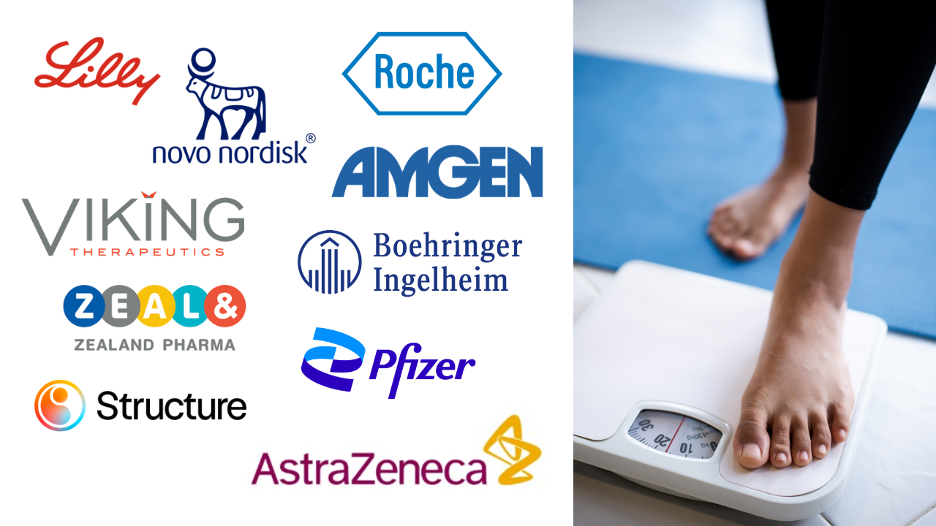
As obesity drug development expands beyond injectable GLP-1s, companies are advancing oral pills, dual and triple agonists, amylin-based candidates and metabolic disease programs.
Obesity drug development is more than mainstream: it has become part of the pharma pop culture space, so to speak. While Novo Nordisk and Eli Lilly seem to be spearheading the weight-loss revolution, 2026 is bringing newer and more diverse drugmakers into view.
Companies are also competing on oral dosing, monthly injections, tolerability, muscle preservation, long-term maintenance and related metabolic conditions.
Reuters reported in 2026 that global obesity drug sales forecasts now generally range from about $100 billion to $130 billion by 2030 to 2035, with some estimates lower than earlier projections.
Public figures have shared mixed experiences with medications such as semaglutide and tirzepatide, including weight loss, health motivations, side effects, stigma and concerns about body-image pressure.
Hormone-based therapies — ranging from GLP-1 drugs to dual and triple agonists — now dominate the 2026 obesity drug pipeline. Although GLP-1 drugs remain the most visible part of the market, new amylin-based candidates are emerging as another way to target appetite, fullness and metabolic health.
Below, we highlight 10 key obesity drug companies to watch this year.
1. Eli Lilly
Lead assets: Zepbound; Foundayo; retatrutide in Phase III
Metabolic focus: Obesity, overweight, type 2 diabetes, sleep apnea, osteoarthritis, MASLD/MASH and cardiovascular/renal outcomes
Eli Lilly’s obesity portfolio includes Zepbound, the newly approved oral GLP-1 drug Foundayo and the Phase III candidate retatrutide. Foundayo gives Lilly a pill-based option in weight management. Retatrutide adds another layer to the pipeline as a triple agonist that targets GLP-1, GIP and glucagon receptors. In Phase III data, the highest retatrutide dose led to an average weight loss of 70.3 pounds, or 28.3% of body weight, over 80 weeks.
2. Novo Nordisk
Lead assets: Wegovy; Wegovy pill; CagriSema filed with the FDA; zenagamtide/amycretin in Phase III
Metabolic focus: Obesity, overweight, type 2 diabetes, cardiovascular disease and MASH
Novo Nordisk is expanding beyond injectable semaglutide, the active ingredient in Wegovy and Ozempic. The company has added a Wegovy pill and filed CagriSema with the FDA for weight management. CagriSema combines semaglutide with cagrilintide, an amylin analog. Novo is also moving another GLP-1/amylin drug, zenagamtide (which used to be called amycretin), into Phase III testing.
Get industry leading pharma and biotech news, events and expert insights delivered to your inbox.

3. Roche
Lead assets: CT-388/enicepatide; petrelintide through its Zealand Pharma partnership
Metabolic focus: Obesity, overweight, type 2 diabetes and broader cardiometabolic disease
Roche entered the obesity race through its Carmot Therapeutics acquisition and Zealand Pharma partnership. Roche’s lead obesity candidate, CT-388/enicepatide, is a once-weekly injection that targets GLP-1 and GIP. In Phase II results, the highest dose led to 22.5% greater weight loss than placebo after 48 weeks. Roche and Zealand are developing petrelintide, a once-weekly amylin-based obesity drug.
4. Amgen
Lead assets: MariTide in Phase III
Metabolic focus: Obesity, overweight, type 2 diabetes, sleep apnea, heart failure and cardiovascular outcomes
Amgen’s obesity program centers on MariTide, also known as maridebart cafraglutide. MariTide is being studied as a monthly or less frequent injectable treatment. After one year, adults without type 2 diabetes lost up to about 20% of their body weight in the Phase II study. The Phase III MARITIME program is now evaluating MariTide in obesity and related conditions, including sleep apnea and cardiovascular disease.
5. Viking Therapeutics
Lead assets: VK2735 injection in Phase III; oral VK2735 in Phase II
Metabolic focus: Obesity, overweight and broader metabolic disorders
Viking Therapeutics is one of the most closely watched smaller biotech companies in obesity. Its lead candidate, VK2735, is a dual GLP-1/GIP receptor agonist. Viking is testing VK2735 as both an injection and a pill. The injectable version is in Phase III, while the oral version helped people lose up to 12.2% of their body weight after 13 weeks in a Phase II study.
6. Boehringer Ingelheim
Lead assets: Survodutide in Phase III
Metabolic focus: Obesity, overweight, type 2 diabetes, cardiovascular disease and MASH with fibrosis
Boehringer Ingelheim’s survodutide targets two hormone pathways involved in appetite and metabolism. In Phase III results, adults without type 2 diabetes lost an average of 16.6% of their body weight. The drug is also being studied in MASH, a serious form of fatty liver disease linked to metabolic dysfunction.
7. Zealand Pharma
Lead assets: Petrelintide moving into Phase III; survodutide through the Boehringer Ingelheim partnership
Metabolic focus: Obesity, overweight and MASH-related metabolic disease
Zealand Pharma has made a noticeable dent in the obesity space, with petrelintide and survodutide in the pipeline. Petrelintide, an amylin analog partnered with Roche, is planned to move into Phase III trials for chronic weight management in the second half of 2026. Zealand is also working with Boehringer Ingelheim on survodutide, a late-stage drug being studied for obesity and MASH.
8. Pfizer
Lead assets: PF-08653944, an ultra-long-acting injectable GLP-1 candidate
Metabolic focus: Obesity, overweight and cardiometabolic disease
Pfizer turned heads when it acquired Metsera. The deal brought in PF-08653944, an ultra-long-acting injectable GLP-1 receptor agonist. Pfizer reported positive Phase IIb data in adults with obesity or overweight without type 2 diabetes. The company said 10 Phase III trials with PF-08653944 were expected to advance in 2026.
9. Structure Therapeutics
Lead assets: Aleniglipron, an oral GLP-1 candidate
Metabolic focus: Obesity, overweight and type 2 diabetes
Structure Therapeutics is developing aleniglipron as an oral GLP-1 drug. In Phase II results, adults taking the two highest doses lost about 16% more body weight than those on placebo after 44 weeks. The company plans to move the candidate into late-stage testing.
10. AstraZeneca
Lead assets: Elecoglipron, an oral GLP-1RA candidate
Metabolic focus: Obesity, overweight, type 2 diabetes and cardiometabolic disease
AstraZeneca is developing elecoglipron as a once-daily GLP-1RA pill for obesity and type 2 diabetes. The company now plans to move it into Phase III testing after two mid-stage studies met their main goals. AstraZeneca is earlier in obesity than several companies on this list, but its oral GLP-1 program adds another large pharma player to the field.
Other Obesity Drug Companies Worth Watching
The next wave of obesity drug development is drawing in more large pharma players.
Regeneron’s Phase II COURAGE program is testing whether add-on therapies, such as the antibody trevogrumab, can help people on GLP-1 therapy lose more fat while preserving lean mass.
AbbVie is also entering the field with ABBV-295, a long-acting amylin analog licensed from Gubra. In Phase I results, adults taking the drug lost about 8% to 10% of their body weight over 12 to 13 weeks.
In metabolic liver disease, Altimmune is advancing a dual-action drug called pemvidutide for MASH. The company recently closed a $225 million public offering to support operations through an anticipated Phase III MASH 52-week data readout.
Finally, Veru is studying the drug enobosarm in older adults with obesity who are starting semaglutide. Its Phase IIb PLATEAU trial is designed to evaluate weight loss alongside fat mass, lean mass, physical function, bone mineral density and safety.
If you want your company to be featured on Xtalks.com, please email [email protected].










Join or login to leave a comment
JOIN LOGIN