
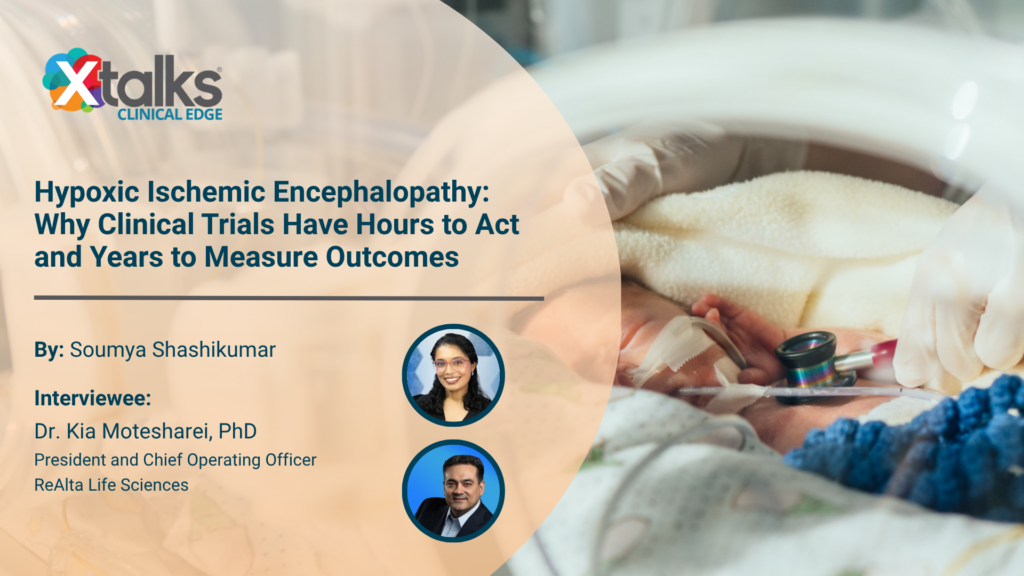
Dr. Kia Motesharei discusses how narrow treatment timelines, neonatal safety considerations and delayed developmental outcomes shape clinical research in HIE.
Hypoxic ischemic encephalopathy (HIE) can often be identified within minutes of birth, and treatment may need to begin only hours later. But while researchers have a short window to intervene, some of the outcomes they need to assess may not become clear for years.
HIE occurs when a newborn’s brain does not receive enough oxygen or blood flow around the time of birth. The current standard of care is therapeutic hypothermia, which lowers the infant’s body temperature to reduce inflammation and limit brain injury. However, there are currently no approved drug therapies for HIE.

President and Chief Operating Officer
ReAlta Life Sciences
In this Xtalks Clinical Edge feature, Dr. Kia Motesharei, PhD, President and Chief Operating Officer of ReAlta Life Sciences, discussed the inflammatory response that follows HIE, the time pressures involved in neonatal clinical trials and the challenge of selecting endpoints when motor and cognitive outcomes take years to assess.
How Inflammation Can Extend the Injury
Dr. Motesharei explained that HIE begins with a lack of blood flow and oxygen to the brain, which can lead to brain cell death. When blood flow returns, reperfusion can trigger a secondary inflammatory response and activate parts of the newborn’s own immune system.
— Dr. Kia Motesharei, President and Chief Operating Officer, ReAlta Life Sciences
Neutrophils and the complement system are two parts of this inflammatory response. These pathways can contribute to tissue damage and weaken the brain’s protective barrier, allowing other damaging molecules to enter and the inflammatory cascade to continue.
Because several biological pathways can contribute to this response, ReAlta is investigating an approach that targets both complement- and neutrophil-related pathways.
“It’s often the case that a single mechanism is not sufficient,” Dr. Motesharei said.
Researchers are studying whether interrupting the inflammatory response that follows restored blood flow could reduce subsequent brain injury.
Therapeutic hypothermia already aims to control some of that inflammation, but Dr. Motesharei sees a need for additional treatment options, especially for babies with more severe HIE.
“Without a therapeutic treatment, we’re going to have a tough time just hoping for the babies to recover from the brain injury that comes just by cooling,” he said.
The Operational Challenge of Enrolling Within Hours
Neonates with HIE may be moved to a neonatal intensive care unit (NICU) and started on cooling within hours of birth. ReAlta is evaluating an investigational therapy in a Phase II study in babies with HIE, with treatment given alongside the three-day cooling protocol.
“Babies are taken and cooled within six to 10 hours after birth. So it’s a very rapid process,” he said.
This compressed timeline also shapes recruitment and consent.

Get industry leading pharma and biotech news, events and expert insights delivered to your inbox.
“That means drug patient recruitment has a very short window. In many other studies in clinical trials, there is a lot of time that patients have to consider whether they want to participate in the clinical trial. Here, we don’t have that convenience unfortunately,” Dr. Motesharei said.
He added that parents may have little prior familiarity with HIE, leaving clinicians to explain the diagnosis and discuss trial participation within the same compressed period.
Dr. Motesharei described situations in which a newborn is transported from a community hospital to a center with a NICU while the mother is still receiving care after delivery. One parent may travel with the baby while the mother is recovering elsewhere, leaving the family in different locations while trial participation and consent are being discussed.
The investigational therapy is given intravenously while the infants are already receiving intensive care.
— Dr. Kia Motesharei, President and Chief Operating Officer, ReAlta Life Sciences
Connecting Early MRI Findings With Long-Term Outcomes
In adult stroke trials, researchers can measure changes in function, motor skills or cognition after treatment.
“But unfortunately, babies don’t have skills at that age. They haven’t developed skills that you can see the difference or the cognitive ability is not quite there,” Dr. Motesharei said.
The study will therefore follow participants for two years, when cognitive and motor outcomes can be evaluated as those abilities develop.
The trial also uses magnetic resonance imaging (MRI) of the brain on Day 4 to measure the extent of brain injury. Dr. Motesharei said ReAlta is discussing with the FDA whether MRI could serve as an earlier endpoint as part of a possible accelerated pathway.
This gives researchers an early look at brain injury within days of birth, followed by longer-term neurodevelopmental outcomes over the next two years.
“We want to be in a position that we can totally prevent brain injury or to the extent most possible to reduce brain injury to lessen the neurodevelopmental problems that may happen in the future,” Dr. Motesharei said.
Safety and the Pace of Neonatal Drug Development
Drug development has historically started in adults, Dr. Motesharei said, with pediatric use often studied after more safety experience has accumulated. Neonatal research brings added caution, including considerations around the still-developing immune system in newborns.
“Having a safety profile for this population is extremely important and has been the reason for the challenges that many companies have faced in the past,” he said.
These safety requirements, long follow-up periods and uncertainty around regulatory endpoints could be factors contributing to limited drug development activity in HIE.
ReAlta’s Phase II study includes 70 babies, with topline data anticipated at the end of the third quarter of 2026. The study combines the near-term measures discussed earlier, including early treatment and MRI-based evaluation of brain injury, with longer-term follow-up of neurodevelopmental outcomes.
Dr. Motesharei said he would like to see more companies and research groups enter the HIE field, supported by regulatory pathways that still preserve the high safety bar required for newborns.
For families, he said, even a reduction in the risk of later complications could have significant implications.
“Any incremental help or decrease in the chance of developing cerebral palsy or epilepsy as your newborn grows up is a huge improvement,” Dr. Motesharei said.












Join or login to leave a comment
JOIN LOGIN