
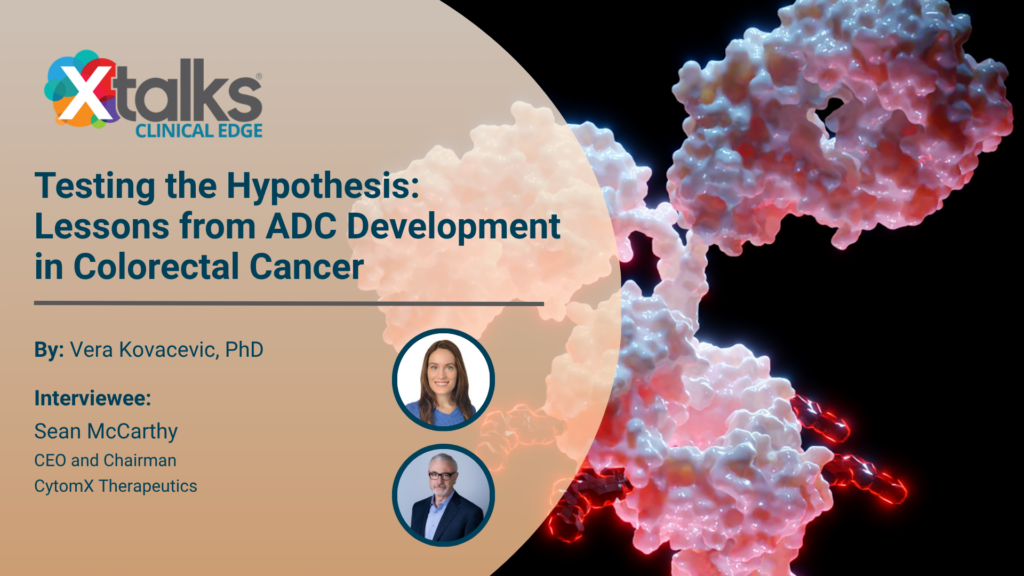
Sean McCarthy outlined how tumor-specific biology, intentional payload selection and focused clinical development can inform masked ADC development.
Antibody-drug conjugates (ADCs) have matured into an established therapeutic class, using antibodies to deliver cytotoxic payloads more selectively to tumor cells. But expanding the modality into difficult-to-treat solid tumors presents a key challenge when an attractive tumor target is also expressed in healthy tissue.
This is a critical consideration in colorectal cancer (CRC), where chemotherapy is still a backbone of treatment, but options become increasingly limited in later lines of therapy.

CEO and Chairman
CytomX Therapeutics
In this Xtalks Clinical Edge feature, Sean McCarthy, CEO and Chairman of CytomX Therapeutics, explored how ADC design and tumor-selective activation may address these clinical gaps.
Using varsetatug masetecan, an investigational masked ADC targeting epithelial cell adhesion molecule (EpCAM), as a case study, Sean discussed how tumor biology can inform drug selectivity, payload selection and clinical development. He also emphasized the value of highly focused clinical studies, or what he calls “killer experiments,” for testing a therapeutic hypothesis early in development.
Using Tumor Biology to Engineer Greater Selectivity
In targeted oncology, a protein can be highly abundant on cancer cells without being exclusive to them.
EpCAM is expressed at high levels in colorectal tumors, making it an appealing target. Sean explained that its presence in normal tissues has complicated previous attempts to target the protein.
For ADC developers, that creates a fundamental selectivity problem. A potent cytotoxic payload can be valuable if it reaches the tumor, but exposure in healthy tissue can constrain how the therapy is used.
One approach is to make target binding dependent on conditions within the tumor microenvironment.
— Sean McCarthy, CEO and Chairman, CytomX Therapeutics
Sean described CytomX’s masking strategy, intended to prevent an antibody from binding its target until the mask is removed. The approach takes advantage of proteases, enzymes involved in breaking proteins into smaller components. Protease activity is tightly controlled in normal tissues but can become elevated in tumors as cancer cells invade surrounding tissue and metastasize.
“In tumor tissue, they’re switched on. So, we reasoned that we could make a masked antibody with a protease cleavable linker next to the mask. And the idea being that the mask would then be cleaved off by proteases in the tumor, but not in normal tissues,” Sean said.
He likened the proteases to molecular scissors that remove the mask once the antibody reaches the tumor.
This tumor-selective activation could provide another way to approach proteins that are biologically attractive but have historically been difficult to target because they are also expressed in healthy tissue.

Get industry leading pharma and biotech news, events and expert insights delivered to your inbox.
Matching ADC Design to the Disease
Target selection is only one component of ADC development. Developers must also consider the antibody, linker, payload, and biological characteristics of the cancer being treated.
Sean described the development of the masked ADC as a series of connected design decisions
After identifying EpCAM as the target and using masking to address its expression in normal tissues, the team had to determine what therapeutic mechanism should be attached to the antibody. It ultimately selected a topoisomerase-1 inhibitor payload.
The rationale was grounded in existing colorectal cancer biology. Irinotecan, another topoisomerase-1 inhibitor, is already a component of commonly used chemotherapy regimens in CRC. The team therefore had evidence that colorectal tumors could respond to this general mechanism before incorporating a related payload into the ADC.
A highly expressed tumor antigen alone does not determine whether an ADC will work. The payload must also make biological sense for the disease, while the linker and antibody determine where and how that payload is delivered.
For clinical developers, the relevant question is whether the complete ADC has been intentionally constructed around the biology of the cancer it is meant to treat.
Asking a Focused Question in Early Clinical Development
The company’s approach to developing the candidate also shaped its entry into clinical testing.
Traditional Phase I oncology studies often enroll patients across multiple solid tumor types. These all-comer studies can establish safety and provide an opportunity to identify early signals of activity in different cancers.
— Sean McCarthy, CEO and Chairman, CytomX Therapeutics
Sean said the team considered that approach because EpCAM is expressed across several solid tumors. But there was a potential drawback. A signal appearing in one or several tumor types might still leave developers without a clear answer about where the therapy should go next.
Instead, the initial study focused on patients with metastatic CRC.
CRC is historically difficult to treat in the late-line setting. At the same time, the high expression of the intended target in CRC made it a direct test of the therapeutic hypothesis.
His takeaway was to design early clinical studies around questions that can produce actionable answers.
“If you’re developing a new technology to translate that technology into the clinic, consider doing highly focused clinical experiments, the killer experiments, so that the answer you get is as definitive as possible,” Sean said.
A tumor-specific Phase I study will not suit every oncology program. The choice depends on the target, therapeutic mechanism, available preclinical evidence, and intended patient population, Sean went on to say.
How Late-Line CRC Shapes Trial Endpoints
Clinical development becomes more complex as patients move into later lines of treatment for metastatic CRC.
Sean described a treatment pathway in which patients can initially respond well to chemotherapy-based regimens, while outcomes generally worsen after disease progression and subsequent lines of therapy. By the third- and fourth-line settings, patients may have rapidly progressing disease, multiple previous treatments and fewer remaining options.
Sean noted that overall survival and progression-free survival remain established endpoints in late-line CRC. Objective response rate, which measures the proportion of patients whose tumors shrink by a predefined amount, has supported accelerated approval strategies in some other tumor types. In late-line CRC, however, limited historical tumor response has meant less precedent for using response rate in this way.
He suggested that this could change if new therapies begin producing more consistent objective tumor responses in later treatment settings.
Another area being explored is circulating tumor DNA (ctDNA).
Tumors can release fragments of DNA into the bloodstream, allowing researchers to measure tumor-derived genetic material through blood samples. Changes in ctDNA could potentially provide an earlier indication of whether a tumor is responding to treatment.
“And it’s becoming increasingly recognized that changes or decreases in circulating tumor DNA can be indicative of whether or not a patient’s tumor is responding to a particular therapy,” Sean said.
He emphasized that the use of ctDNA is currently an early and experimental approach. Although it has yet to be validated as a regulatory endpoint, ongoing research is examining its potential as a blood-based measure of treatment response across multiple tumor types.
From Target Selection to Clinical Translation
The development of ADCs in CRC illustrates how decisions made at the laboratory stage can shape the clinical strategy that follows.
The next questions extend beyond late-line disease. Sean discussed evaluating combinations with treatments used earlier in the CRC pathway and the longer-term possibility of moving ADCs into earlier treatment settings.
Whether ADCs can ultimately reduce reliance on conventional chemotherapy in those settings will require substantially more clinical evidence. For now, ADC development in CRC shows how target biology, drug design and the clinical experiment used to test them can remain closely linked throughout translation.












Join or login to leave a comment
JOIN LOGIN