
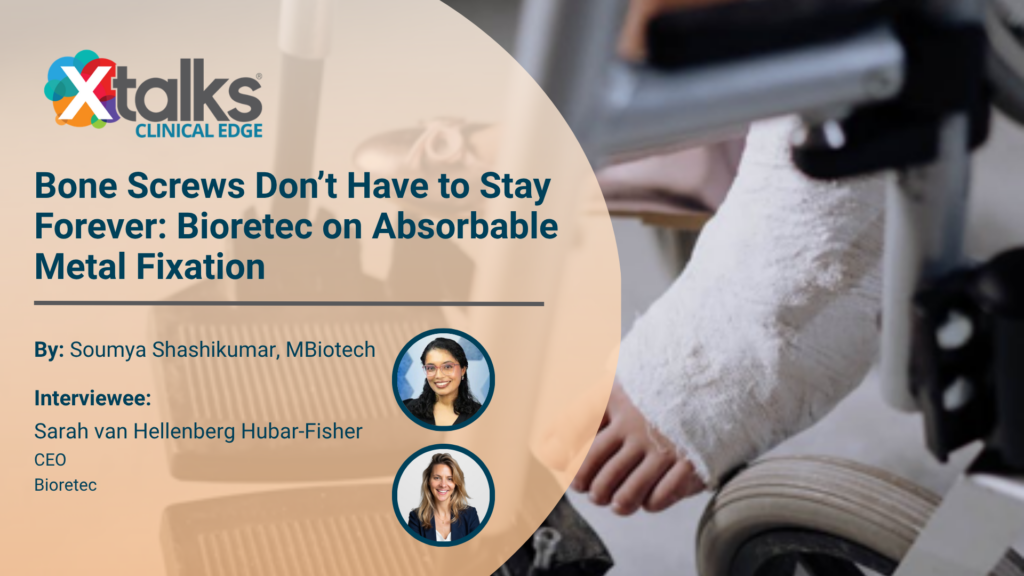
Bioretec CEO Sarah van Hellenberg Hubar-Fisher discusses metal-like absorbable implants, long-term degradation evidence and payment pathways for outpatient fracture care.
When a broken bone needs surgical repair, the first priority is to hold the bone in place long enough for it to heal. This process is called fracture fixation.
For some patients, the metal hardware used for fixation can become a problem later, especially if it causes pain, discomfort or leads to a second surgery for removal.
A 20-year Finnish registry study found that 27% of adults who had ankle fracture surgery later had their hardware removed. Hardware removal has been estimated to make up 5% to 15% of orthopedic surgeries, and an even larger share of elective orthopedic procedures.
There is not always a clear answer, however, on whether hardware should stay in place or be removed, once the fracture has healed, particularly if the patient does not have symptoms.

CEO
Bioretec
As Sarah van Hellenberg Hubar-Fisher, CEO of Bioretec, described it, the field of fracture repair has been looking for an implant material that “feels like metal” and “acts like metal,” but also has an absorbable aspect.
Finnish company Bioretec is stepping in with orthopedic implants that are absorbable.
The company’s RemeOs implants use a magnesium-based absorbable metal designed to support fracture fixation during healing and gradually degrade over time.
Xtalks spoke with Sarah about these absorbable implants, alongside outpatient fracture care, regulatory and reimbursement pathways and the evidence needed for next-gen orthopedic devices.
Outpatient Orthopedics Is Changing Implant Expectations
Fracture care is increasingly moving into outpatient settings.
“You’re seeing a general shift to outpatient procedures, whether they’re hospital outpatient centers or ambulatory surgery centers,” Sarah explained. “And so therefore, really ensuring that you have efficient processes, but also taking into consideration that patients are leaving and follow-up times or follow-up commitment from patients when they don’t have symptoms after procedures is really tough to get people to return for those follow-up appointments,” explained Sarah.
Surgeons should be able to discharge patients knowing the bone is stable, properly aligned and supported through recovery. Bioretec sees absorbable implants as one way to help provide that support without leaving permanent hardware behind.
Get industry leading pharma and biotech news, events and expert insights delivered to your inbox.

The Problem With Hardware That Has Already Done Its Job
Traditional fracture fixation often uses permanent metal implants such as titanium. These materials are familiar to surgeons and have a long history in orthopedics. But once the bone has healed, some patients may experience discomfort from hardware that is no longer needed.
Sarah pointed to removal surgeries as one reason the field is exploring new materials. Outside of pediatrics, she said, many removal surgeries are linked to pain and discomfort rather than fixation failure.
For patients, once the fracture has healed, the fixation has done its job and they no longer want metal in the body.
Absorbable materials are not new to orthopedics, but earlier generations have often been polymer-based. Sarah noted that some polymers have been associated with later-stage events because of how they degrade in the body. That history has pushed the field to look at alternatives, including absorbable metal alloys.
“There has been a desire to try to find a solution like a magnesium-based alloy or a metal-based implant that could replace polymers in the future,” Sarah said. “The field is asking, what can we look for that feels like metal and acts like metal, like titanium that we’re used to, but also has that absorbable aspect.”
How FDA and CMS Decisions Can Support Device Adoption
Adoption of next-gen orthopedic implants also depends on regulatory pathways, reimbursement and whether hospitals and surgery centers can use the technology in routine care.
Bioretec has received FDA Breakthrough Device designations for RemeOs products, including the RemeOs DrillPin, and Sarah said that pathway has helped the company work through regulatory questions for novel absorbable implants.
“There is no predicate. Maybe there was no animal model that’s ever been developed as a standard of care on how that technology would get tested,” Sarah explained. “So those kinds of breakthrough regulatory pathways have been really helpful to us in trying to navigate that regulatory process with the FDA in particular.”
Reimbursement can also influence whether hospitals, surgery centers and surgeons can adopt new technologies. Bioretec’s RemeOs Screw LAG Solid received Transitional Pass-Through Payment status from CMS for outpatient use, which can provide temporary additional Medicare payment for certain new outpatient technologies while CMS collects more cost data.
Why Evidence Takes Time for Absorbable Implants
Clinical trials are quite complex, and they are even more so for absorbable orthopedic implants. With a new biomaterial, developers may need to answer questions not only about fixation, but also about how the material behaves as it degrades.
These challenges can begin before human studies, especially when companies need to design or validate new animal models for regulators. Developers also have to consider how much clinical evidence is needed for future products made from the same material.
Degradation time is one of the most important questions.
“The degradation time is definitely one that comes up,” Sarah said. “If you’ve got a larger piece of material, does it have a faster or slower degradation time than if you have a smaller piece of material in the body, and how can we validate that?”
Bioretec took a long follow-up approach for its de novo pathway. Patients were followed for three years to show degradation over time, giving the company evidence to state that the implants fully degrade in the body between two and three years.
The company received CE mark for its first metal absorbable trauma screw with more designs and a broader indication set, allowing it to collect post-market and clinical follow-up data outside the US.
“The FDA’s willingness now to really look at real-world evidence as part of the regulatory process allows us then to leverage data from different geographies around the world where our product is actually already approved and being used for things we’re looking for approval for in the United States,” Sarah said.
Material Choices and Cost Questions in Fracture Fixation
The material used for fixation can change how an implant performs during and after healing.
“I really think the majority of this is still a material science space. The material makes a difference,” Sarah said. “I’m not sure that the surgical techniques or the actual tools applied necessarily are going to change drastically overnight, in which case you’re just looking for the optimal material to do the job.”
“I think we’d be remiss if we forgot about the economic side as well,” Sarah said.
Sarah added that fracture fixation may also see changes in how implant-related tools and accessories are handled, including whether single-use instruments are bundled with implant costs instead of managed separately through re-sterilization.
If you want your company to be featured on Xtalks.com, please email [email protected].













Join or login to leave a comment
JOIN LOGIN