
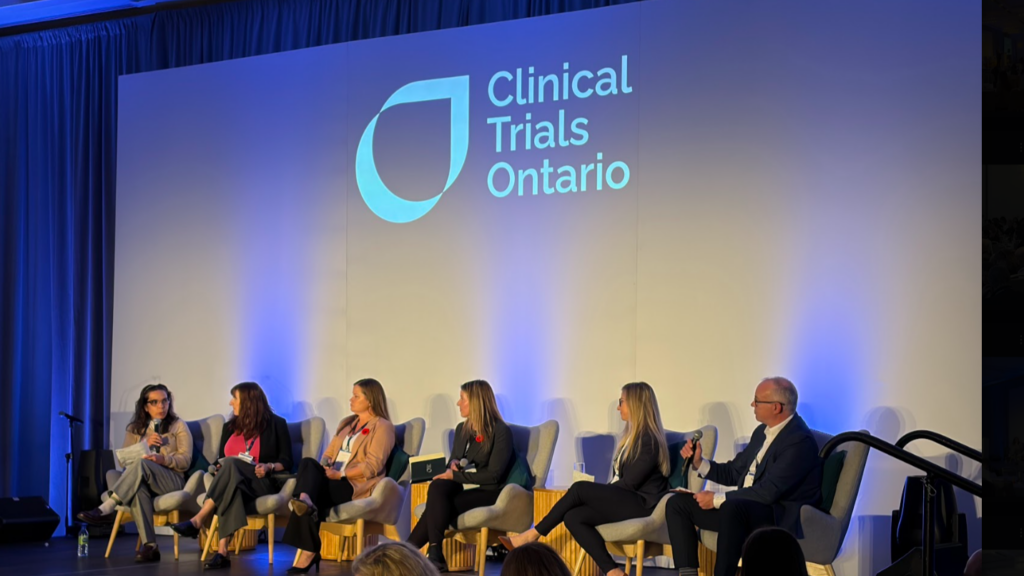
CTO 2026 examined trial delays and AI oversight, while singer-songwriter Shawn Hook shared his experience of cancer, recovery and research consent.
Behind every clinical trial is a complex web of contracts, ethics approvals and research logistics. But for patients waiting on a trial, speed is personal.
At the 2026 Clinical Trials Ontario (CTO) Conference in Toronto, held on November 4 and 5, researchers, healthcare leaders and patient advocates gathered to discuss faster trial start-ups and ways to strengthen Canada’s place in global clinical research.
Held November 4 and 5, the conference brought together researchers, healthcare professionals, industry leaders and patient advocates. Xtalks attended as a media partner, speaking with speakers and attendees about trial start-up, AI, health data and Indigenous leadership in research.
British Columbia-based singer-songwriter Shawn Hook brought real-world urgency to the conference, sharing his fight against tonsil cancer, his journey to reclaim his singing voice and why a clear, respectful consent process meant so much to him as a research participant.

Get industry leading pharma and biotech news, events and expert insights delivered to your inbox.
Getting Canadian Clinical Trials Off the Ground
Susan Marlin, President and CEO of CTO, said competitiveness comes down to sharing the best ideas across Canada and backing the people who carry them out.
Most trials run in busy hospitals and clinics, alongside the demands of patient care.
“We really need to work locally to support the people who do those trials to ensure that we’re competing as well as we can across Canada,” she said.
QuickSTART is built for that reality. It coordinates contracting, budgets and research ethics review within a 45-day start-up timeline. The program has already reported results from five pilot start-ups across four sites and two sponsors, all completed in under 40 days, some in under 25.
Eleana Rodriguez, Director of Research Legal for Clinical Trial Agreements at University Health Network (UHN), moderated the QuickSTART panel.
“We want to make not only Ontario, we want to make Canada the first choice for all these pharma companies to do clinical trials here,” she said.
Eleana also emphasized how crucial it is to create more opportunities for patients to participate in research and access potential treatments.
Eisha Amjad, a Clinical Research Coordinator in Research Operations at The Hospital for Sick Children (SickKids) added, “How do we accelerate the start of clinical trials in Canada? That is something that I am really interested in.” Her team was actively involved in QuickSTART.
Heidy Morales, a Research Quality Associate at UHN and a former clinical research coordinator, was glad to see progress on coordinating ethics review, particularly in Nova Scotia.
“Kudos to Nova Scotia for getting things centralized, which we wish we could do in other bigger provinces,” she said.
CanReview aims to replace duplicated ethics reviews with a single review for studies spanning provinces and territories. In her presentation, Susan said the system was ready to pilot its first studies, with nearly 50 sites and research ethics boards across four provinces signed on.
Where AI Helps and Where People Need to Check
Dr. Shurjeel Choudhri, Senior Vice President and Head of Medical and Scientific Affairs at Bayer, sees AI helping at every stage of a trial. Digital twin simulations can help teams explore trial design choices before a study begins, and tools that read unstructured medical records can match patients to eligibility criteria. During a study, they can flag unusual data for review.
He also described how quickly AI tools can help with data analysis and study report preparation.
“Things that would’ve taken weeks to months, now we can do in hours,” he said.
He stressed that people need to stay involved, including checking AI-written code.
“So I think the goal is to use AI as a tool, speed things up, but keep that human in the loop throughout.”
UHN Research Quality Associate Amanda Weston wanted the risks discussed as openly as the promise.
“I think it’s also important to consider potential risks and ethical considerations and downsides to AI as well,” she said.
Nicole Yada, Director of VITAL, discussed how clinical data can support research. She oversees the platform’s strategy, operations and partnerships.
“So the VITAL Platform was founded really with an emphasis on making clinical data available for research and innovation. And clinical trials are really one of the important use cases for that.”
She found the keynote on Denmark’s use of clinical data for research and trials at scale particularly inspiring.
Separating Drug Effects From Expectations and Support
During his conference presentation, Dr. Ishrat Husain, Department Head and Program Medical Director of Mental Health at UHN, cautioned that the evidence for psilocybin in depression and substance use disorders was still low in certainty.
Psilocybin’s noticeable psychological effects make blinding difficult, as participants may recognize which treatment they received.
People may also join expecting a life-changing result. His team measures those expectations and examines how they relate to outcomes.
Trained therapists prepare participants, support them during dosing and follow up afterwards. Researchers need to work out how much the drug, participants’ expectations and the surrounding psychological support each contribute to outcomes.
From Consultation to Shared Governance
Dr. Tibetha Kemble (Stonechild), Director of Indigenous Clinical Trials at the University of Alberta, focused on who makes decisions about research affecting Indigenous communities.
She distinguished consultation, which gathers input but leaves decision-making where it was, from shared governance, where authority is explicitly shared. Practical steps include defining who holds decision rights and building accountability to communities.
In her interview with Xtalks, Dr. Kemble spoke about the growth of Indigenous leadership in clinical research.
“I think I’m really excited about the growth and evolution of indigenous peoples taking up space and creating our own space within clinical trial research here in what is now known as Canada.”
She also recognized Inuit, First Nations and Métis clinical trial scientists and leaders working to change how research is conducted.
The Human Heart of CTO 2026: Why Consent Mattered to Shawn Hook
Before cancer surgery, Shawn asked his care team to play Bob Marley’s Three Little Birds. Music had been his escape throughout his life. Now it accompanied him into an operating room.
Recovering from tonsil cancer treatment meant relearning how to speak, swallow and sing. He spoke about the support of family, friends and his partner, and his return to performing in March 2024.
Near the end of treatment, his oncologist invited him to join BC Cancer’s Personalized OncoGenomics (POG) program. The research studies genetic information from patients and their tumors to help understand cancer biology and inform treatment planning.
Shawn took part as a precaution, in case the cancer returned. After years of music-industry contracts, he appreciated a research consent process that laid out the risks and made clear he could step away at any time without anyone holding it against him.
Shawn thanked the coordinators who collect samples and arrange follow-ups, the ethics boards protecting participants and the people working to secure research funding.
He credited progress to people willing to go first, from researchers committing years to an untested idea to participants who agree to take part. Shawn asked the research community to move quickly, within the limits of safety, to turn promising treatments into standard care.
At CTO 2026, Xtalks saw a blend of science and patient perspective. From lively panel-audience exchanges to Shawn’s personal journey, punctuated by music, it was a truly memorable event.
If you want your company to be featured on Xtalks.com, please email [email protected].













Join or login to leave a comment
JOIN LOGIN