

In a recent Xtalks webinar, experts discussed how an integrated obesity evidence strategy can help sponsors capture patient-relevant outcomes, address payer and regulator needs, differentiate their drug and generate evidence of long-term value beyond weight loss.
Obesity medications are achieving levels of weight loss that were previously difficult to reach without surgery. As the development landscape becomes more crowded, weight-loss efficacy remains foundational but may no longer provide the full value story that drives long-term success. Sponsors are increasingly considering how clinical trials can differentiate their therapies by demonstrating durable clinical benefits, meaningful changes that patients experience in their daily lives and value in routine clinical practice.
In a recent Xtalks webinar, experts from PPD clinical research solutions and Clario endpoint solutions, part of the clinical research business of Thermo Fisher Scientific, discussed how obesity trials can incorporate patient-centered outcomes, objective measures, payer considerations and real-world evidence. Speakers included Eling Gaines, Dr. Hayley Karn, Dr. Todd Rudo, Almudena Olid Gonzalez, Dr. Firas Dabbous and Dr. Leslie Harrold.
Ms. Eling examined the gap between controlled trials and routine treatment. Dr. Karn discussed patient-reported outcomes (PROs), while Dr. Rudo reviewed objective measures such as imaging modalities for assessing body composition analysis and activity measures with wearables. Almudena addressed payer and health technology assessment (HTA) considerations and integrated evidence planning. Dr. Dabbous and Dr. Harrold discussed the role of real-world evidence across development
The speakers outlined a broader evidence strategy that connects weight-loss efficacy with patient-relevant outcomes, payer considerations and performance in routine care.
Closing the Gap Between Trials and Routine Care
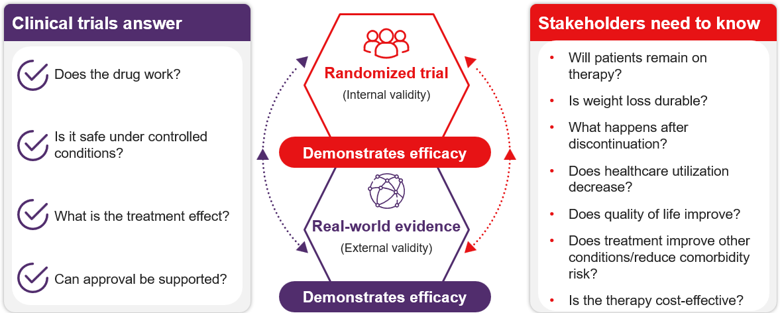
Randomized clinical trials establish whether a treatment works under controlled conditions but may not fully capture its effectiveness across diverse patient populations and the complexities of routine clinical practice.
Eling noted that participants enrolled in current obesity trials can achieve double-digit weight loss with relatively high treatment adherence. However, discontinuation rates may still range from approximately 25% to 35% — and can be even higher in longer duration trials. In real-world settings, discontinuation may be higher still, reaching approximately 47% to 50% at 12 months.
Participants may also receive structured lifestyle support, optimized dosing and close monitoring during the randomized clinical trials. In routine care, affordability, access, structured lifestyle support, tolerability and treatment complexity may make it harder for patients to remain on therapy.
“These findings suggest that treatment persistence may become one of the most important determinants of long-term success,” Eling said.
Development teams may therefore need to consider persistence, access and long-term follow-up. At the same time, protocols are still being planned, so they can assess not only weight-loss efficacy but also whether benefits are maintained under conditions that more closely reflect routine care.
“It might seem very obvious, but we need to listen to patients to identify those outcomes that are meaningful to them.”
— Dr. Hayley Karn, Senior Research Scientist, PPD Evidera Patient-Centered Research
Capturing Outcomes That Matter to Patients
Dr. Karn described weight loss as “the foundational endpoint for obesity drug development,” but added that it is “increasingly being viewed as a starting point rather than the full story.”
Patients value benefits that are not captured by body weight reduction alone. These “non-scale goals” can include better sleep, emotional well-being, improved physical functioning, changes in eating behaviors, greater confidence and increased participation in daily or social activities (Fig. 1).

“It might seem very obvious, but we need to listen to patients to identify those outcomes that are meaningful to them,” Dr. Karn said.
Patient-reported outcome measures (PROMs) are standardized questionnaires that allow patients to report directly on how they feel and function. Some assess general health or quality of life, while others focus on obesity-related experiences.
Qualitative research can help sponsors select and validate PROMs. Concept-elicitation interviews identify outcomes that matter to patients, while cognitive interviews assess whether questions and response options in PROMs are relevant, comprehensive and understood as intended. In-trial interviews can also help explain why an observed change is meaningful to patients. Emerging concepts such as “food noise” — persistent thoughts or preoccupation with food — may require entirely new PROMs as obesity therapies continue to evolve.
Dr. Karn discussed a review by her team that identified a number of PRO measures that have been incorporated into FDA and EMA submission packages for approved obesity management medications (OMMs), but none have resulted in a label claim.. The review found that regulatory feedback sometimes cited limited qualitative evidence or interviews were conducted with patients who did not adequately represent the intended trial population. Qualitative interviews with patients are a crucial component of patient-focused drug development (PFDD) and can help inform the selection, development and validation of meaningful trial PROMs. This is also consistent with FDA’s PFDD guidance series on incorporating patient experience into drug development..
Assessing the Type of Weight Loss
Patient reports describe how treatment affects daily life, while medical imaging assessments can show what is changing inside the body.
A scale cannot determine whether a participant is losing fat, muscle or bone density. Loss of muscle mass and/or bone density could offset some of the expected health benefits of weight reduction.
Dual-energy X-ray absorptiometry, or DXA, can assess body composition, including fat mass and lean mass. and bone mineral density. It is widely available, relatively inexpensive and associated with very low radiation exposure.
MRI can provide more detailed measurements of muscle and fat compartments, including visceral fat around the organs and subcutaneous fat beneath the skin. However, it is generally more expensive and operationally complex than DXA. With these considerations, despite being more informative than DXA, MRI is more commonly deployed in smaller, early phase studies, with DXA more commonly included in late phase development. Dr. Rudo noted that the 2025 FDA draft guidance specifically addresses the importance of assessing the type of weight loss that is occurring, not just the quantity.
These objective measurements can complement patient reports by providing additional information on treatment effects and potential risks.
Measuring Daily Function and Sleep
Obesity can affect physical functioning, mobility and sleep, but changes in these areas can be difficult to capture through periodic clinic visits.
Objective measures complement patient-reported outcomes by providing independent evidence of how therapies affect body composition, physical function and sleep, creating a more complete picture of treatment benefit.
In-clinic sensor systems can assess prescribed tasks involving gait, balance and mobility under standardized conditions. Remote wearable devices can collect passive data as participants go about their daily lives.
Depending on the technology, wearables may measure physical activity, vital signs and sleep quality outside the clinic. They can support decentralized or hybrid trial designs which can meaningfully reduce patient burden.
Assessment of sleep quality metrics can also provide useful information about the broader effects of treatment. Dr. Rudo referenced a secondary analysis of the S-LiTE trial, published in Sleep, in which shorter sleep duration or poorer sleep quality was associated with greater weight regain during the maintenance phase of weight-loss treatment.
Wearable devices may provide a lower-burden option for assessment of sleep quality in obesity trials, as compared to traditional in-clinic formal sleep assessment.
“Weight loss sometimes tends to plateau in the long term. Sometimes weight is recovered. So, if you’re linking that weight loss to some of the other outcomes, you need to make sure that value or benefit is being sustained in the long term. And you might not be able to mitigate this through your trial on its own.”
— Almudena Olid Gonzalez, Director, Market Access, PPD Evidera Health Economics and Market Access
Designing Evidence for Payers and HTA Bodies
Even substantial weight loss may not answer every question raised by payers and HTA bodies.
Obesity is a heterogeneous disease, with patients varying in their comorbidities, treatment histories, unmet needs, and anticipated treatment benefits. Sponsors therefore need to define the intended treatment population and consider relevant subgroups, such as people with cardiovascular disease, diabetes or metabolic dysfunction-associated steatohepatitis. Countries may also differ in their obesity treatment guidelines, including the BMI threshold considered before treatment is initiated.
Comparator selection is increasingly important as the obesity treatment landscape evolves. While placebo-controlled trials remain the regulatory standard for establishing efficacy, active-comparator studies can provide valuable evidence on relative clinical benefit. Study design should account for differences in dosing, administration, tolerability, treatment burden and adherence.
“HTA bodies and payers want to see outcomes, want to see things beyond weight loss,” Ms. Almudena Olid Gonzalez said. “Weight loss in of itself is not necessarily a surrogate for patient-relevant outcomes all the time. And think about how to demonstrate long-term impact. Weight loss sometimes tends to plateau in the long term. Sometimes weight is recovered. So, if you’re linking that weight loss to some of the other outcomes, you need to make sure that value or benefit is being sustained in the long term. And you might not be able to mitigate this through your trial on its own.”
Depending on the intended positioning and market, payers and HTA bodies will look to confirm that weight loss correlates with evidence on cardiovascular, renal or metabolic outcomes, quality of life, treatment persistence and long-term durability.
Some of these questions may require longer-term evidence on durability, treatment discontinuation and healthcare utilization beyond a conventional randomized trial.
Connecting Efficacy With Real-World Value
“Randomized clinical trials and real-world evidence aren’t competing approaches. They are complementary,” Dr. Dabbous said.
Real-world evidence can evaluate effectiveness, persistence and value in routine practice and across broader patient populations.
Longitudinal data may help determine whether patients remain on treatment, why they discontinue, whether weight loss is maintained and whether quality of life or healthcare use changes over time (Fig. 2).
Before approval, real-world evidence can clarify disease burden, unmet need and treatment patterns while informing site selection, eligibility criteria, recruitment and endpoint planning.
Dr. Harrold explained that real-world evidence “is no longer viewed as something you generate after a product reaches the market. It’s becoming an integral part of evidence generation from the very beginning.”
Clinical registries offer flexible platforms for generating longitudinal real-world evidence and supporting targeted sub-studies throughout development.
Other sources include electronic health records, insurance claims, digital technologies and patient-reported measures. After an asset is approved, these data can support safety monitoring, comparative-effectiveness and health economic research, payer discussions and guideline development.
“So start early and start together to do this.”
— Almudena Olid Gonzalez, Director, Market Access, PPD Evidera Health Economics and Market Access
Moving Toward an Integrated Evidence Plan
The speakers recommended bringing clinical development, patient-centered research, real-world evidence, medical affairs, health economics and market access teams together earlier in development, as a single evidence-generation strategy.
Almudena recommended aligning payer, HTA and real-world evidence needs earlier through integrated scientific advice, and a cross-functional evidence plan across the product lifecycle.
“Some evidence takes years to develop and get published or get reviewed,” she said. “So start early and start together to do this.”
Joint protocol review can help teams identify evidence gaps, avoid duplicated research and determine which questions should be addressed in clinical trials or through longer-term real-world follow-up.
The webinar highlighted an expanding evidence strategy for successful obesity treatment development
As the team summarized, “Future obesity management and future obesity trials is not simply achieving greater weight loss. It’s delivering sustainable, personalized and clinically and commercially meaningful outcomes supported by both the clinical trial and the real-world evidence.”
This article was created in collaboration with the sponsoring company and the Xtalks editorial team.










Join or login to leave a comment
JOIN LOGIN