
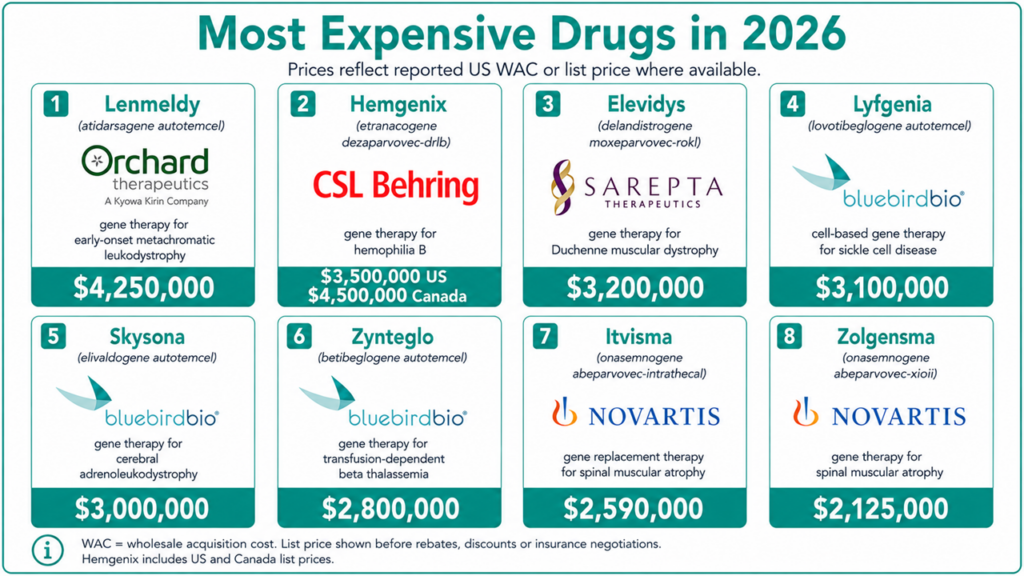
From Lenmeldy to Zolgensma, the most expensive drugs in 2026 show how rare disease science, specialized manufacturing and upfront payment models are testing healthcare systems.
The most expensive drugs in 2026 are not usually daily medicines taken by millions of people. Many are one-time gene or cell therapies for rare, serious diseases where the eligible patient population is small, the manufacturing process is specialized and the price is concentrated into a single treatment.
That makes them hard to compare with regular medicines. A drug taken every day spreads its cost over months or years. A one-time therapy puts most of the cost at the start.
Why One-Time Drugs Can Carry Multimillion-Dollar Prices
USC Schaeffer researchers have noted that the US payment system was built around chronic treatments paid over time, making it a poor fit for one-time therapies whose value may accrue over decades.
Some therapies use a patient’s own cells, which may be collected, frozen, shipped to a manufacturer, changed in a lab, tested and sent back to the hospital. This process takes a long time. The National Cancer Institute says the CAR-T process, from blood collection to infusion, currently takes about three to five weeks.
Advanced therapies are not like pills waiting on a pharmacy shelf. They involve hospitals, manufacturing sites, quality-control teams, shipping partners, insurers and specialized treatment centers before a patient receives treatment.
Reuters reported that the median annual list price for new US drugs reached more than $370,000 in 2024, more than double the level reported in 2021. They also shared that 72% of new drugs launched in 2024 were for orphan diseases, which affect fewer than 200,000 Americans.
Get industry leading pharma and biotech news, events and expert insights delivered to your inbox.

Drug Pricing Explained, a project by NORC at the University of Chicago, noted that cell and gene therapies can cost anywhere from a few thousand dollars to millions for a single dose or short course.
Zolgensma, a gene therapy first priced at $2.1 million for infants with spinal muscular atrophy (SMA), shows why these costs can climb. Its eligible patient group is small because it is approved only for children under age two. The therapy also uses an AAV vector, a delivery tool that can be difficult to produce in large amounts. In addition, Zolgensma can be manufactured at only two locations and must be administered within 14 days of arriving at a treatment site.
Zolgensma’s example paints a precedent for ramping up costs.
In our blog, we spotlight some of the most expensive drugs in 2026.
High-Price Drugs in 2026
Lenmeldy
Maker: Orchard Therapeutics, now part of Kyowa Kirin
Drug type: One-time gene therapy using a child’s own modified blood stem cells
WAC/list price: $4.25 million
Where available: US; FDA-approved for certain children with early-onset metachromatic leukodystrophy (MLD)
Lenmeldy (atidarsagene autotemcel) is used for children with specific early forms of MLD, a rare inherited disease that damages the brain and nervous system. The FDA approved Lenmeldy in 2024 for children with pre-symptomatic late infantile, pre-symptomatic early juvenile or early symptomatic early juvenile MLD. Its US WAC was set at $4.25 million, making it one of the highest-priced drugs in the US.
The cost reflects the one-time treatment model, the rarity of MLD and the complexity of collecting, modifying and reinfusing a patient’s own cells.
Hemgenix
Maker: CSL Behring, developed with uniQure
Drug type: One-time gene therapy
WAC/list price: $3.5 million
Where available: US; FDA-approved for certain adults with hemophilia B
Hemgenix (etranacogene dezaparvovec) treats adults with hemophilia B, a genetic bleeding disorder caused by low or missing Factor IX, a protein needed for blood clotting. The FDA indication covers adults who use Factor IX prophylaxis, have current or past life-threatening bleeding or have repeated serious spontaneous bleeding episodes. CSL set the US WAC price at $3.5 million after FDA approval.
The price is tied to a one-dose model that may reduce long-term reliance on repeated clotting factor infusions, though coverage and eligibility remain central access issues.
Elevidys
Maker: Sarepta Therapeutics
Drug type: AAV vector-based gene therapy
WAC/list price: $3.2 million
Where available: US; FDA-approved for ambulatory patients aged 4 years and older with Duchenne muscular dystrophy (DMD) and a confirmed DMD gene mutation
Elevidys (delandistrogene moxeparvovec) is used in DMD, a progressive muscle-wasting disease. The therapy is designed to help the body produce a shortened form of dystrophin, the muscle-supporting protein affected in DMD. Sarepta reported three-year data suggesting Elevidys may help slow movement decline in children with DMD. Children who received the therapy were still above their starting point on a standard movement test at an average age of nine. They also did better than an untreated comparison group on timed movement tests, including standing up and walking or running 10 meters. Elevidys’ US WAC is $3.2 million.
Lyfgenia
Maker: bluebird bio
Drug type: Cell-based gene therapy using a patient’s own blood stem cells
WAC/list price: $3.1 million
Where available: US; FDA-approved for patients aged 12 years and older with sickle cell disease and a history of vaso-occlusive events
Lyfgenia (lovotibeglogene autotemcel) is one of the first FDA-approved cell-based gene therapies for sickle cell disease, a genetic blood disorder that can cause severe pain episodes when misshapen red blood cells block blood flow. The FDA approved it for patients aged 12 and older who have a history of these painful events. Children’s Hospital of Michigan reported in 2026 that its first commercially treated Lyfgenia patient had received monthly blood transfusions since age eight before completing treatment. bluebird priced Lyfgenia at a US WAC of $3.1 million.
Skysona
Maker: bluebird bio
Drug type: Cell-based gene therapy
WAC/list price: $3 million
Where available: US; FDA-approved for boys aged four to 17 with early, active cerebral adrenoleukodystrophy (CALD) without an available matched donor for transplant
Skysona (elivaldogene autotemcel) is used for boys with early cerebral adrenoleukodystrophy, or CALD, a rare genetic disease that can damage the brain and nervous system. The therapy aims to slow the disease before more severe neurologic symptoms develop. Bluebird set Skysona’s US WAC at $3 million. In 2025, the FDA required stronger safety warnings for Skysona after reviewing reports of serious blood cancers following treatment. The updated label also limits use to boys without an available HLA-matched stem cell donor.
Zynteglo
Maker: bluebird bio
Drug type: Cell-based gene therapy
WAC/list price: $2.8 million
Where available: US; FDA-approved for adults and children with beta thalassemia who require regular red blood cell transfusions
Zynteglo (betibeglogene autotemcel) treats transfusion-dependent beta thalassemia, an inherited blood disorder that can leave patients dependent on regular red blood cell transfusions. The therapy uses a patient’s own blood stem cells, which are modified so the body can produce functional hemoglobin, the protein that helps red blood cells carry oxygen. bluebird set the US WAC at $2.8 million. In 2026, Lonza and Genetix extended their commercial manufacturing agreement for Zynteglo, with Lonza saying it would expand manufacturing capacity at its Houston cell and gene therapy site to support growing demand.
Itvisma
Maker: Novartis
Drug type: One-time gene replacement therapy
WAC/list price: $2.59 million
Where available: US; FDA-approved for patients aged two years and older with SMA and a confirmed SMN1 mutation
Itvisma (onasemnogene abeparvovec-brve) is a newer SMA gene therapy from Novartis. It uses the same active ingredient as Zolgensma, but it is formulated differently and delivered into the spinal fluid rather than through an IV. The approval expanded Novartis’ one-time gene therapy approach to older children, teens and adults with SMA. Reuters reported Itvisma’s WAC at $2.59 million.
Zolgensma
Maker: Novartis
Drug type: AAV vector-based gene therapy
WAC/list price: $2.5 million, according to Reuters
Where available: US; approved for children younger than 2 years with SMA and biallelic SMN1 mutations
Zolgensma (onasemnogene abeparvovec) is a one-time gene therapy for SMA, a rare disease that weakens muscles and can be life-threatening in infants. The therapy delivers a working copy of the SMN gene, helping the body make a protein needed for motor neuron survival. It is given by intravenous infusion and is used in children under age two. Reuters reported its WAC at $2.5 million in 2025, while Novartis originally launched it at $2.125 million in 2019, touted as the most expensive at the time by NPR.
If you want your company to be featured on Xtalks.com, please email [email protected].












Join or login to leave a comment
JOIN LOGIN