
Medical devices are no longer defined only by hardware. Some of the clearest areas of activity included connected wearables, AI-enabled software, neurotechnology, targeted drug delivery and devices designed for use outside traditional care settings.
In their Pulse of the MedTech Industry Report 2025, EY said medtech reached $584 billion in revenue in 2025. The report revealed areas such as pulse field ablation, structural heart, robotics and diabetes as notable growth segments.
AI is marking its footprint with applications in areas such as cardiology, neurology, oncology and radiology across imaging, diagnostics, patient monitoring, infusion systems and surgical robotics.
Medtech innovation is accelerating. In 2026, Rapid Medical won clearance for a device used to remove blood clots in certain stroke patients. Also, Protaryx Medical cleared a tool designed to help physicians reach the left side of the heart during minimally invasive procedures, while California-based SonoMotion cleared a noninvasive kidney stone treatment designed to break up stones without surgery or anesthesia.
With such rapid progress, Fast Company’s World’s Most Innovative Companies 2026 list draws focus on top industries that are advancing products and technology. Below we highlight 10 medical device companies from the list, taking a quick look at who they are and what they do.

1. Cresilon
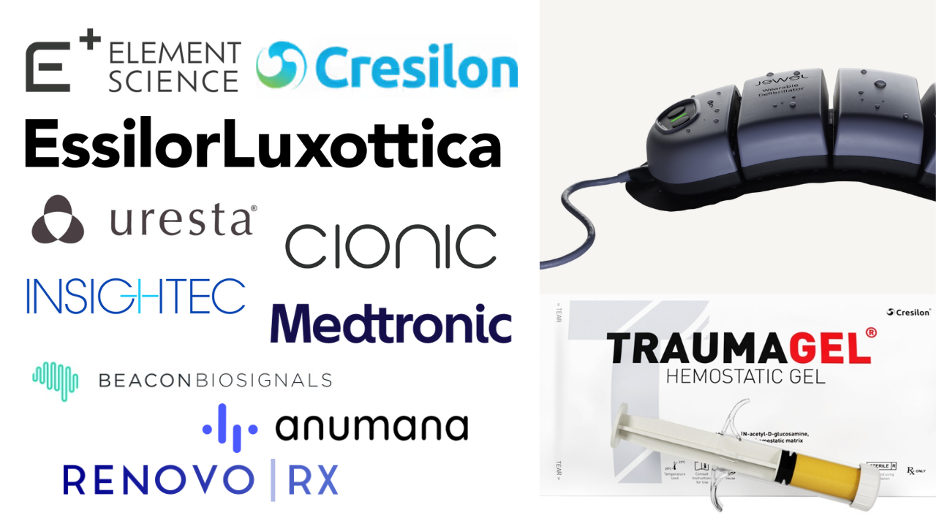
Brooklyn-based Cresilon develops plant-based products that help stop bleeding quickly. Its flagship product, TRAUMAGEL, is a prefilled gel used for temporary control of moderate to severe bleeding, making it relevant for emergency responders, trauma teams and hospital care settings. TRAUMAGEL launched nationwide in 2025 following FDA clearance, and it recently received a Vizient Innovative Technology contract.
2. Element Science
San Francisco-based Element Science focuses on people at risk of sudden cardiac arrest. Its FDA-approved Jewel patch wearable cardioverter defibrillator is designed to monitor patients continuously and deliver treatment if a dangerous heart rhythm occurs, while being less bulky than traditional wearable options. The company has said Jewel is being introduced in limited US markets.
3. EssilorLuxottica
EssilorLuxottica is a global vision care and eyewear company known for prescription lenses, frames and optical retail. It serves consumers with vision and hearing needs, including through newer products such as Nuance Audio glasses, which use built-in microphones and open-ear speakers to help users hear conversations more clearly. In 2025, the company also expanded further in eye care with its acquisition of ophthalmology platform Optegra.
4. Cionic
California-based Cionic develops wearable technology for people with mobility challenges. Its Neural Sleeve is a leg-worn device that uses sensors, software and electrical stimulation to help improve walking and muscle movement in people with conditions such as stroke, cerebral palsy and multiple sclerosis. In 2025, the FDA cleared Neural Sleeve 2, which the company said can both activate muscle movement and help relax muscle spasms.
5. Insightec
Israel-based Insightec develops focused ultrasound systems that treat certain conditions without incisions. Its technology is used in movement disorders such as essential tremor and Parkinson’s disease, giving physicians a less invasive treatment option. In 2025, Insightec introduced an FDA-cleared incision-free ultrasound treatment for Parkinson’s disease that, for the first time, could be used on both sides of the brain in staged procedures. Health Canada recently approved Insightec’s Exablate Prime, a system that uses focused ultrasound to treat the hand tremors of essential tremor without surgery, expanding access in Canada.
Related: Top 15 Best Medtech Companies to Work For in 2026, Per Forbes
6. Uresta
Canada-based Uresta focuses on women’s pelvic health, specifically stress urinary incontinence. Its reusable bladder support is designed to help prevent leaks during everyday activities such as exercise, coughing or laughing, offering women a non-surgical and over-the-counter option. USA Today highlighted the Uresta device as an OTC, reusable option for women dealing with postpartum stress urinary incontinence, particularly those looking to avoid surgery.
7. Medtronic
Medtronic is one of the world’s largest medical device companies, with products used across heart care, neuroscience, diabetes, surgery and other specialties. Fast Company highlighted its Parkinson’s work, but the company serves a broad global patient population across more than 150 countries. In 2025, Medtronic received FDA approval for BrainSense adaptive deep brain stimulation, which adjusts therapy based on a patient’s brain signals. This year, the FDA cleared its Stealth AXiS system for cranial and ear, nose and throat procedures, combining surgical planning, navigation and robotics in one platform to help guide complex procedures.
8. Beacon Biosignals
Boston-based Beacon Biosignals develops brain-monitoring technology that combines wearable EEG devices with AI-based software. It works with researchers, clinicians and biopharma companies in areas such as neurology, psychiatry and sleep medicine, helping them collect and interpret brain activity data more efficiently. Beacon extended its Series B financing to more than $97 million to support its at-home EEG and analytics platform.
9. Anumana
Cambridge, Massachusetts-based Anumana develops AI-powered heart software that analyzes routine ECGs for early signs of disease. Founded by Mayo Clinic and nference, it works with clinicians and health systems looking for earlier, data-driven support in cardiology. The company just received FDA clearance for an ECG-AI tool that helps clinicians spot signs of cardiac amyloidosis — a serious condition caused by abnormal protein buildup in the heart — using a standard 12-lead ECG.
10. RenovoRx
California-based RenovoRx is developing targeted cancer therapies and commercializing RenovoCath, an FDA-cleared drug-delivery device. The company is focused on helping physicians deliver treatment closer to solid tumors, including in pancreatic cancer, rather than relying only on standard systemic treatment. In March 2026, RenovoRx said its Phase III TIGeR-PaC trial in locally advanced pancreatic cancer had passed 100 randomized patients. The company also said some trial centers were using RenovoCath as a stand-alone drug-delivery device in oncology care.
FAQs
What medical device innovation trends are shaping the industry in 2026?
Medical device innovation in 2026 is being driven by a shift toward less invasive treatments, increased adoption of wearable and at-home technologies and the growing integration of artificial intelligence (AI). AI is being applied across areas such as cardiology, neurology, diagnostics and surgical planning, while devices are increasingly designed for use outside traditional hospital settings, including outpatient and home care environments.
Where are the most innovative medical device companies in 2026 located?
Innovative medical device companies in 2026 are not concentrated in a single geography. While many are based in the United States, others are headquartered globally, including in countries such as Israel, Canada and across Europe. This reflects the increasingly international nature of medtech innovation and commercialization.
If you want your company to be featured on Xtalks.com, please email [email protected].














Join or login to leave a comment
JOIN LOGIN