
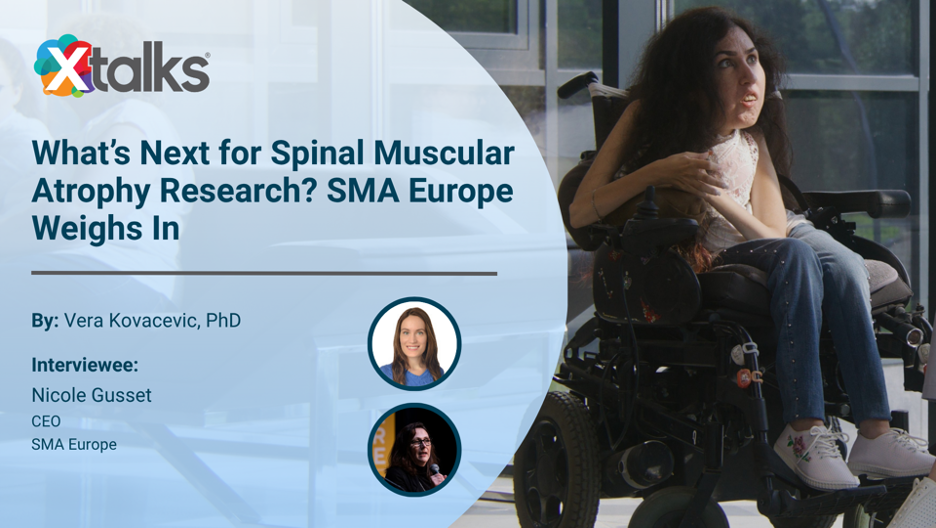
Spinal muscular atrophy (SMA) is a rare genetic neuromuscular disorder characterized by progressive degeneration of motor neurons, leading to muscle weakness, respiratory complications and reduced life expectancy in severe cases.
Recent epidemiological estimates suggest that SMA affects approximately one in 10,000 live births worldwide, with a carrier frequency of about one in 40 to one in 60 individuals.
Over the past decade, the introduction of three disease-modifying therapies has significantly reshaped the clinical setting, improving survival and functional outcomes for many patients.
However, SMA remains incurable, and as patients live longer, new clinical challenges and long-term management considerations are emerging. The field is now entering a more complex phase, where innovation must extend beyond survival to address quality of life, functional independence and lifelong care.
CEO
SMA Europe
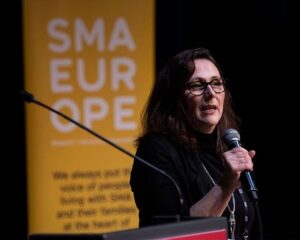
In an interview with Xtalks, Nicole Gusset, CEO of SMA Europe, reflected on the field’s current trajectory following the 5th International Scientific Congress on Spinal Muscular Atrophy, held in Budapest in 2026, highlighting the importance of global collaboration and patient-driven research priorities.
Her insights point to a field that is evolving rapidly, with growing emphasis on collaboration, innovation and addressing persistent gaps in care and access.
Global Collaboration Driving Momentum in SMA Research
Gusset noted that the Congress held in Budapest demonstrated both the scale and energy of the global SMA ecosystem.
“We had representatives from across the globe, more than 70 countries were present, and we welcomed over 1,000 participants,” she said, adding that the event reinforced just how “strong our global community is: energized, engaged and truly motivated to move the field one or two or three steps forward.”
Beyond attendance, she emphasized the role of the Congress as a catalyst for collaboration. Clinicians and researchers were able to connect during poster sessions and informal discussions, often identifying overlapping research interests and initiating new partnerships. These interactions are particularly important in rare diseases, where expertise is distributed globally.
Rather than a single breakthrough, Gusset pointed to the breadth of innovation across the field. Emerging themes included drug repurposing strategies, biomarker development and increasing integration of bioengineering approaches, reflecting a shift toward more transdisciplinary research.
She also highlighted the importance of engaging the next generation of researchers, noting that a strong presence of early-career scientists is essential to sustaining momentum in the field.
At the same time, Gusset emphasized the value of sustained research investment despite therapeutic progress. “SMA is a condition that has three disease-modifying treatments on the several markets, but still we also need to spread the message: SMA is not cured,” she said, underscoring ongoing unmet needs.
Get industry leading pharma and biotech news, events and expert insights delivered to your inbox.

Embedding Patient Priorities into Research Agendas
A central element of SMA Europe’s strategy is ensuring that patient perspectives inform research direction in a structured and measurable way. Gusset described a two-year initiative involving multiple survey rounds and a multi-stakeholder workshop to identify the top ten unanswered research questions facing the community.
This process brought together both patients and healthcare professionals, ensuring that priorities reflect real-world clinical and lived experiences. These priorities directly inform how SMA Europe shapes its scientific priorities and broader advocacy work.
Importantly, these insights are integrated into the design of the Congress itself. Gusset noted that this helps ensure “patient needs remain at the heart of every discussion, from fundamental research through to clinical development.”
She explained that the Congress is intentionally designed as a multi-stakeholder scientific forum, bringing together fundamental researchers, clinicians, industry representatives and advocacy leaders.
According to Gusset, “it’s a genuine dialogue, we bring the needs, and researchers bring the solutions,” enabling a two-way interaction where patient perspectives inform innovation, and scientific advances are grounded in real-world needs.
What Gaps Remain in SMA Care, Outcomes and Access?
Despite advances in treatment, Gusset highlighted that SMA continues to present complex, multi-system challenges. While disease-modifying therapies have improved outcomes, they do not fully address underlying disease pathology or all functional limitations.
Key areas of ongoing research include motor neuron regeneration, muscle tissue repair and improving fatigability, reflecting the need to move beyond stabilization toward restoration of function. Patients may also experience complications such as contractures and skeletal issues, reinforcing the importance of comprehensive care models.
Gusset emphasized that SMA’s impact extends beyond motor function alone, affecting multiple aspects of daily life and long-term health outcomes.
Access remains one of the most pressing global challenges. “There are so many countries where people do not have access to diagnosis. They do not have access to basic care. They do not have access to medicines,” she said, pointing to significant disparities across healthcare systems.
She also highlighted the broader systemic issue, noting that healthcare fragmentation contributes to inequality “across countries, and even within countries.” In a globally connected environment, this creates additional strain for families who are aware of available treatments but cannot access them.
SMA Europe frames innovation more broadly, recognizing that solutions may include medicines, care models and assistive technologies. However, Gusset stressed that without equitable access, even the most advanced solutions risk becoming ineffective at scale.
Strengthening Global Advocacy Networks in SMA
As an umbrella organization comprising 30 national member groups, SMA Europe plays a central role in connecting and strengthening advocacy efforts. Collaboration is embedded in its structure, enabling organizations to exchange knowledge and build capacity.
Gusset described growing demand for cross-border collaboration, particularly from organizations outside Europe. In response, SMA Europe hosted a Global SMAdvocacy Event alongside the Congress, bringing together advocacy groups from across regions, including low- and middle-income countries.
She emphasized the importance of mutual learning across organizations, noting that “everyone has something to share and everyone has something to learn.”
The organization has also launched the SMAcademy, a global training platform designed to support patient advocates. The program includes foundational resources as well as a mentorship model that connects experienced organizations with those at earlier stages of development.
These initiatives reflect a broader focus on capacity building and long-term sustainability. Gusset noted that bringing stakeholders together — both formally and informally — is critical in rare diseases, where coordination can directly influence progress.
Such interactions, she said, can help “accelerate progress in the end,” particularly by fostering collaboration and shared understanding across the ecosystem.
Future Directions in SMA Research and Innovation
Looking ahead, Gusset does not frame the future of SMA around a single breakthrough, but around a shift in how the field works together. The next phase, she suggests, will depend less on isolated advances and more on how effectively the ecosystem aligns around shared priorities across academia, industry, clinical care and patient organizations.
Central to that shift is the ability to translate patient needs into research and development that delivers meaningful outcomes. As the field becomes more complex, ensuring that innovation is grounded in real-world experience is increasingly becoming a defining factor, shaping not only what gets developed but what ultimately makes a difference.
At the same time, the boundaries of innovation are beginning to expand. Gusset pointed to a shift toward approaches that move beyond traditional pharmacological models and toward a convergence of biology and technology. “In the next decade, progress in SMA won’t come from “one magic” bullet. It will come from combining next-generation biology with smarter data, bioengineered approaches, better delivery technology and AI-enabled insights that help us to understand who benefits from what, when and why,” she said.
That evolution is not limited to therapeutics. Advances in care delivery, assistive technologies and long-term disease management are also expected to play a greater role, particularly as more people live longer with SMA.
For Gusset, the direction is clear: the future of SMA will be defined not only by new treatments, but by whether people living with the condition have the options and support needed to navigate their condition and its long-term impact — a goal that will require both scientific progress, stronger coordination and a more coherent global approach to access.













Join or login to leave a comment
JOIN LOGIN