
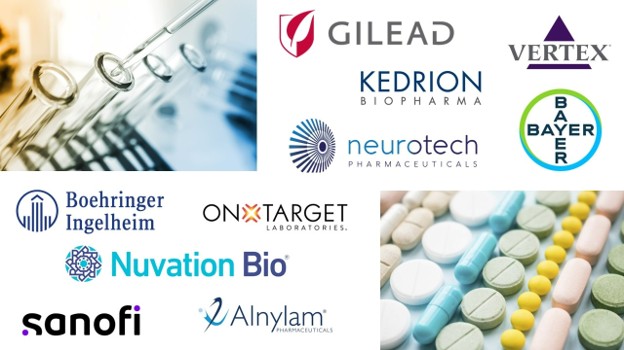
In a year marked by shifts in regulatory and market dynamics, innovation in biopharma continues to gain momentum. According to Fast Company, the top pharmaceutical companies of 2026 are redefining treatment paradigms, from HIV prevention and gene therapy to AI-driven drug discovery and next-generation manufacturing.
Below is a closer look at the 10 most innovative pharma companies of 2026.
Get industry leading pharma and biotech news, events and expert insights delivered to your inbox.

1. Gilead Sciences
Gilead tops the list for a potentially historic breakthrough in HIV prevention. In 2025, the FDA approved Yeztugo (lenacapavir), the first twice-yearly injectable for HIV pre-exposure prophylaxis (PrEP). Gilead reported full-year 2025 revenues of $29.4 billion, a 2% increase over 2024, driven by strong growth across its HIV and liver disease portfolio. Gilead’s 2025 performance was primarily driven by continued strength in its HIV franchise, especially growing demand for Biktarvy (bictegravir/emtricitabine/tenofovir alafenamide) and Descovy (emtricitabine 200mg/tenofovir alafenamide 25mg), alongside the successful launch of Yeztugo. Growth was further supported by expanding liver disease treatments such as Livdelzi (seladelpar) and continued momentum in oncology assets like Trodelvy (sacituzumab govitecan-hziy). Looking ahead, in HIV, Gilead’s focus is on next-generation long-acting regimens. Gilead has been expanding its oncology, liver and cell therapy pipelines through several strategic deals, including the acquisition of CymaBay Therapeutics, which brought in seladelpar for liver and inflammatory diseases. It also strengthened its oncology and immunology footprint recently through collaborations and acquisitions, including its continued investment in Kite Pharma for CAR-T development and a multibillion-dollar 2026 deal to acquire Arcellx to advance next-generation cell therapies in indications such as multiple myeloma.
2. Vertex Pharmaceuticals
Vertex earned its ranking through its positioning in the non-opioid pain management space. Its newly approved drug Journavx (suzetrigine) offers a non-addictive alternative for acute pain, potentially transforming a market long dominated by opioids. The company also continues to build on its strong cystic fibrosis franchise while expanding into gene editing and rare diseases. In April 2025, Halozyme entered a global exclusive collaboration with Vertex Pharmaceuticals, granting Vertex rights to use its Hypercon drug delivery technology, which enables the design of higher-concentration biologics with smaller injection volumes, for up to three targets, with an upfront payment of $15 million plus potential milestones and royalties. Vertex’s 2025 earnings amounted to $12 billion, driven by continued strong performance of its cystic fibrosis franchise that includes newly marketed CFTR modulator Alyftrek (vanzacaftor/tezacaftor/deutivacaftor) and contributions of newly launched therapies like Casgevy (exa-cel) and Journavx. Vertex is advancing a broad pipeline strategy beyond cystic fibrosis, with multiple mid- and late-stage programs progressing into pivotal development across gene therapy, pain and kidney disease. Key assets include Casgevy in expansion studies, Journavx in acute pain and several high-priority clinical programs such as povetacicept for IgA nephropathy and inaxaplin for APOL1-mediated kidney disease.
3. Alnylam Pharmaceuticals
A pioneer in RNA interference (RNAi), Alnylam continues to validate gene-silencing as a mainstream therapeutic modality. Ranked third, the company is advancing treatments for rare genetic, cardiometabolic and hepatic diseases. Alnylam reached GAAP profitability in 2025 with roughly $3 billion in net product revenues, driven by an 81% year-over-year increase in sales, fueled largely by Amvuttra (vutrisiran) in its newly approved transthyretin amyloid cardiomyopathy (ATTR-CM) indication. Alnylam is advancing its RNAi pipeline with a strong focus on transthyretin (ATTR) amyloidosis, driven by the continued expansion and commercialization of Amvuttra. The company is also pushing forward a broader pipeline strategy, outlined in its “Alnylam 2030” plan, including multiple upcoming clinical readouts, new Phase II studies and additional investigational new drug (IND) filings to expand into both rare and more common diseases.
4. Neurotech Pharmaceuticals
Neurotech Pharmaceuticals is redefining ophthalmology with Encelto (revakinagene taroretcel-lwey), the first FDA-approved implantable cell-based gene therapy for macular telangiectasia type 2 (MacTel), a neurodegenerative retinal disease. The therapy, approved in March 2025, continuously delivers therapeutic proteins directly into the eye, offering a novel approach to the treatment of chronic retinal disease. The tiny, rice-sized capsule is surgically implanted into the eye to release recombinant human ciliary neurotrophic factor (rhCNTF) directly to the retina, with the goal of slowing disease progression and vision loss in MacTel. In April 2025, Neurotech provided a corporate update on the commercial progress of Encelto, highlighting growing physician adoption, expanding reimbursement coverage and increasing integration into retina practices following its launch. The update also emphasized scaling commercial manufacturing capacity and improving patient access, with procedures surpassing key treatment milestones and broader payer coverage supporting more predictable uptake across healthcare systems.
5. On Target Laboratories
On Target Laboratories is focused on transforming cancer surgery with its FDA-approved product Cytalux (pafolacianine), a fluorescent imaging agent that is given to patients prior to surgery to help surgeons visualize ovarian and lung cancer lesions during surgery. By 2025, the technology had been used in over 1,000 surgeries, improving precision and preserving healthy tissue. On Target raised $30 million in Series C funding to accelerate the commercialization of Cytalux. A real-world study published in June 2025 found that Cytalux’s performance in routine clinical practice closely matches its clinical trial results. Notably, it enabled identification of tumors that were missed under standard white-light visualization, highlighting its value as an intraoperative imaging tool to improve cancer detection and surgical outcomes.
6. Sanofi
Sanofi made Fast’s list for reimagining vaccine manufacturing. Its modular “Modulus” facilities, backed by over $1 billion in investment, can rapidly switch production between vaccines and biologics, reducing timelines from months to days. Financially, Sanofi reported roughly €43.6 billion (~$47.7 billion) in 2025 revenue, driven by strong demand for blockbuster biologics like Dupixent (dupilumab). With 80+ pipeline projects, Sanofi is focusing on immunology, rare diseases and vaccines. In April 2026, Sanofi’s multiple sclerosis (MS) drug Cenrifki (tolebrutinib) received a positive recommendation from European regulators, putting it on track for its first approval to treat non-relapsing secondary progressive MS after showing it can delay disability progression. However, the drug has faced setbacks elsewhere, including a recent FDA rejection in the US over safety and efficacy concerns. Sanofi received tolebrutinib as part of its $3.7 billion acquisition of Principia Biopharma in 2020.
7. Kedrion Biopharma
Kedrion Biopharma is dedicated to innovation in plasma-derived therapies. Its immunoglobulin therapy Qivigy (immune globulin intravenous, human-kthm 10% solution), which received FDA approval in 2025, targets primary immunodeficiency, a group of rare but serious immune disorders. The company is backing this with major infrastructure investments, including hundreds of millions toward plasma collection and manufacturing expansion, critical for ensuring supply in a resource-constrained category. The company’s 2025 revenues totaled €1.65 billion ($1.93 billion), up 4.5% from the previous year (€1.57 billion or $1.84 billion in 2024). Kendrion says it is the world’s fifth-largest company in plasma-derived products.
8. Boehringer Ingelheim
Boehringer Ingelheim has been building a base in respiratory disease. In 2025, the company received approval for its anti-inflammatory drug Jascayd (nerandomilast) for the treatment of idiopathic pulmonary fibrosis (IPF). Boehringer reported 7.3% sales growth in 2025, with net sales of €27.75 billion ($32.5 billion). Its current pipeline spans oncology, CNS and cardiometabolic diseases. This week, Boehringer shared positive Phase III results for its experimental dual GLP-1/glucagon agonist survodutide. The candidate showed about 16.6% average weight loss in people with obesity or overweight, while also improving metabolic markers like waist circumference and cardiometabolic risk.
9. Nuvation Bio
A rising oncology player, Nuvation Bio achieved a major milestone with the 2025 FDA approval of Ibtrozi (taletrectinib) for ROS1-positive lung cancer, making it the company’s first approved commercial product. The drug stands out for overcoming resistance mutations and treating brain metastases. Financially, the company reported $38.2 million in collaboration revenue and $24.7 million in product revenue from Ibtrozi in 2025. In early April, Nuvation Bio amended its licensing deal with Daiichi Sankyo to acquire Japan rights to safusidenib, giving it full global development and commercialization control of the investigational brain cancer drug. The move allows the company to expand its ongoing Phase III SIGMA trial into Japan and consolidate ownership of all clinical data and future development of the therapy.
10. Bayer
Bayer rounds out the list with innovation in women’s health. Its newly approved nonhormonal therapy Lynkuet treats menopausal hot flashes without the cancer risks associated with hormone therapy. Bayer’s 2025 net annual sales amounted to €45.58 billion ($49 billion). Bayer had several notable FDA approvals in 2025, with the most significant being Hyrnuo (sevabertinib), which was approved in November 2025 for HER2-mutant non-small cell lung cancer. It also received approval for Lynkuet (elinzanetant), a first-in-class non-hormonal treatment for menopausal hot flashes. Additionally, Kerendia (finerenone) gained a new indication for heart failure, while Nubeqa (darolutamide) received an expanded approval in prostate cancer. In Bayer’s crop science division, the company is facing thousands of lawsuits alleging its Roundup weedkiller causes cancer, with shares falling after the US Supreme Court recently appeared divided on whether the company can block the claims. The case hinges on whether federal pesticide laws override state-level failure-to-warn lawsuits, with a decision expected later this year that could potentially shape Bayer’s legal exposure.













Join or login to leave a comment
JOIN LOGIN