
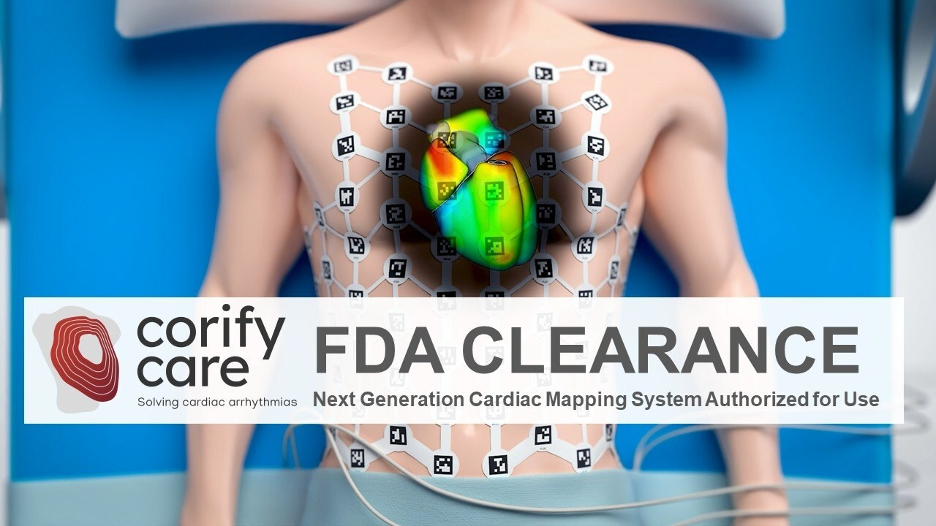
The FDA-cleared Acorys system is designed to give electrophysiology teams a real-time, four-chamber view of cardiac electrical activity without requiring CT or MRI imaging.
The FDA has cleared Corify Care’s Acorys system, a non-invasive cardiac mapping platform designed to provide a real-time, four-chamber view of the heart’s electrical activity.
Corify Care says the system combines 3D anatomical modeling with live electrical activity over time, allowing clinicians to see how signals move across the heart in real time. The company describes this as “4D cardiac mapping.”

Cardiac mapping is commonly used in electrophysiology (EP) procedures to identify abnormal electrical pathways that cause arrhythmias, such as atrial tachyarrhythmias or ventricular tachycardia (VT).
EP is the area of cardiology focused on the heart’s electrical activity and rhythm disorders. Standard EP mapping often relies on catheter-based contact mapping, in which clinicians collect electrical data point by point inside the heart. In more complex cases, that process can take time and may require inducing unstable arrhythmias to identify where they start.
According to Corify Care, the Acorys system is designed to address some of these limitations by enabling global mapping from a single heartbeat, rather than stitching together multiple measurements over time.
Several companies currently offer systems that help clinicians visualize abnormal electrical activity in the heart. These include Abbott’s EnSite X EP system, which supports 3D cardiac mapping during ablation procedures, and Medtronic’s noninvasive CardioInsight system, which uses signals from a mapping vest together with CT scan images to create 3D maps of the heart.

Acorys, on the other hand, uses an imageless workflow, meaning it does not depend on pre-procedural CT or MRI scans to build its mapping view. It can also be used before, during and between procedural steps, which may help clinicians assess arrhythmia complexity and identify treatment targets without triggering high-risk rhythms.
Corify Care reports that the technology has been evaluated in more than 2,500 patients across electrophysiology centers in Europe. The system can identify arrhythmia mechanisms, determine the chamber of origin and help guide ablation targets.
The platform has been used to localize ventricular tachycardia substrate during sinus rhythm, or normal heart rhythm, which may reduce the need to induce unstable arrhythmias during procedures.
Additional findings include the ability to map atrial activation patterns and assess electrical synchronization across the heart. These capabilities may be relevant in cases of cardiac desynchronization.
The company plans to present further clinical data and scientific studies at the Heart Rhythm Society Annual Scientific Sessions 2026 in Chicago.
Following clearance, Corify Care said it will begin a phased commercial rollout in the US, working with selected electrophysiology centers to introduce the system into clinical practice.
Cardiac mapping has also remained an active area for acquisitions and new FDA clearances. In 2024, Boston Scientific had planned to acquire Cortex, which was developing mapping technology to help physicians identify harder-to-locate sources of atrial fibrillation in complex cases.
In December 2025, Vektor Medical got FDA clearance for the next-generation vMap. The software uses standard 12-lead ECG data to generate 2D and 3D cardiac maps and can localize potential arrhythmia sources across all four chambers of the heart in under a minute.
If you want your company to be featured on Xtalks.com, please email [email protected].















Join or login to leave a comment
JOIN LOGIN