
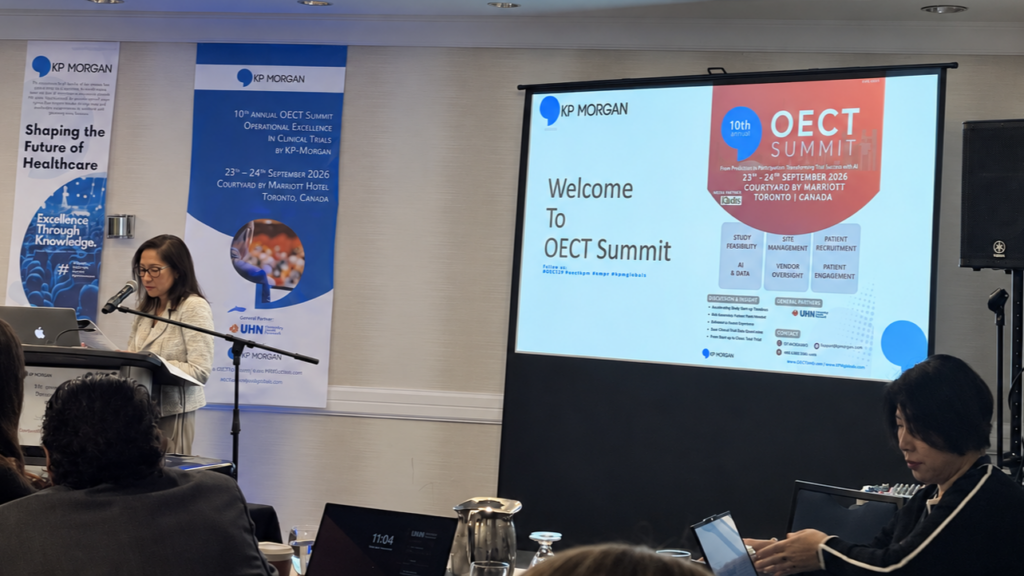
AI may speed up clinical trials, but at the 2026 OECT Summit in Toronto, speakers stressed that sites, sponsors and patients need to be part of the conversation before key decisions are made.
At the 10th Annual OECT (Operational Excellence in Clinical Trials) Summit, hosted by KP Morgan in Toronto, AI came up in nearly every session. Yet across two days, attendees kept returning to the idea that technology alone won’t fix the operational problems slowing clinical trials.
Held September 23 – 24, 2026, at the Courtyard by Marriott, the summit brought together sponsors, CROs, research sites and patient advocates under the theme “From Prediction to Participation: Transforming Trial Success with AI.” Xtalks attended as an official media partner, and on the ground, we spoke with speakers about the ideas being floated, debated and still digested across the two days.
Sessions covered study feasibility, site management, patient recruitment, AI and data, vendor oversight and patient engagement, with discussions ranging from AI-powered site selection and patient identification to risk-based quality management and patient experience.

Get industry leading pharma and biotech news, events and expert insights delivered to your inbox.
AI Reaches Every Stage, With Guardrails
Alex Karabanow of University Health Network (UHN) said AI is already reaching across clinical research.
“At every step of the trajectory of clinical research, AI is being applied,” Alex said. “And of course, we want to know and make sure that we also proceed with caution so that we have guardrails in place.”
UHN has also been working to shorten institutional authorization timelines. Alex said the median has dropped substantially over the past few years.
“It’s a bit of a transformative target because traditionally we’ve been at a median of about 170 days to institutional authorization [IA] . But over the last few years, we’ve been able to bring that down to about 110 days. And when we focus on clinical trials, we can get them approved within 45 days with enough resources,” he said.
What the Data Cannot See
Melissa Thomas, Associate Director, Risk-Based Quality Management at Alexion, said centralized monitoring cannot always capture what is happening around an individual site or patient.
“I think the site has that local context. They are having day-to-day discussions with the patients. They know a little bit more about what’s going on in the rest of the patient’s lives… So that context and discussion with the site is important to understand the whole story,” Melissa said.
She also identified communication as a recurring theme across the summit, particularly between sites, CROs and sponsors.
“I think a big theme is communication, clear communication on why things are happening, what’s being done, understanding perspectives both from the site, CRO and sponsor,” she said.
From Talking About Patients to Involving Them
Sabrina Ramkellawan, President and Board Director of the Clinical Research Association of Canada, questioned whether patient centricity is consistently translating into practice.
“How do we move from talking about involving patients to actually doing it?” Sabrina asked.
Ursula Mann of Patient Voice Partners raised a related issue: whether the right perspectives are entering discussions early enough to influence decisions.
“One question I’m still thinking about is how do we have different teams talk to each other at the right point in time? Too many decisions are made that teams are responsible for where they learn important information after the fact,” Ursula said.
Her caregiving experience has also influenced how she thinks about representation in research.
“My caregiving experience has changed how I have considerations around health literacy and ensuring we have diversity of voices and we’re getting representation from the patients and caregivers that are experiencing the diseases in question,” Ursula said.
She added that it is “a big miss” when clinical trials or healthcare systems reach the end of a process only to realize that groups with different experiences were never heard from.
Fragmentation: The Canadian Challenge
Sabrina also raised fragmentation across Canada’s clinical research landscape and the risk of organizations duplicating work already underway.
“Why don’t we talk and don’t reinvent the wheel? Exactly. Work together. Work together,” she said. “We still are very provincial. While other countries are already doing a national initiative, we need to do that.”
She said the next step includes understanding which organizations are already tackling particular needs and where gaps remain.
“So even just knowing what people are doing, so people are not doing the same thing… Who is doing what already and what is still open for us to do?” Sabrina said.
In the end, it comes down to who is involved, when they are brought in and how well teams communicate. AI has many opportunities to support faster, more data-driven trials, but the human in the loop remains essential.
If you want your company to be featured on Xtalks.com, please email [email protected].










Join or login to leave a comment
JOIN LOGIN