
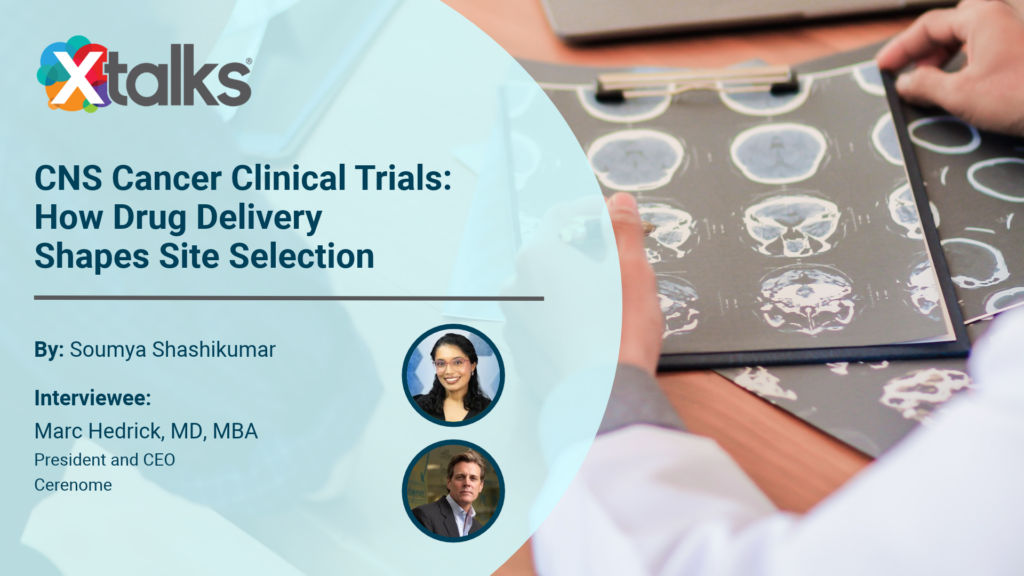
From delivering radiation into brain tissue to treating cancer in the fluid surrounding the brain, Cerenome CEO Dr. Marc Hedrick explains how these procedures influence clinical trial site selection and future treatment access.
Many cancer treatments struggle to reach the brain because of the blood-brain barrier. For targeted radiotherapeutics, researchers must also consider how radiation is delivered and what hospitals need to conduct specialized clinical trials.
In an exclusive interview with Xtalks, Marc Hedrick, MD, MBA, President and CEO of Cerenome, discussed what it takes to conduct central nervous system (CNS) cancer clinical trials, from drug delivery procedures and site selection to how these treatments could eventually reach smaller hospitals.
Dr. Hedrick previously spoke with Xtalks in 2025 about precision radiotherapeutics for CNS cancers, including glioblastoma and leptomeningeal metastases. Since then, Plus Therapeutics rebranded as Cerenome in August 2026.

President and CEO
Cerenome
Why CNS Cancers Are Especially Difficult to Treat
CNS cancers include tumors that begin in the brain or spinal cord and cancers that spread there from other parts of the body. According to Dr. Hedrick, metastatic CNS cancers are a particularly pressing concern as patients increasingly survive their original cancers.
These metastatic tumors can also have different genetic characteristics, influencing which treatments may work.
“And so the breast cancer in the breast is different from the breast cancer when it metastasizes to the brain,” Dr. Hedrick said.
A drug that works against the original tumor may therefore be less effective once the cancer reaches the brain.
Another major obstacle is the blood-brain barrier, a protective system that controls which substances can enter the brain from the bloodstream. It also prevents many cancer drugs from reaching tumors in sufficient amounts, making drug delivery an important focus of CNS cancer research.

Get industry leading pharma and biotech news, events and expert insights delivered to your inbox.
How Targeted Radiotherapeutics Could Address Drug Delivery Challenges
Cerenome is developing Reyobiq (rhenium Re186 obisbemeda), an investigational targeted radiotherapeutic designed to deliver radiation directly to CNS tumors while limiting exposure to surrounding healthy tissue.
Reyobiq combines a radioactive substance called rhenium-186 with a chemical component that helps package it inside tiny fat-based particles called liposomes. These particles are designed to keep the radioactive material in the treatment area as it releases radiation.
“For our patients, the key is getting past the blood-brain barrier in the central nervous system, and there are two ways of doing that,” Dr. Hedrick said.
The delivery approach depends on where the cancer is located:
- Convection-enhanced delivery (CED): For tumors within brain tissue, a neurosurgeon places a catheter into the brain to deliver the treatment directly to the affected area. The catheter stays in place for approximately 24 hours before being removed.
- Cerebrospinal fluid (CSF) delivery: For patients with leptomeningeal cancer, where cancer has spread into the fluid-filled spaces around the brain and spinal cord, a neurosurgeon places a small port into the CSF. Once the port is in place, patients can receive treatment in an outpatient setting.
In a recent development, Cerenome announced on October 29, 2026 that it had completed enrollment in the Phase II portion of its ReSPECT-GBM trial evaluating Reyobiq for recurrent glioblastoma, an aggressive brain cancer that has returned after treatment. Topline results are expected in mid-2027.
What Makes a Hospital Suitable for Specialized Oncology Trials?
Radiotherapeutic clinical trials often require several specialists working together, including neuro-oncologists, nuclear medicine experts, neurosurgeons and clinical research teams.
Dr. Hedrick added, “It’s really driven by delivery. It’s not so much the radiopharmaceutical.”
Hospitals studying convection-enhanced delivery need neurosurgeons who can place brain catheters, while studies involving leptomeningeal cancer require specialists who can establish access to the CSF.
“Generally speaking for trials, you need more of a tertiary hospital or a NCI cancer center for the trials,” Dr. Hedrick said.
These include major academic hospitals and National Cancer Institute (NCI)-designated cancer centers, where the necessary expertise and infrastructure are available. Such centers also receive referrals for patients with complex CNS cancers, making them important locations for clinical research.
For CNS radiotherapeutics, site selection is closely tied to the delivery procedure. Hospitals studying convection-enhanced delivery need neurosurgeons who can place brain catheters. Studies involving leptomeningeal cancer require specialists who can establish access to the CSF.
The FDA also considers safety issues associated with radioactive treatments and their delivery methods. Dr. Hedrick noted that these requirements can generally be incorporated into clinical trial protocols and do not usually determine where trials take place.
Could These Treatments Eventually Reach Smaller Hospitals?
Although clinical trials typically take place at specialized centers, Dr. Hedrick sees opportunities to expand access if these therapies receive regulatory approval.
The physical properties of rhenium-186 could help simplify some of the shipping and handling challenges associated with radioactive medicines.
“You can ship them. They don’t have to go to the radio pharmacist. They can go right to just straightforward radio pharm shipping and receiving and then can go to the clinic or go to the hospital for treatment.”
This could make distribution to smaller hospitals more practical, although treatment availability would still depend on appropriate facilities, neurosurgical expertise and regulatory approval.
If you want your company to be featured on Xtalks.com, please email [email protected].












Join or login to leave a comment
JOIN LOGIN