
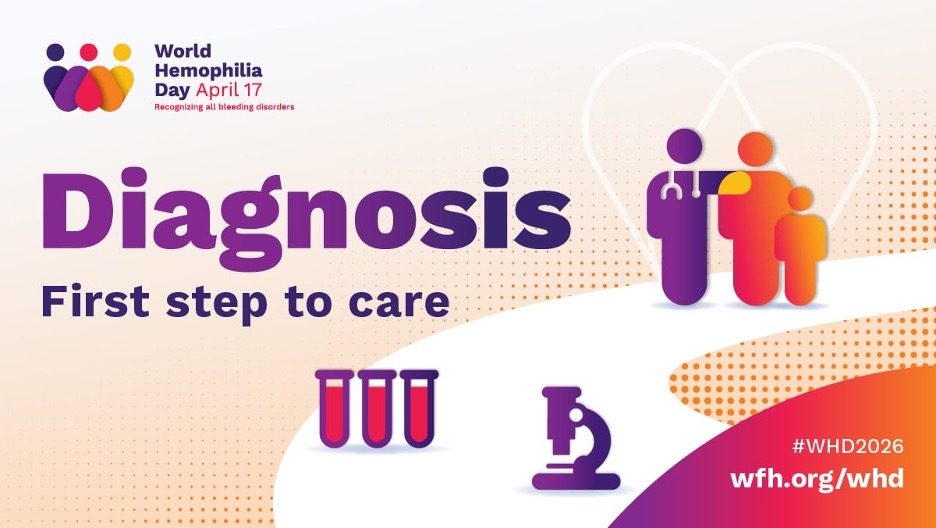
April 17 is World Hemophilia Day, a day dedicated to increasing awareness of hemophilia and other inherited bleeding disorders.
Organized by the World Federation of Hemophilia (WFH), the day brings together patients, caregivers, healthcare providers and advocates to push for better diagnosis, treatment and access to care worldwide.

The theme of World Hemophilia Day 2026 is focused on improving diagnosis.
The WFH estimates that over three-quarters of the population of people with hemophilia worldwide are undiagnosed. The organization says an even more significant gap exists for other bleeding disorders.
“This means that hundreds of thousands of people with bleeding disorders around the world still lack access to basic care. We have the power — and the shared commitment — to change this,” WFH says.
WFH is committed to a vision of “Treatment for All,” by increasing global diagnosis rates. It aims to achieve this by improving diagnostic outcomes through strengthening the skills of healthcare professionals, along with enhancing the effectiveness of laboratories.
April 17 was chosen to honor the birthday of Frank Schnabel, who founded the WFH in 1963. His vision helped catalyze a global movement focused on improving the lives of those affected by bleeding disorders, many of whom still face barriers to diagnosis and treatment today.
Hemophilia is a rare genetic bleeding disorder in which the blood does not clot properly due to a deficiency in clotting factors, most commonly factor VIII (hemophilia A) or factor IX (hemophilia B). People living with hemophilia may experience prolonged bleeding after injuries, spontaneous internal bleeding and joint damage over time.
Although hemophilia primarily affects males, women can be carriers and, in some cases, experience symptoms themselves. Other related bleeding disorders, such as von Willebrand disease, also fall under the broader awareness efforts of this day.

Latest Scientific Innovations in Hemophilia
Hemophilia has become one of the most dynamic rare disease spaces, with a marked shift away from traditional clotting factor replacement toward RNA therapies, monoclonal antibodies and gene therapies. Over the past couple of years, several major approvals and late-stage clinical programs have reshaped the treatment space.
Recent notable approvals in the space include Sanofi’s siRNA therapy Qfitlia (fitusiran), which received FDA approval in March 2025. The first-in-class siRNA therapy works by reducing antithrombin levels to restore thrombin generation and improve clotting. Clinical data from the Phase III ATLAS program showed substantial reductions in annualized bleeding rates, positioning it as a major alternative to factor replacement therapies.
Novo Nordisk’s Alhemo (concizumab), initially approved for patients with inhibitors, received a label expansion in 2025 to include patients without inhibitors, making it one of the first once-daily subcutaneous prophylactic options across a broader hemophilia population.
Several high-profile programs in hemophilia are advancing through late-stage trials.
Pfizer has been developing gene therapies such as fidanacogene Beqvez (elaparvovec) for hemophilia B, evaluated in Phase III trials (BENEGENE-2), aimed at delivering a functional copy of the clotting factor gene using adeno-associated viral vectors.
Novo Nordisk is also advancing Mim8 (denecimig), a next-generation bispecific antibody designed for flexible dosing (weekly to monthly), with regulatory filings submitted in 2025.
Multiple biotech players, including uniQure and CSL Behring, continue to invest in gene therapies such as Hemgenix, which aims to provide long-term or potentially curative benefit through a single administration.
At the same time, companies like Sanofi and Alnylam Pharmaceuticals are expanding RNA-based platforms as part of growing confidence in gene silencing approaches for bleeding disorders.
While gene therapy once dominated headlines as a “one-and-done” cure, the commercial reality has been more complex. For example, Pfizer discontinued commercialization of its approved gene therapy Beqvez due to limited uptake, reflecting challenges around cost, durability and patient acceptance.
Similarly, other programs have faced strategic pivots or slower-than-expected adoption, even as clinical innovation continues.















Join or login to leave a comment
JOIN LOGIN