
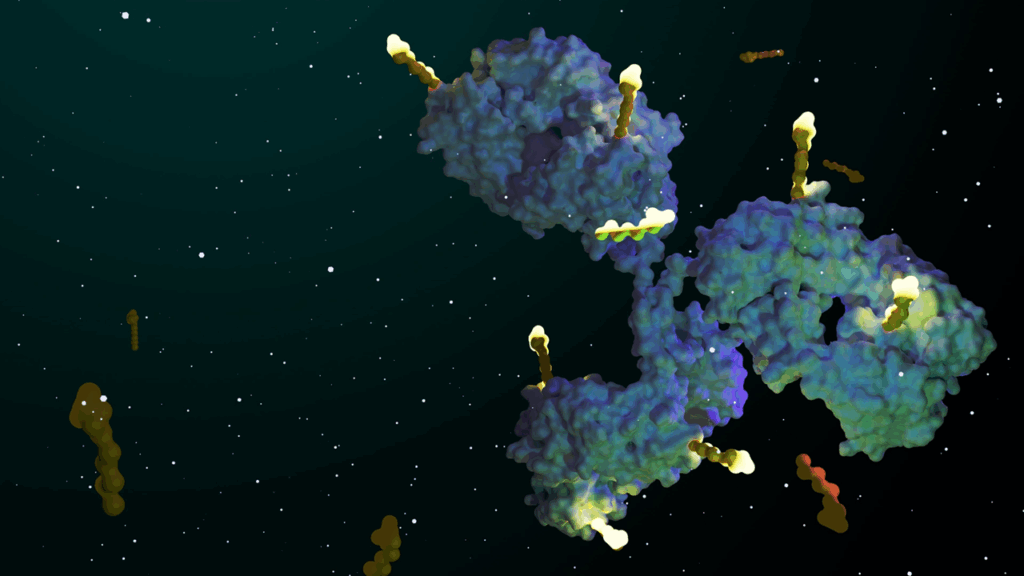
Antibody-drug conjugates (ADCs) have become one of oncology’s most promising and transformative therapeutic classes. These biologics combine the tumor-targeting precision of antibodies with the potent cytotoxicity of chemotherapy, linked together through finely tuned chemical connectors that control when and where the drug is released.
After decades of research to optimize payloads, linkers and conjugation technologies, this drug modality has entered a new phase of innovation. Biopharma’s clinical pipeline now includes hundreds of ADCs, multiple approved therapies and a rapid expansion into solid tumors that were once thought to be unreachable.

President, CEO and CMO
Pyxis Oncology
Driving progress in this field is Pyxis Oncology, a clinical-stage biotech developing a first-in-concept ADC designed for recurrent and metastatic head and neck squamous cell carcinoma (HNSCC) and other advanced solid tumors.
Leading Pyxis Oncology through this next phase is Dr. Lara Sullivan, MD, MBA, the company’s President, CEO and CMO. With a background spanning medicine, finance, R&D strategy and biotech company building, Dr. Sullivan brings a uniquely holistic view of how scientific discovery, operational execution and patient insight intersect in oncology drug development.
Before joining Pyxis Oncology, she served as the Founder and President of SpringWorks Therapeutics, a spinout from Pfizer that went public in 2019 and was acquired by Merck KGaA in 2025 for $3.4 billion, one of the largest biotech acquisitions year to date.
Now, at Pyxis Oncology, she’s leading the next phase of growth, this time centered on advancing ADC science and rethinking how companies evolve across different stages.
Read Xtalks Clinical Edge™ Issue 6
Xtalks Clinical Edge is a magazine for clinical research professionals and all who want to be informed about the latest trends and happenings in clinical trials. This magazine immerses you in a world where industry leaders, patient advocates and top researchers converge to provide the most insightful perspectives on clinical trials.

Building the Right Company for the Stage You’re In
Dr. Sullivan sees biotech as an ecosystem of vastly different risk profiles, timelines and talent needs.
“There are differences between companies in the startup phase where they have an idea, a concept, a hypothesis,” she explained. “That’s a different stage than a company that’s on the cusp of mid- to late-stage clinical development or an approval. And of course, it’s different still if you’re private versus public.”
Each stage, she said, demands a clear-eyed assessment of the risk profile of the asset, which then defines the risk profile of the company itself.
Pyxis Oncology, for instance, began as a discovery-stage spinout from the University of Chicago, with “six or seven scientists and me as the beginning of the team.”
At that time, what mattered most was deep biology and chemistry expertise to “de-risk the asset” and prove that the science worked.
In contrast, when she helped launch SpringWorks Therapeutics from Pfizer, the company already had Phase I and Phase II data in hand, meaning it needed talent fluent in later-stage development and regulatory strategy.
“Both started out with six or seven colleagues around a table and a rented shared office space,” she said. “But the profile of the talent was very different because the maturity of the asset and the risk profile of the asset were different.”
The CEO-CMO Perspective
When Pyxis Oncology expanded its clinical trial footprint this year, Dr. Sullivan made a bold decision, temporarily serving as both CEO and CMO to steer through a critical inflection point.
“I came up more on the business side of drug development. But this year, as we’ve been navigating the transition from being an earlier-stage clinical company to a more mature clinical company, it made a lot of sense for me to put that CMO hat on and work in depth with the team on development strategy and execution.”
With Pyxis Oncology approaching major data milestones in the second half of this year and the first half of next year, she’s using this phase to bridge strategy and science.
“I think it’s made me a much better CEO,” she added. “Having real granular insight into the clinical operations, clinical strategy, the execution and all the medical functions that go into drug development helps me chart the company’s course more effectively. And conversely, as a CMO, I bring that strategic, investor- and market-aware lens to how we prioritize and execute trials.”
The dual role, she said, also strengthened her appreciation of the different needs across functions: “The needs of the investigator community are different from the needs of the finance team. The ability to empathize with both helps bridge communication and align goals.”
While the arrangement is temporary and Pyxis Oncology expects to bring on a dedicated CMO at some point following its next major data release, it has shaped her leadership viewpoint: “It’s one of the best things I’ve done for myself as a leader and for the company during this transition.”
How ADCs Redefined Targeted Chemotherapy
Few drug classes have undergone as many reinventions as ADCs. The first approved ADC, Pfizer’s Mylotarg (originally developed by Wyeth), entered the market in 2000, but it took another decade or so before the next generation arrived.
“What’s interesting is, here we are in 2025 with hundreds of ADCs in development,” Dr. Sullivan said. “There’s been a real uptick in focus and interest over the last five or six years.”
At its simplest, she explained, “an ADC takes the potency of chemotherapy and directs it to the cancer cell instead of allowing it to circulate throughout the body systemically.”
The design involves attaching a chemotherapy “payload” to an antibody via a chemical linker. The antibody recognizes and binds to a tumor-specific antigen, delivering the payload precisely to cancer cells while sparing healthy tissue.
This targeted approach can improve safety and efficacy, but the challenge lies in aligning multiple variables simultaneously: the antibody, the linker, the payload and the conjugation chemistry.
Dr. Sullivan compared this process to a slot machine: “You had to have the right payload with the right antibody, with the right linker, with the right target binder, with the right conjugation chemistry. If any one of those things was wrong, the ADC would fail.”
That alignment, she said, was what made Mylotarg successful, and why it took so long for the industry to innovate again.
The next decade of trial and error has yielded a new generation of approved ADCs such as Padcev, Trodelvy and Enhertu, each advancing the field’s understanding of payload potency, target specificity and bystander effects.
– Dr. Lara Sullivan
When Traditional Endpoints Fall Short
Clinical innovation, Dr. Sullivan emphasized, is not just about the molecule; it’s about how success is measured.
Dr. Sullivan noted that innovation in clinical trial endpoints often arises from two directions.
On one hand, it’s driven by clinicians and medical experts who encounter diseases where traditional measures of response simply don’t apply, for instance, certain sarcoma subtypes where tumors may “deflate” or liquefy without visibly shrinking on standard 2D CT scans. Those cases require creative trial designs and alternative endpoints, such as volumetric or 3D imaging and biological markers that capture meaningful change.
On the other hand, it’s being shaped by regulatory agencies, which are beginning to explore new ways of thinking about trial design and endpoint validation.
She mentioned the FDA’s recent listening tour with biotech CEOs, during which she and others shared ideas on clinical research, such as endpoints and trial flexibility. “We don’t know yet which ideas will take hold,” she said, “but it’s encouraging that the agency is taking a hard look.”
Patient-Driven Progress
Beyond design, patient engagement is becoming a core competency for oncology companies. Dr. Sullivan has witnessed firsthand how patient advocacy can catalyze development, recalling her experience with SpringWorks Therapeutics:
“The Desmoid Tumor Research Foundation literally knocked on Pfizer’s door and said, ‘Hey, this drug may work in desmoid patients. Help us get this asset out and back into development.’ That’s how SpringWorks was born.”
She remembers attending those early community meetings, listening to patients, principal investigators and advocacy leaders discuss outcomes that mattered most, such as pain reduction, mobility and daily function, outcomes that were not yet standardized in regulatory endpoints.
“There was a real groundswell of support for patient-reported outcomes to be developed, measurable and made objective to support drug development,” she said.
In larger tumor indications, where infrastructure and sponsors are plentiful, she believes companies must be even more intentional about listening. “Sometimes it’s small things, like providing transportation stipends that can make all the difference in a patient’s ability to participate in a trial.”
“Even as someone who’s worked in this industry for years, it was eye-opening to see the experience from the patient side,” she said. “It changes how you view the process and what you prioritize.”
Evolving Trial Design, Regulatory Dialogue and Clinical Rigor
Dr. Sullivan expects oncology trial design to continue evolving in step with scientific innovation. Adaptive designs, master protocols and real-time data analytics are gradually reducing the rigidity of traditional Phase I to Phase III trials.
For Pyxis Oncology, engaging early with regulators is key. “When you’re developing something first-in-class, the best strategy is to be transparent about what you’re trying to solve, what biological or clinical question your study is answering that no one else has before.”
She also emphasized the importance of fit-for-purpose trial execution: defining inclusion criteria, endpoints and statistical analyses that capture both efficacy and quality of life.
“We have to remember that our endpoints represent real patient experiences,” she said. “If the patient feels better, moves better and lives longer, that’s meaningful data.”
Resilience, Curiosity and the Human Side of Biotech Leadership
Dr. Sullivan’s career has spanned management consulting, finance and Pfizer’s R&D strategy organization, culminating in leading two biotechs through pivotal growth stages. Throughout it all, curiosity and resilience have been guiding her work.
“What’s distinctive about our industry,” she said, “is that everyone, whether they’re a scientist, clinician or finance professional, is driven by curiosity and wanting to make a difference. Science is hard. It’s high stakes for patients, and it takes you in a million zigzags often before you get to where you need to go.”
She encourages early-career professionals to stay open to opportunities. “I never sat at Pfizer thinking, ‘I’m going to be a biotech CEO.’ I just stayed curious about how I could help scientists communicate their ideas and advocate for funding. That curiosity led me from one opportunity to the next.”
Her advice to the next generation: “Stay open-minded and resilient. Sometimes the right opportunity is one you didn’t plan for.”
She points to her current experience at Pyxis Oncology as proof: “I didn’t expect to wear the CMO hat, but it’s been one of the best developmental experiences of my career.”
The Next Chapter: ADCs, AI and Adaptive Trial Methodologies
Looking ahead, Dr. Sullivan envisions a future where ADC innovation intersects with AI-driven biomarker discovery, real-time data analytics and adaptive trial methodologies.
– Dr. Lara Sullivan
For Pyxis Oncology, the immediate goal is clear: advance their first-in-concept ADC through upcoming data readouts, continue expanding its ADC pipeline and translate the hard-earned lessons of the last two decades into better therapies for patients facing some of the most aggressive cancers.
Dr. Sullivan said this is an especially exciting time for ADCs. It’s a moment when decades of scientific progress are converging to deliver more precise, transformative treatments for patients.














Join or login to leave a comment
JOIN LOGIN