

Dr. Oren Gilad discussed how tumor evolution, drug selectivity and early clinical data can influence which patients are most likely to benefit from synthetic lethality approaches.
Cancer cells carry a potential vulnerability in their own genetic instability. As tumors grow, they accumulate damage that can leave them dependent on specific DNA repair and checkpoint pathways.
Researchers can exploit these dependencies through synthetic lethality, identifying a function the cancer has already lost and using targeted therapy to shut down a second system it needs to survive.
PARP inhibitors have established this approach in the clinic, while researchers are now studying targets including ATR, WEE1 and PRMT5. Once these therapies reach patients, tumor evolution, biomarker selection and drug exposure can all influence how the underlying biology translates into a clinical response.

President and CEO
Aprea Therapeutics, Inc.
In an exclusive interview with Xtalks, Dr. Oren Gilad, President and CEO of Aprea Therapeutics, Inc., broke down the biology of synthetic lethality, the search for biologically relevant biomarkers and how early clinical development can help identify the patients most likely to benefit.
Understanding Synthetic Lethality Through Two Backup Systems
Dr. Oren Gilad’s focus on DNA damage response research is rooted in his early work at the University of Pennsylvania, where he studied the ATR pathway and its potential as a cancer therapy target. DNA damage response pathways help cells detect and repair damaged DNA, while cell-cycle checkpoints give cells time to complete those repairs before division continues.
Healthy cells maintain a highly coordinated replication process. Cancer cells can accumulate more DNA damage and replication stress, increasing their dependence on the repair and checkpoint mechanisms that are still functioning. Dr. Gilad likened these checkpoints to a quality control system that prevents cells from continuing through the cell cycle with damaged DNA.
To explain how researchers can exploit this dependence through synthetic lethality (Fig. 1), Dr. Gilad used the analogy of two backup systems. When both systems are working, the cell survives. If one fails, the other can compensate. If both are lost, the cell can no longer survive.
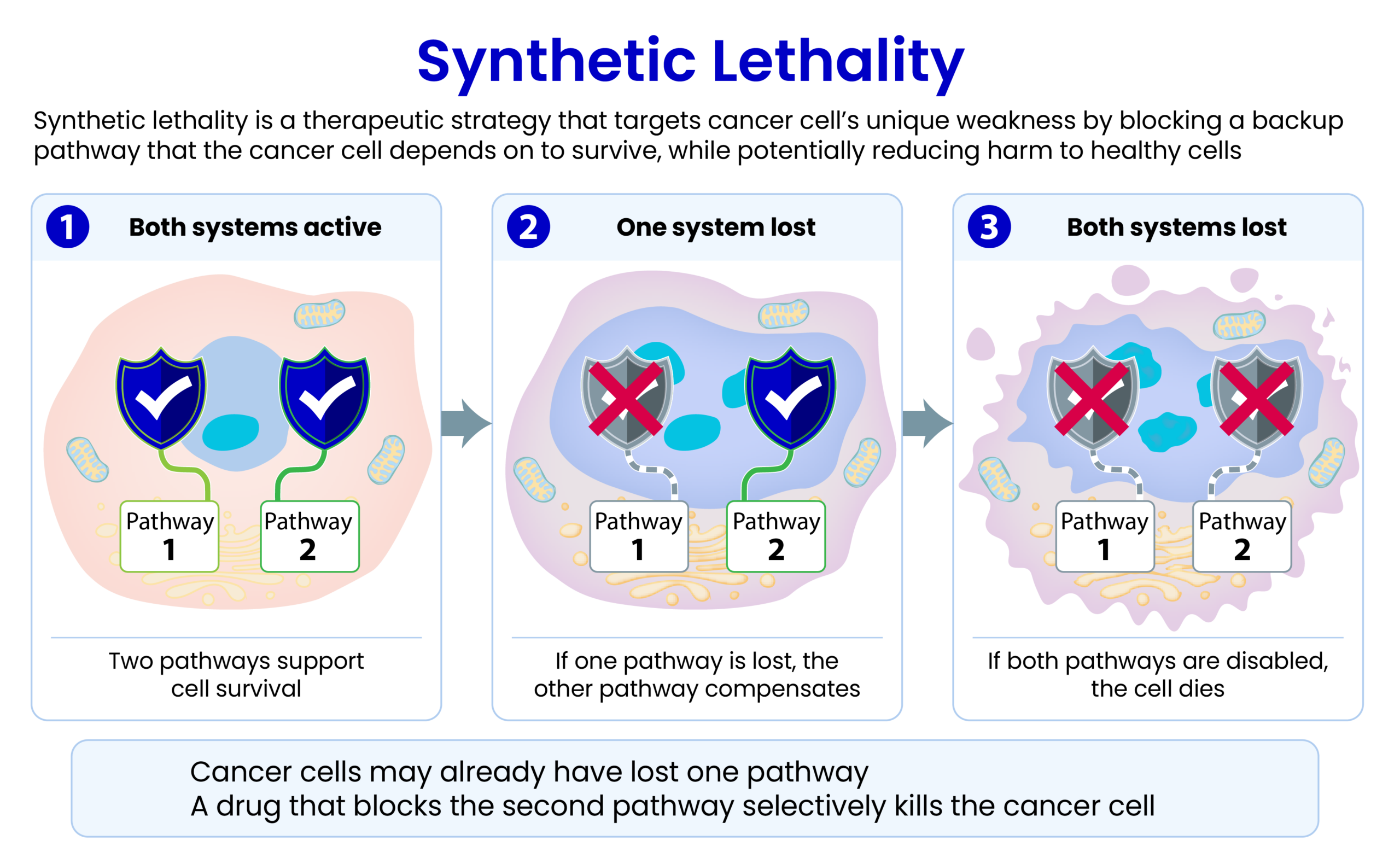
In cancer, a genetic mutation may disable the first backup system, while a targeted drug inhibits the second. Healthy cells can still have the first system available to compensate for the drug’s effects, creating the potential to target tumor cells more selectively. As Dr. Gilad said, “That’s the advantage. That’s the Achilles heel that we’re targeting. That’s what should give us a therapeutic window.”
“So instead of broadly killing rapidly dividing cells, now the treatment is taking advantage of a specific mutation that’s being created by the cancer cell as it goes through transformation,” he explained.

Get industry leading pharma and biotech news, events and expert insights delivered to your inbox.
Why a Strong Biomarker Needs a Biological Rationale
A biomarker is most useful when it closely matches how the drug is expected to work. As Dr. Gilad emphasized, “In synthetic lethality, a useful biomarker should be biologically connected to the drug’s mechanism of action. You got to have that in there.”
BRCA loss of function is already used to guide PARP inhibition. Researchers are also studying ATM mutations with ATR inhibitors and alterations including CCNE1, FBXW7 and PPP2R1A with WEE1 inhibitors and MTAP deletion for PRMT5 inhibitor.
If a molecule also inhibits additional kinases or unintended targets, those effects can interfere with the activity researchers are trying to measure and make it more difficult to see whether the intended mechanism is working.
Biomarker selection should reflect the tumor a patient has at time of treatment.
What Early Clinical Signals Can Tell Us
Phase I oncology trials typically start with a very low dose of a new drug, which is gradually increased as clinicians monitor safety and how well patients tolerate treatment. Once researchers have learned enough from dose escalation, the study can move into expansion cohorts, where selected groups of patients are studied more closely.
Even a few signs of activity can be informative, especially in heavily pretreated patients or biomarker-defined tumors. A response may show that the drug is reaching its target and that the biology behind the treatment could be working as expected.
Small patient numbers limit how much can be concluded from those early responses. As Dr. Gilad noted, “It’s a small number, so it’s pointing us in the right direction, but we have to be cautious.”
A handful of responses cannot tell clinicians the true response rate, how long the benefit may last or how the treatment compares with existing therapies. Those questions require larger studies and more focused testing.
Dose escalation can also help researchers learn which biomarker-defined patients appear most responsive before the study moves into expansion. Dr. Gilad emphasized the value of using that stage deliberately: “you want to spend time there to acquire knowledge to guide you with the expansion.”
Biomarker patterns and pharmacodynamic data collected early in development can then help guide which patient groups are studied in later cohorts.
Connecting the Right Biology, Drug and Patient
Dr. Gilad expects combination strategies to play a larger role in DNA damage response drug development. Those combinations need a clear biological rationale and, just as importantly, should avoid overlapping toxicities that can limit how much of each drug a patient can receive.
When two treatments bring similar toxicities, “One plus one makes it worse if it’s overlapping,” he said.
Dosing schedules can also give normal tissue time to recover between treatments. This means considering the effects of therapy across the whole patient, including healthy tissues as well as the tumor.
Protein expression, epigenetic changes such as methylation, pathway activity, replication stress markers and a patient’s treatment history can all help predict how a cancer may respond to therapy.
Some of that information can be collected during dose escalation, alongside pharmacodynamic data, and used to refine which biomarker-defined patient groups move into later expansion cohorts.
“Let’s remember that the ultimate goal of precision oncology is to connect the right drug with the right biological sensitivity and the right patient,” Dr. Gilad said.
If you want your company to be featured on Xtalks.com, please email [email protected].















Join or login to leave a comment
JOIN LOGIN